
Behind the film
- Year
- 1993
- Director
- Martin Scorsese
- Writers
- Martin Scorsese, Jay Cocks
- Genres
- Romance, Drama, Historical drama
- Production
- Columbia Pictures
- Country
- United States
- Cast
- Daniel Day-Lewis, Michelle Pfeiffer, Winona Ryder, Alexis Smith, Geraldine Chaplin, Richard E. Grant, Miriam Margolyes, Robert Sean Leonard
About the film
Contains story spoilers.
The Age of Innocence creates a world in which an apparently gentle encounter can carry considerable force. Nobody needs to announce every rule because the people inside the circle have learned what an invitation, a silence or an expression of concern implies. That makes desire difficult to separate from social interpretation. A private feeling does not remain entirely private when a community knows how to read the circumstances around it. The film's romance unfolds under that scrutiny, where the question is not only whether two people love each other, but what acknowledging the love would require them to disturb.
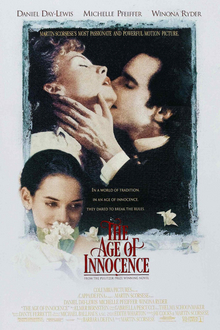
Martin Scorsese directs the 1993 adaptation of Edith Wharton's novel, with a screenplay by Scorsese and Jay Cocks. Daniel Day-Lewis plays Newland Archer, Michelle Pfeiffer plays Ellen Olenska and Winona Ryder plays May Welland. The setting is wealthy New York society in the 1870s, a world whose order rests on reputation, family relationships and carefully maintained conventions. The film approaches that order through a love triangle rather than a detached catalogue of customs. Rules become intelligible through their effect on people who must decide whether obedience is an expression of care, an act of fear or a surrender of possibility.
Engaged to May, Newland becomes drawn to her cousin Ellen, whose failed marriage has made her position precarious. He discourages her divorce even as his own feelings deepen. After Newland and May marry, he continues to seek Ellen; May's announcement of pregnancy helps bring the relationship to an end. Decades later, widowed Newland has an opportunity to visit Ellen in Paris but chooses not to enter. The ending leaves the imagined relationship intact while declining the actual meeting. What he once wanted and what he can now bear to encounter are no longer necessarily the same thing.
Newland's situation is revealing because disapproval of a convention does not automatically release a person from helping enforce it. He can sympathise with someone harmed by a rule while still acting in the interests of the people who maintain that rule. The film's tension rests partly in that inconsistency. An individual may experience himself as more open-minded than his circle without accepting the consequences that genuine departure would bring. Wanting another life can remain safer than choosing it. In that space, romance becomes tied to a flattering private account of oneself as much as to the actual person desired.
Ellen makes the cost of that distinction harder to ignore. Her position exposes the difference between a society protecting a marriage and a society protecting the appearance that marriage is beyond questioning. A rule can claim to defend stability while denying the person inside an unhappy arrangement any convincing route out. The film gives her return a disruptive effect because it asks the circle to confront something its manners are designed to contain. She does not need to reject every convention for her choices to seem threatening. The threat lies in demonstrating that a familiar arrangement can be lived differently.
May complicates any simple division between a passive conventional wife and an active unconventional rival. Appearing to accept the rules can be a way of using the knowledge those rules provide. The film invites attention to what she understands without making her announce every part of that understanding. This changes the triangle's balance. A man can underestimate someone because her responses conform to the behaviour he expects, missing the intention within that conformity. Innocence, in this context, is not a quality that can safely be inferred from softness of manner. The social world makes indirect action especially effective because direct acknowledgement would carry its own consequences.
The passage of years adds another pressure by revealing that conventions can change after a decision has become irreversible. What once appeared impossible may later seem ordinary, yet a later permission cannot simply restore the earlier moment. People have lived through the interval, formed attachments and acquired a history of their own choices. That gives the final opportunity its emotional difficulty. Meeting somebody again is not identical to recovering a lost possibility. The person who arrives has been shaped by the life actually lived, and the imagined alternative may have survived precisely because it was never subjected to ordinary continuation.
The Age of Innocence closes around that difference between a memory sustained and a life resumed. Its restraint should not be confused with a lack of intensity. A world governed by unsaid things can make a small decision carry the weight that another story would give to an open confrontation. The film's portrait of society is intimate because its power is felt through longing, loyalty and regret rather than merely described. It leaves a question about the stories people preserve when they cannot change their past: whether an untouched possibility consoles them, protects them, or quietly becomes the last convention they choose to obey.