
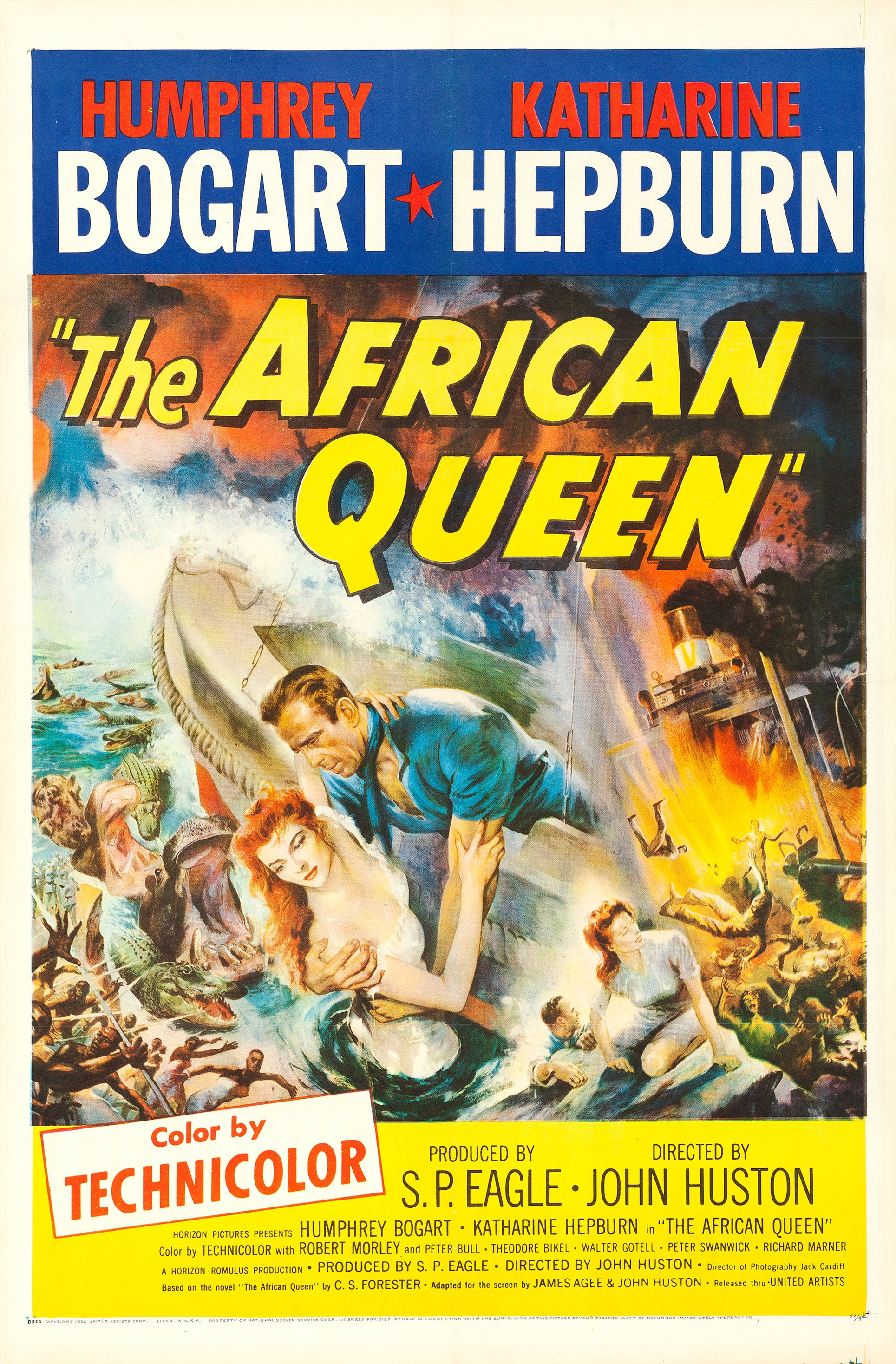
Behind the film
- Year
- 1951
- Director
- John Huston
- Writers
- James Agee, John Huston
- Genres
- Drama, Romantic comedy
- Production
- Horizon Pictures
- Country
- United States, United Kingdom
- Cast
- Humphrey Bogart, Katharine Hepburn, Robert Morley, Peter Bull, Theodore Bikel
About the film
Contains story spoilers.
After German troops destroy the mission and Rose’s brother dies, she leaves with Charlie Allnut aboard his battered river launch, the African Queen. Rose insists they should strike back by converting the boat into a weapon against the German gunboat Louisa. Charlie doubts both the plan and her ability to endure the river, but their journey through rapids, reeds and illness gradually makes them companions. They survive repeated setbacks, admit their affection, and are captured and taken aboard the Louisa. With execution near, Charlie and Rose marry; their drifting launch then strikes the German vessel. The explosion destroys the target, while the newlyweds survive and swim toward shore together.
John Huston builds the film around a mismatch in scale: two people in a small, unreliable craft set themselves against an empire’s armed presence. The adventure stays close to the boat’s cramped deck, so the jungle is experienced through immediate practical concerns—steering, fuel, water, weather and the next bend. That restricted view makes the setting feel like a force acting on the characters rather than a decorative panorama. The African Queen is at once their home, their transport and the fragile instrument of Rose’s plan; every weakness in the vessel gives the larger undertaking a comic vulnerability.
Rose and Charlie begin with opposing habits of thought. She is disciplined, devout and accustomed to giving instructions; he is improvisational, profane and more interested in keeping his boat running than in grand causes. Neither position is simply mocked. Rose’s moral certainty can push her beyond prudence, while Charlie’s appetite for comfort masks a capacity for courage. Their conversations let the film test both approaches against circumstances that neither can control. As the journey wears them down, their differences become a shared vocabulary: teasing and irritation replace the formal distance between a missionary and a hired boatman.
Katharine Hepburn makes Rose’s composure active. Her upright posture and carefully shaped speech suggest someone who has learned to maintain order by controlling herself, and the river gradually strips away the usefulness of that performance. She does not become a different person so much as discover how much energy she has spent hiding fear. Humphrey Bogart gives Charlie a contrasting physical looseness: a shrug, a distracted glance at the machinery, or a complaint about discomfort can carry as much character as his dialogue. Their styles make intimacy visible through small adjustments rather than a sudden declaration of sameness.
The romantic turn works because the film makes cooperation concrete. Rose and Charlie have to attend to the same boat and respond to the same hazards, even when they disagree about the purpose of the trip. Their affection grows in the pauses between tasks, where no one can maintain a heroic pose for long. A shared ordeal also complicates the usual adventure pairing: Rose is not simply rescued into safety, and Charlie’s roughness is not a ready-made substitute for wisdom. Each has knowledge the other lacks, so trust becomes practical before it becomes romantic.
The river gives the adventure its changing rhythm. Narrow passages and rushing water turn navigation into suspense, while slower stretches allow the characters to talk and reassess their plan. The boat’s engine is an especially useful dramatic presence: it requires attention, threatens to fail, and makes the pair’s progress depend on continual maintenance. The story’s objective is enormous in political terms, but the film measures it through intimate work. This tension keeps the mission from becoming a simple fantasy of individual heroism; the characters can only act within the limits imposed by water, machinery and chance.
The production’s location photography contributes to that physical immediacy. The changing river and dense vegetation give the frame depth and texture, while close views keep the stars’ expressions legible within the landscape. Jack Cardiff’s cinematography balances the grandeur of the setting with the uncomfortable proximity of the boat. The camera rarely lets the environment become an abstract postcard: the waterline, the hull and the people sharing its narrow space remain connected. Cuts between wide river views and tight two-shots turn geography into a relationship, with the landscape repeatedly pressing the pair into the same limited space. That visual scale helps the film sustain both adventure and comedy, because each picturesque view still contains a practical problem.
The conclusion joins the film’s comic romance to its wartime adventure without pretending that two people have changed the whole political order. Rose and Charlie achieve their immediate goal through an improvised act of sabotage, but their personal future matters most to the film. Their connection does not require either person to abandon every previous belief, but it does require making room for a way of living neither could have planned alone. The final escape is buoyant rather than triumphant: the couple have survived and found each other, while the larger colonial conflict remains far beyond their control. That modest scale is what makes the ending feel both playful and earned.