
Behind the film
- Year
- 1959
- Director
- François Truffaut
- Writers
- François Truffaut, Marcel Moussy
- Runtime
- 1h 39m
- Genres
- Drama, Crime
- Production
- Les Films du Carrosse
- Country
- France
- Cast
- Jean-Pierre Léaud, Claire Maurier, Albert Rémy, Guy Decomble, Georges Flamant, Patrick Auffay, Daniel Couturier, Richard Kanayan
About the film
Contains story spoilers.
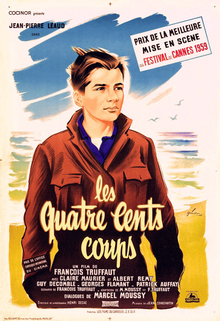
The 400 Blows follows a boy through places that repeatedly expect him to behave without giving him much opportunity to explain himself. Antoine Doinel lives in Paris, where school and home offer different rules but little dependable refuge from judgement. François Truffaut's film stays close enough to Antoine to show the invention, boredom and appetite for experience inside behaviour adults describe as troublesome. It does not make every choice he takes sensible or harmless. Instead, it allows a child's life to contain more than the record of his failures. Jean-Pierre Léaud gives Antoine a watchful presence: he can be evasive, absorbed, delighted or suddenly exposed, and those shifts make his surroundings feel different according to the room he is allowed to occupy within them.
Antoine skips school, lies and quarrels with the institutions meant to care for him. His friendship with René provides companionship outside those pressures. An essay drawing on his admiration for Balzac is condemned as plagiarism. After leaving school, he steals a typewriter from his stepfather's workplace, cannot sell it and is caught returning it. His stepfather hands him to the police, and Antoine is eventually placed in a juvenile observation centre. There, questioning gives him space to speak about his family and unhappiness. He escapes during football, runs to the sea he has wanted to see, and turns towards the camera. The final freeze-frame offers no account of what will happen next.
The city gives Antoine possibilities that his household and classroom cannot. Walking, watching and going somewhere with a friend can temporarily make him the organiser of his own day. That is a different kind of freedom from being secure. An opportunity to wander can coexist with the knowledge that returning will bring another confrontation, and staying away creates new practical problems. The film's movement through Paris allows both conditions to remain visible. Antoine is not simply trapped in a room, nor is the world outside reliably available to him. The streets give him space without guaranteeing a place. That distinction becomes more important as small evasions develop into actions with consequences he cannot negotiate away.
His relationship to books similarly shows how intention can disappear in the gap between an act and its adult interpretation. Antoine's enthusiasm for Balzac belongs to a part of him that the disciplinary account has little room to describe. Reproducing admired writing is still a problem in the classroom, but treating the incident only as another offence misses the attachment that produced it. The film keeps inviting that second look. A lie may be an attempt to escape punishment; theft may be part of an impractical plan for independence. Understanding those motives does not change the action into something else. It changes how much of the child is visible when somebody decides what the action means.
The household's limited space makes family relationships difficult to avoid and difficult to settle. Antoine's mother and stepfather can be affectionate in one moment and rejecting in another, leaving warmth less dependable than the child needs it to be. There is no simple division in which all adults occupy one emotion towards him. That instability can be more confusing than a constant rule, because he has to keep interpreting whether a reprieve means that circumstances have changed. The film does not organise those fluctuations into a lesson Antoine can confidently learn. He is still young enough to need the adults who disappoint him, which makes withdrawal and rebellion incomplete alternatives rather than exits into an independent life.
The observation-centre interview changes the distribution of attention. So much of Antoine's earlier life has involved being seen in the act of doing something wrong that the opportunity to speak can feel unusual. The camera lets an account emerge through pauses and fragments instead of requiring the boy to become an eloquent interpreter of himself. That form matters: a person need not have a finished explanation of his suffering for it to be real. At the same time, the institution's questions belong to a system deciding how to classify him. Listening can open understanding or become another stage in producing a judgement. The scene leaves that tension present rather than claiming that a single interview has supplied the care missing elsewhere.
Truffaut wrote the 1959 film with Marcel Moussy, drawing on experiences from his own childhood while creating Antoine as a fictional character. Henri Decaë's black-and-white cinematography gives the moving city and the boy's face different kinds of attention. The final run extends movement beyond the immediate act of escaping, then stops it at the shoreline. Reaching the sea fulfils a wish but does not provide food, shelter or reconciliation. The freeze-frame keeps Antoine at that unresolved boundary, looking out rather than being delivered into a neatly explained future. His later appearances in other films belong to later stories. Here, the ending asks us to remain with a child who has achieved distance from confinement without yet finding somewhere to belong.