
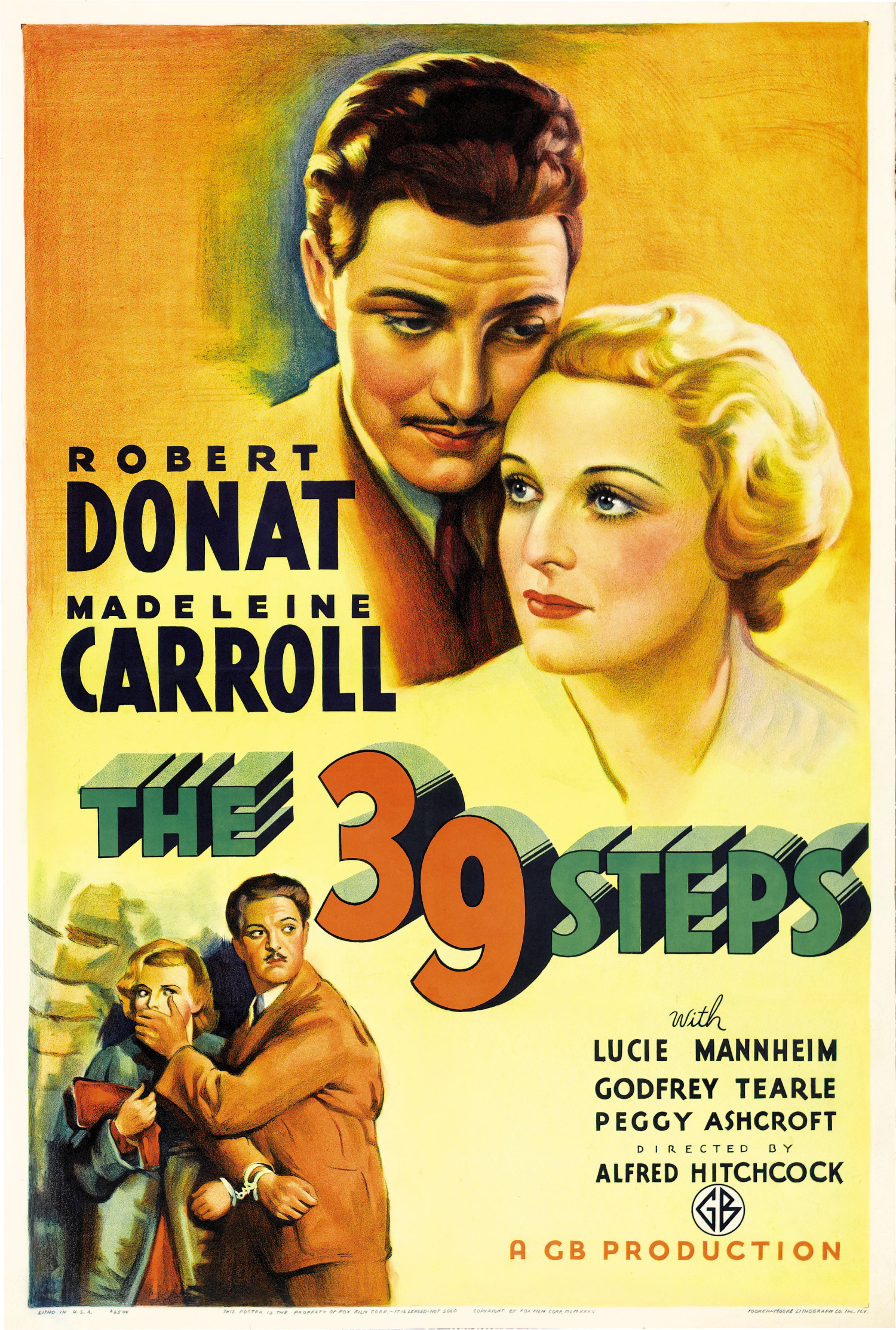
Behind the film
- Year
- 1935
- Director
- Alfred Hitchcock
- Writers
- Charles Bennett, Alma Reville, Ian Hay
- Runtime
- 1h 26m
- Genres
- Spy, Mystery, Crime, Drama
- Production
- Gaumont-British Picture Corporation
- Country
- United Kingdom
- Cast
- Robert Donat, Madeleine Carroll, Lucie Mannheim, Godfrey Tearle, Peggy Ashcroft, John Laurie, Helen Haye, Jerry Verno
About the film
Contains story spoilers.
The 39 Steps puts an ordinary man into a situation where a plausible account of events is no longer enough to protect him. Alfred Hitchcock's thriller begins with entertainment and turns almost immediately toward the danger concealed around it. Richard Hannay has to move because remaining in place would allow other people's version of his story to become the accepted one. The film makes that movement varied rather than monotonous, changing the setting, the company and the kind of difficulty facing him. Robert Donat gives the pursued man enough composure to improvise, while leaving room for uncertainty about whom he can safely approach.
After taking Annabella Smith home from a music hall, Hannay learns that she is investigating a spy organisation. She is murdered, leaving him accused of the crime and following her clue to Scotland. Professor Jordan proves to be an enemy rather than the ally Hannay expects, and a book in a borrowed coat saves him from a bullet. Pamela initially betrays him to supposed authorities, but being handcuffed to him draws her into the pursuit. She later overhears evidence that supports his account. Back at a London theatre, Hannay realises that performer Mr. Memory carries the stolen secrets in his head. Jordan shoots him, but the wounded entertainer reveals enough to expose the conspiracy, leaving Hannay and Pamela together.
Donat's Hannay has a useful ability to keep talking when circumstances demand a role he has not prepared to play. Confidence becomes a temporary tool rather than proof that he understands the entire situation. That distinction helps the film move between danger and humour: the same readiness that buys time can also place him in an awkward public position. A pursued man must sometimes make himself conspicuous to avoid being recognised in the wrong way. The character's resourcefulness therefore operates through social expectations as well as physical escape, with the audience watching him turn an immediate misunderstanding into something he can use.
Madeleine Carroll's Pamela makes trust an active part of the adventure. She does not begin as a companion who accepts Hannay's innocence simply because the audience follows him. Her resistance creates friction, forcing his explanation to compete with the apparently sensible interpretation offered by his pursuers. Their enforced proximity then turns that disagreement into a shared practical problem. Neither can move as though the other were irrelevant. The resulting comedy has a physical basis, but it also allows the relationship to change through experience. Believing him becomes a judgment Pamela reaches rather than a quality assigned to her from the outset.
The Scottish journey gives the thriller room to vary the apparent sources of safety. Open country, private households and official settings each promise a different kind of protection, yet Hannay cannot assume that any setting's outward character tells him who controls it. Godfrey Tearle's Jordan is especially important to that uncertainty, embodying a respectable surface that makes danger harder to identify. The film's suspicion falls on the gap between social appearance and private intention. Manners and confidence can make someone credible without making him trustworthy, leaving the fugitive to revise judgments while the pursuit continues around him.
Peggy Ashcroft and John Laurie's household introduces another register of confinement. The journey pauses within an intimate setting where the dynamics between husband and wife have their own pressures. Hannay is passing through, but the people he meets belong to lives that will continue after his departure. That brief encounter makes the world feel populated beyond the conspiracy, with a woman's kindness acquiring importance within circumstances not organised around his needs. A borrowed coat can consequently carry both practical assistance and an echo of the household he has left. Ordinary generosity interrupts the chase without removing the danger ahead.
The return to performance gives the ending a form connected to the opening. A public show allows knowledge to be displayed as amusement while concealing its use within another undertaking. Mr. Memory's talent depends on answering, making a professional habit dramatically consequential when a question threatens the people exploiting him. The film brings spectacle and secrecy into the same space, where spectators can witness something without immediately understanding its significance. That arrangement also changes the pursuit's scale. What has seemed to require movement across a country converges on a person whose apparently familiar function contains the missing explanation.
Hitchcock's mixture of tones keeps the thriller from requiring a single emotional response for its entire length. An encounter can be funny because Hannay must maintain a pretence, then dangerous because someone sees through it or recognises him. Romance develops amid that instability rather than in a separate interval where the chase has conveniently stopped mattering. By the end, a small gesture between Hannay and Pamela carries a quieter resolution than a long speech about what they have survived. The conspiracy has been exposed, but their changed relationship gives the conclusion its human scale. The 39 Steps makes movement and suspense the route toward an unexpected connection, allowing two people who began at odds to finish with an understanding neither could simply have declared at the beginning.