
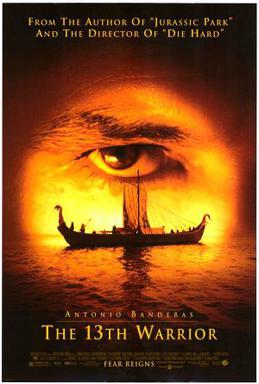
Behind the film
- Year
- 1999
- Director
- John McTiernan
- Writers
- William Wisher, Warren Lewis
- Genres
- Action, Thriller, Fantasy, Adventure
- Production
- Touchstone Pictures
- Country
- United States
- Cast
- Antonio Banderas, Vladimir Kulich, Dennis Storhøi, Omar Sharif, Diane Venora, Clive Russell, Richard Bremmer, Tony Curran
About the film
Contains story spoilers.
The 13th Warrior makes its outsider essential before he feels remotely prepared to be useful. Ahmed is drawn into a company whose customs he does not share and whose danger he would not voluntarily choose. That creates a different starting point from the warrior who has been waiting for an opportunity to prove himself. Survival requires adjustment before it can require heroics. The adventure's first question is how someone learns to act among unfamiliar people without assuming that unfamiliarity makes those people unintelligible. Its title promises a fighting group, but the extra member must initially find a way to belong to it.
Released in 1999, the film is directed by John McTiernan, with a screenplay by William Wisher and Warren Lewis based on Michael Crichton's Eaters of the Dead. Antonio Banderas plays Ahmed and Vladimir Kulich plays Buliwyf. The story combines a journey across cultures with a siege adventure and a frightening account of an enemy emerging from the mist. It is a fictional adventure, and its historical setting should not be mistaken for an authenticated record of this expedition. Its interest lies in the relationship between an outsider's perspective and a group's shared understanding of what they are about to face.
Chosen as the required non-Norse thirteenth warrior, Ahmed accompanies Buliwyf to a threatened kingdom. The attackers, the Wendol, prove to be human cannibals associated with bears rather than supernatural creatures. The survivors enter their caves and kill their Mother, but Buliwyf is poisoned. He returns for a final defence, defeats the enemy's leader and dies. Ahmed honours him before returning home. That progression takes the expedition from uncertain fear to a more concrete understanding of its opponent. Understanding does not remove the danger, but it changes the kind of response the company can imagine making.
Ahmed's initial difference gives the story a way to examine skills that a warrior culture might not immediately recognise as combat skills. The capacity to notice, interpret and learn can be as important as the capacity to strike. Reading the adventure through that distinction makes his place in the group more interesting than the discovery that an unlikely participant can eventually fight. He must find value in what he brings while discovering what other people know. Respect can develop in both directions. Neither side needs to become an exact copy of the other for cooperation to become possible. Understanding another person’s language makes cooperation possible before complete agreement about customs or beliefs could ever be reached.
The enemy's frightening reputation introduces another kind of interpretation. A threat described through legends may appear limitless because the account does not explain how it works. Fear can fill every gap, especially when darkness and mist restrict what people can actually see. Once an opponent becomes comprehensible, it may still be powerful, violent and numerous, but it no longer occupies exactly the same place in the imagination. The film's revelation therefore does more than remove a supernatural explanation. It restores the possibility of thinking about the enemy in terms of actions, vulnerabilities and choices rather than helpless astonishment.
That movement does not mean the adventure has left legend behind. A community can respond practically to a danger while continuing to understand courage through inherited stories and beliefs. Buliwyf's place in the film rests partly on that relationship. Leadership is not merely supplying the strongest arm; it is giving frightened people a reason to remain beside one another when their circumstances offer few assurances. The leader becomes a focus for the group's account of what enduring danger means. His importance can outlast his ability to survive, because an example can remain active in the people who witnessed it.
The company's losses keep that account from becoming a painless celebration of fellowship. A successful defence is not an ending in which everyone gets to return unchanged. The story asks its survivor to carry knowledge of people whose contribution cannot be rewarded with a future. That gives the return journey a different emotional weight from simply escaping an unpleasant place. Ahmed's perspective has become attached to the expedition's memory. Being an outsider at the beginning makes his later obligation especially clear: the experience is not originally his tradition, but the dead are no longer strangers whose lives he can forget.
The 13th Warrior consequently belongs to the adventure tradition in which travelling changes the traveller's measure of other people and of himself. Its horror elements create urgency, while the fellowship gives that urgency a human centre. The ending offers survival and remembrance rather than a claim that courage guarantees safety. It also leaves room for difference to remain meaningful after mutual respect has been earned. Ahmed can return to his own world carrying an understanding of another, and the journey's value depends on that enlarged understanding as much as on the defeat of the force that first made the expedition necessary.