
Behind the film
- Year
- 1983
- Director
- James L. Brooks
- Writers
- James L. Brooks
- Genres
- Romantic comedy, Drama, Comedy drama
- Production
- Paramount Pictures
- Country
- United States
- Cast
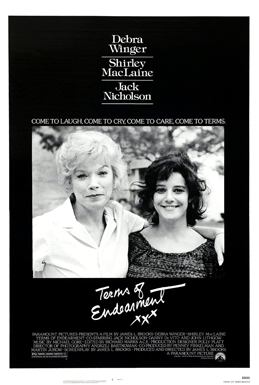
- Shirley MacLaine, Debra Winger, Jack Nicholson, Danny DeVito, Jeff Daniels, John Lithgow, Lisa Hart Carroll, Huckleberry Fox
About the film
Contains story spoilers.
James L. Brooks follows Aurora Greenway and her daughter Emma across roughly thirty years. Aurora’s elegance and control clash with Emma’s wish to make her own life, and Emma marries Flap Horton despite her mother’s objections. As Flap’s academic career moves the family from Texas to Iowa and Nebraska, Emma and Aurora maintain a close but argumentative connection. Both build other relationships: Emma with Sam Burns, Aurora with her neighbor Garrett Breedlove. When Emma is diagnosed with advanced cancer, the family gathers around her. She entrusts her children to Aurora, says goodbye to her sons and dies with Aurora nearby. In the final scene, Aurora hosts a garden memorial, while Garrett steps into a more committed role with the children. The film closes on a family changed by loss but still capable of continuing.
The mother-daughter bond is not softened into a simple story of lifelong harmony. Aurora and Emma love each other, but they also know where to press, which subjects provoke a reaction and how to retreat into familiar habits. Their calls and visits let affection persist across distance without making every conflict disappear. Aurora’s controlling nature can feel protective to her and invasive to Emma at the same time. Emma’s independence is similarly complicated: she resists her mother’s authority, yet she does not always know what future she wants beyond escaping it. Brooks finds drama in the way a relationship can be secure enough to survive repeated arguments while still leaving real hurt behind.
Aurora’s carefully arranged world is a defense as much as a preference. She is attentive to decorum, age, romance and the way other people see her; her wit lets her turn discomfort into a joke before anyone else can name it. Garrett challenges that self-presentation because his coarse manner does not obey the codes she uses to control a room. Yet the film does not frame him as a magical cure for loneliness. Their relationship requires Aurora to admit she wants intimacy, and Garrett to reckon with the demands that come when affection connects him to a family. The contrast between his irreverence and her precision creates comedy, but it also shows how hard it is for either person to change once the routines that protected them become limiting.
Emma’s marriage is shown through the ordinary pressures that accumulate over time: money, work, children, relocation and the question of whether a partner is being honest. The film gives her more than one kind of attachment, avoiding the idea that choosing a family life erases desire or that an affair explains every unhappiness. Sam offers attention at a moment when she feels unseen, but he does not replace the history she shares with Flap. Flap, meanwhile, is neither an ideal husband nor a caricature of villainy; his behavior forces Emma to reassess what she can tolerate. These relationships make the film’s domestic world feel shaped by choices with practical consequences rather than by a single dramatic betrayal.
The children widen the story’s sense of time. Tommy, Teddy and Melanie are not simply milestones in the adults’ lives; their needs complicate what Emma and Aurora think they can promise one another. The women’s disagreements about motherhood reveal different assumptions about work, responsibility and the freedom to choose. Brooks allows them to say things that sound sharp because their intimacy permits candor, but those moments never erase the care beneath the conflict. By the time the family faces Emma’s illness, the question of who will look after the children is not an abstract symbol of reconciliation. It is a concrete responsibility that requires Aurora and Flap to coordinate around the person they both love.
The film’s movement between Texas, Iowa and Nebraska underscores how geography alters a family’s daily closeness. Phone calls sustain the relationship when visits are difficult, and domestic interiors become places where people can be both at home and uncomfortable. The story’s thirty-year span is handled through changing circumstances rather than a succession of grand historical events; jobs, pregnancies, money and family gatherings mark the passage. Brooks’s tonal control lets comic embarrassment sit beside grief without making either mode feel like a detour. A social gathering can turn into a source of humiliation, while a hospital scene can hold practical concern and tenderness together. The film treats ordinary conversation as action because what people say, avoid and repeat gradually changes their obligations.
MacLaine and Winger give Aurora and Emma distinct rhythms: one woman’s sharp certainty meets the other’s more open, sometimes impulsive way of answering. Their performances make interruption, a glance or a pause carry as much weight as a declaration of love. Nicholson’s Garrett brings a deliberately different comic energy, while Daniels and Lithgow help the surrounding relationships feel like lives continuing beyond the central pair. The screenplay is Brooks’s adaptation of Larry McMurtry’s novel, but the film’s emotional shape belongs to its ensemble and to the specific balance of comedy and sorrow in each exchange. Its last image of care is not a claim that grief has been repaired; it is a modest indication that affection can take on new responsibilities after the person at the center is gone.