
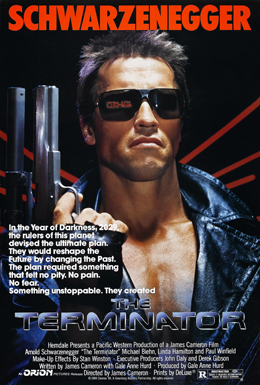
Behind the film
- Year
- 1984
- Director
- James Cameron
- Writers
- James Cameron, Gale Anne Hurd, William Wisher Jr.
- Runtime
- 1h 48m
- Genres
- Action, Science fiction, Cyberpunk, Dystopian
- Production
- Hemdale films, Pacific Western Productions, Orion Pictures
- Country
- United States, United Kingdom
- Cast
- Arnold Schwarzenegger, Michael Biehn, Linda Hamilton, Paul Winfield, Earl Boen, Lance Henriksen, Rick Rossovich, Bill Paxton
About the film
Contains story spoilers.
The Terminator opens on a future shaped by war between human survivors and Skynet, an artificial intelligence whose machines have nearly destroyed civilization. The film quickly shifts to 1984 Los Angeles, where two figures arrive from that future. One is a cyborg assassin, played by Arnold Schwarzenegger, sent to kill Sarah Connor before she can give birth to John, the future resistance leader. The other is Kyle Reese, played by Michael Biehn, a human soldier sent to protect her. Sarah, played by Linda Hamilton, is initially an ordinary waitress trying to make sense of a sudden threat. The story's central rules are stated plainly: the future war is already underway in one timeline, and the machine is trying to erase the person who will challenge it.
The hunt initially appears to be a case of mistaken identity. The Terminator targets women named Sarah Connor, which brings the danger into ordinary city life before the intended Sarah realizes she is involved. The machine can imitate human appearance, use weapons efficiently and keep pursuing after injuries that would stop a person. Kyle knows what it is because he has lived through the ruined future; Sarah has only his account and the evidence of the chase. This difference shapes their relationship. He understands the stakes but is a stranger to her, while she has to decide whether to trust someone whose story sounds impossible. The movie does not delay the action for a long explanation; each new attack forces Sarah to revise what she thinks is happening.
Los Angeles is presented as a working, sometimes shabby city rather than a futuristic spectacle. Night streets, apartment buildings, police rooms and industrial spaces give the chase a tangible route. The future appears in brief, violent images from Kyle's memories: machines, rubble and humans surviving underground. Those flashes supply scale without displacing the main pursuit. Kyle is not a visitor from an abstract time-travel puzzle; he has learned his skills in a specific war and carries its trauma into the present. Sarah's transformation therefore begins through practical tasks: escape, find shelter, recognize the machine's capabilities and decide whom to trust. The story's science-fiction framework is continually tied to immediate questions of movement and survival.
The two pursuers make a sharp physical contrast. Kyle is a human body that tires, bleeds and improvises, while the Terminator operates with relentless mechanical purpose. Stan Winston's effects work gives that distinction a physical endpoint: damage to the disguise reveals a metal endoskeleton that can continue moving after the human-looking surface has been destroyed. The stop-motion effects team Fantasy II and composer Brad Fiedel also contribute to that contrast between a relentless machine and the people trying to stay ahead of it. The effects do not interrupt the chase to show off technology; they clarify why the threat cannot be handled like an ordinary attacker. The electronic score adds a hard pulse to the action, and the film's night photography gives the machine's movements an unnerving presence in otherwise recognizable locations.
Kyle and Sarah's alliance changes as they learn more about each other. Kyle's mission is to keep her alive, but his knowledge of her future role can make Sarah seem like an emblem rather than a person. She pushes back by asking for details and making decisions of her own. Reese's memories also reveal that the future and the present are linked in a loop: he has seen John lead the resistance, and his connection to Sarah becomes part of the history that produces that leader. The movie treats this as a fact of its time-travel story, not as an elaborate scientific theory. What matters dramatically is that Kyle's devotion to the mission also becomes personal, while Sarah has to decide how much of this impossible history she can accept.
The final confrontation pushes the pursuit into an industrial setting where the cyborg's concealed body can no longer pass for human. Sarah survives by acting rather than waiting for someone else to rescue her, and the machine's destruction does not undo the future Kyle described. She is left with knowledge of a coming war and a child whose life will carry unusual importance. The ending gives the story forward motion: Sarah is no longer the person who dismissed an implausible warning, but she is also not yet the experienced figure the future needs. Cameron's film sustains a thriller's urgency while opening a larger science-fiction history around it. Its craft rests on simple, legible goals, an antagonist with a clear method and a protagonist whose growing competence changes the shape of the chase.
Fiedel's score reinforces that relentless forward motion with a recurring electronic pulse rather than a lush orchestral cushion. The music reinforces the film's mechanical world, alongside Winston's effects and the stop-motion work used to bring the future machine into view. The contrast matters: Sarah and Kyle are vulnerable people whose plans change under pressure, while the Terminator's pursuit is brutally consistent. Each encounter forces the humans to improvise around a force that does not tire or negotiate. The result is a film where sound and effects strengthen the same dramatic rule: escape can buy a moment, but it cannot end the hunt.