
Behind the film
- Year
- 2019
- Director
- Tim Miller
- Writers
- David S. Goyer, Justin Rhodes, Billy Ray
- Runtime
- 2h 8m
- Genres
- Action, Science fiction, Time-travel, Post-apocalyptic
- Production
- Paramount Pictures, Skydance Media, Lightstorm Entertainment
- Country
- United States
- Cast
- Linda Hamilton, Arnold Schwarzenegger, Mackenzie Davis, Natalia Reyes, Gabriel Luna, Diego Boneta
About the film
Contains story spoilers.
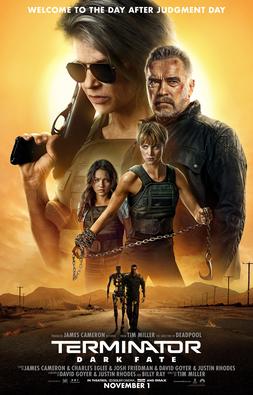
Years after John Connor’s death, a new Terminator called the Rev-9 travels back to kill Dani Ramos, while enhanced soldier Grace arrives from a future ruled by Legion. Sarah Connor joins them, and the group eventually finds Carl, the T-800 responsible for John’s death, now living among people and seeking redemption. They learn Dani will lead humanity’s resistance against Legion. The Rev-9 pursues them across borders and through several attempts to escape. At a hydroelectric dam, Grace and Carl disable the machine at the cost of their own lives. Dani uses Grace’s power core to destroy the Rev-9, and she and Sarah leave together to prepare for the coming conflict. They later watch a young Grace playing with her family, determined to change the future that sent her into their lives.
Tim Miller’s Terminator: Dark Fate returns to a familiar question while changing the names around it: can anyone prepare for a future that technology keeps rewriting? Its answer is not a simple claim that history repeats. The film makes continuity unstable, so the characters must decide what parts of an old warning remain useful when the machinery of catastrophe has changed. That shift lets the series revisit its core fear—humanity creating systems it cannot control—without pretending that one generation can hand down a complete map of what comes next.
Linda Hamilton’s Sarah Connor carries the weight of a person who has spent years translating grief into vigilance. Her toughness is not presented as effortless, and that matters. The film’s action heroine is not an emblem frozen in the past; she is someone whose old purpose has been fractured and must be reconsidered. Sarah’s return connects the franchise to its earlier films, but the character’s presence has meaning beyond nostalgia. She embodies the cost of treating the future as a permanent emergency, and the possibility that experience can still be redirected toward protecting someone new.
Natalia Reyes’s Dani gives the story a different kind of centre. She begins outside the mythology that Sarah and the Terminators carry, so her perspective can challenge the assumption that only familiar figures matter. Dani’s importance is not simply the future role assigned to her; it is the person she becomes while facing that expectation. The film’s emphasis on her as a potential leader invites a question about destiny: if history identifies someone as essential, how much room remains for that person’s own choices? Sarah’s involvement makes mentorship part of that tension, because preparing someone for danger can never guarantee what they will decide.
Mackenzie Davis’s Grace complicates the conventional protector role by making sacrifice and survival visibly physical. She is augmented, but the film presents that enhancement as a burden with limits rather than an all-purpose upgrade. Grace’s body communicates the cost of living in a militarised future; her power does not remove vulnerability. This creates a useful contrast with the machines pursuing the characters. A human soldier can be exhausted, injured and dependent on other people, while an artificial pursuer appears relentless. The action gains emotional force from that difference, because the characters’ strength is tied to relationships and cooperation rather than infinite capacity.
Carl is the most direct challenge to the idea that a machine can only be understood by its original programming. Arnold Schwarzenegger’s familiar presence brings franchise history into the role, while the character’s new circumstances ask what responsibility means after a person—or machine—has caused irreversible harm. The film does not erase the violence of the past simply by giving the T-800 a domestic life. Instead, it asks whether changed behaviour can matter when forgiveness is not owed. That tension makes Carl more than a nostalgic callback and gives the story room to explore accountability without pretending that remorse can restore what was lost.
The Rev-9 is designed as an adaptable threat, and its split form gives the action a clear visual expression of multiplicity. It can appear human enough to pass unnoticed while retaining an inhuman capacity to keep pursuing its target. That combination connects physical danger with a broader anxiety about systems that are difficult to identify until they are already operating. The antagonist is frightening less because it expresses personal hatred than because it converts a task into an absolute. The series’ machine horror has always depended on that distinction: intention is not required for relentless harm.
The film’s new timeline broadens its focus from preventing one known catastrophe to confronting the human habit of building dangerous systems under new names. Legion is not identical to Skynet, but the recurring possibility of a machine-led war remains. This gives the franchise a way to discuss technological change without making technology itself a magical explanation for every social problem. The characters face weapons, surveillance and automated force, yet their practical defence depends on trust between people with different histories. Dark Fate’s most durable idea is that a different future requires more than changing a label; it requires people to act differently toward one another. The story’s generational handoff also asks who gets to define what counts as a future worth defending.