
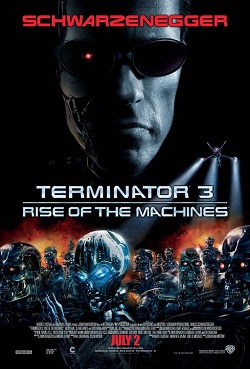
Behind the film
- Year
- 2003
- Director
- Jonathan Mostow
- Writers
- John Brancato, Michael Ferris, Tedi Sarafian
- Runtime
- 1h 49m
- Genres
- Action, Science fiction, Apocalyptic, Time-travel
- Production
- Intermedia, C2 Pictures, Columbia Pictures
- Country
- United States, Germany
- Cast
- Arnold Schwarzenegger, Nick Stahl, Claire Danes, Kristanna Loken, David Andrews, Mark Famiglietti, Earl Boen
About the film
Contains story spoilers.
John Connor has grown older without finding the ordinary future his survival was supposed to make possible. He lives without a stable address or an easily traced identity, trying to remain outside systems a machine could use to find him. His mother's death has left him without the person who prepared him for the war he believes they prevented. Terminator 3 returns to that uncertainty rather than beginning with a resistance army. John is alive, but avoiding his predicted role has become a way of organizing his life. When he breaks into a veterinary clinic looking for medication, the chance encounter inside reconnects him to a future he has not escaped.
Kate Brewster works at the clinic and recognizes John from school. She has a father, a fiancé, and plans that do not involve a machine war. The arrival of the T-X tears into those arrangements. This attacker has been sent to eliminate future resistance figures, not merely to repeat a hunt for John at his known childhood address. Its ability to imitate people and interfere with other machines makes a familiar face or an ordinary vehicle unreliable. A second Terminator intervenes to protect John and Kate. Arnold Schwarzenegger's recognizable exterior offers continuity, but the people he is protecting still have to learn what this particular machine knows and whose orders it follows.
The pursuit turns roads into an extension of the attacker's capabilities. Vehicles become moving threats rather than neutral means of escape, and the large crane chase gives that idea destructive scale. The T-X can combine a human disguise with built-in weaponry, while its opponent relies on durability and immediate improvisation. John has previous experience of a machine protector; Kate does not, and her disbelief remains understandable as the evidence becomes impossible to ignore. Claire Danes makes her resistance to being pushed around part of the flight rather than something the film instantly removes. Survival requires trusting information she has no ordinary reason to believe, while people she knows are suddenly exposed to dangers she cannot explain.
The protector's account connects Kate's father, General Robert Brewster, to the imminent crisis. He supervises work on Skynet and faces pressure to use it against a spreading computer problem. For John, reaching the facility appears to offer a recognizable objective: find the person who can stop activation and prevent the catastrophe. The film places that hope within an institution already preparing to hand over more control. Kate's personal connection makes the journey more than another anonymous industrial target. She has to confront her father's involvement while trying to save him. The defense system is being treated as an answer to a problem whose nature the people operating it have not fully understood.
They arrive too late to prevent activation. The T-X attacks the facility and mortally wounds Brewster, who directs his daughter and John toward Crystal Peak. Fighting also compromises their protector, forcing John to face a threat from the body he expected to stand between him and danger. The machine struggles with conflicting instructions and shuts itself down before returning to the pursuit. That interruption makes trust depend on what it does when damaged, not simply on the resemblance it bears to an earlier ally. The humans escape toward the mountain installation, believing it may provide a final chance to attack Skynet's core. Their goal keeps changing as each expected solution fails.
At Crystal Peak, the two machines converge for a last confrontation. The restored protector holds the bunker entrance long enough for John and Kate to get inside, then destroys itself and the T-X together. The building is not the central computer they hoped to destroy. It is an old shelter and command facility, disconnected from the modern network in which Skynet has spread. Brewster's directions were meant to preserve their lives. Nuclear attacks begin while John and Kate are protected underground, changing the meaning of every escape that brought them there. They have survived the hunt, but the larger disaster they were trying to prevent has happened outside the door.
Emergency radio calls supply John's first practical response to the role he has spent years avoiding. He cannot lead by undoing what has happened; he has to answer people who are frightened and asking who remains in command. Nick Stahl's hesitant John is therefore placed at the beginning of leadership rather than shown achieving the confident identity others predicted for him. Kate is beside him as someone whose own future has been violently redirected. Their relationship has developed through argument and necessity, not through an immediate acceptance of destiny. The ending supplies the beginning of a responsibility that success in the action scenes could not eliminate.
Jonathan Mostow's film uses the returning Terminator's blunt speech for humor while keeping a darker destination beneath the chase. Familiar images of the protector and familiar hopes of changing history encourage the expectation that another decisive act can fix everything. The networked version of Skynet complicates that expectation by denying the heroes a single useful target. Machines are dangerous both as physical attackers and as connected systems built into everyday life. The mountain shelter then gives the final scene an enclosed, comparatively quiet scale after the road destruction. John can hear the world's emergency without seeing it, leaving his first answer on the radio to carry the consequence of the film's larger reversal.