
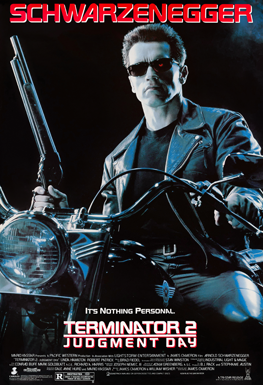
Behind the film
- Year
- 1991
- Director
- James Cameron
- Writers
- William Wisher Jr., Gale Anne Hurd, James Cameron
- Runtime
- 2h 17m
- Genres
- Action, Thriller, Science fiction, Post-apocalyptic
- Production
- Carolco Pictures, Lightstorm Entertainment, Pacific Western Productions
- Country
- United States
- Cast
- Arnold Schwarzenegger, Edward Furlong, Linda Hamilton, Robert Patrick, Earl Boen, Joe Morton, S. Epatha Merkerson, Xander Berkeley
About the film
Contains story spoilers.
Terminator 2: Judgment Day returns to the future war of the first film but shifts the immediate conflict to 1990s Los Angeles. John Connor, played by Edward Furlong, is still a child, though the future resistance will depend on him. Two machines arrive from that future. The T-800, again played by Arnold Schwarzenegger, has been reprogrammed to protect John. The T-1000, played by Robert Patrick, is a liquid-metal prototype sent to kill him. The sequel reverses the roles established in the first film: the old assassin becomes the guardian, while a new model takes over the pursuit. The audience must reconsider what it means when a familiar face returns, because appearance and purpose no longer match in the expected way.
John's mother, Sarah Connor, has spent years preparing for the war she believes is inevitable. Linda Hamilton plays her as capable and formidable, but also deeply strained by the knowledge she carries. She has been separated from John and confined in a psychiatric hospital, where her warnings about Skynet are treated as delusions. The T-800's arrival changes the balance: Sarah can confirm what she has been saying, yet she must trust a machine that once hunted her. John, meanwhile, sees the protector as both an extraordinary weapon and a being that can be instructed. Their different responses create the story's central family tension. They share the same danger but do not agree on how to confront it.
The T-1000 makes the chase more difficult because it can alter its surface and recover from damage. A familiar face may conceal an attacker; a shot that would end a conventional fight may only slow this machine. The film stages the abilities through physical effects and repeated pursuit, keeping the threat understandable through what happens onscreen rather than through technical explanation. The T-800 is strong and direct, while the T-1000 is fluid and deceptive. Their visual contrast gives action scenes clear stakes: the protector can meet force with force, but the pursuer's ability to change shape undermines any simple escape plan. The heroes must constantly decide whether a person or place is safe.
John and the T-800 form an unlikely partnership. The machine follows commands with literal precision and initially lacks the social understanding needed to live among people. John tries to teach it behaviours that make it less frightening and more responsive, while the T-800's commitment to protecting him gives their relationship unusual reliability. The character's learning is shown through small moments and repeated instructions, not a sudden declaration of humanity. Sarah sees the bond as useful but cannot easily set aside her memory of the first Terminator. Her caution is justified by the machine's nature; her son's willingness to connect with it presses on the possibility that violence does not have to be the only answer.
The attempt to prevent Judgment Day leads Sarah toward Cyberdyne and its researcher Miles Dyson, played by Joe Morton. His work is connected to the technology that will eventually produce Skynet, although he does not begin with knowledge of the destruction it may cause. That makes the future war more than a distant fate delivered by a machine: it is linked to research, corporate decisions and ordinary people who do not yet see the full result of their work. Sarah wants to stop catastrophe at its source, but her growing readiness to use force threatens to repeat the brutality she fears. The film places her urgency beside John's insistence that people can be more than their worst future use.
James Cameron's action scenes are built around a larger emotional question: can these characters prevent the future without becoming its instruments? The chases and destructive set-pieces provide scale, but they repeatedly return to the small group trying to stay together. Sarah has to decide whether she can rely on the machine guarding her son; John has to confront the limits of his optimism; and the T-800 must carry out an increasingly humanly meaningful task while remaining a machine. The climax tests that development through a final sacrifice. Its power depends on the film having made trust visible through action before it becomes a question of life and death. The sequel extends the first film's time-war premise into a story about what choices may interrupt it.
The action's emotional rhythm depends on differences among the three characters, not simply on the amount of destruction. John can move through ordinary teenage spaces, but the future he is expected to lead has already shaped his mother's life. Sarah approaches each threat as evidence that she must stay prepared; the boy sees a person in the machine that protects him. The T-800, meanwhile, can learn instructions but cannot make its origins disappear. Cameron repeatedly places these attitudes in the same scene, so the family's arguments have practical consequences for what happens next. The spectacular pursuit remains readable because the audience knows whose safety is at stake and why the characters disagree about how to secure it.