
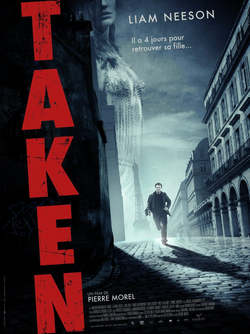
Behind the film
- Year
- 2008
- Director
- Pierre Morel
- Writers
- Luc Besson, Robert Mark Kamen
- Genres
- Action, Vigilante, Thriller, Crime
- Production
- EuropaCorp, Canal+, TPS Star
- Country
- France, United States, United Kingdom
- Cast
- Liam Neeson, Maggie Grace, Famke Janssen, Leland Orser, Jon Gries, David Warshofsky, Katie Cassidy
About the film
Contains story spoilers.
When Bryan Mills learns that his daughter Kim has been abducted in Paris, he has only seconds of her phone call in which to gather clues. His former intelligence work becomes a search method: he listens, remembers sounds, and follows what she can provide. Kim and her friend Amanda travelled despite his reservations; now the trip’s ordinary independence has become a race against traffickers. Bryan moves through criminal contacts and hidden rooms, identifies the man who bought Kim, and reaches the buyer’s yacht. He rescues his daughter and brings her home. The reunion closes the immediate danger but does not erase the distance between a daughter seeking freedom and a father who fears losing her.
Taken first establishes the emotional problem its action will make urgent. Bryan is trying to become more than a distant presence in Kim’s life, but his habits are those of a professional who anticipates threats. His early visits and practical gifts are attempts at care, yet they can feel like instructions rather than affection. Kim experiences vigilance as overprotection; Bryan sees dangers she cannot imagine. The film sets these positions beside one another without suggesting a single rescue solves them. His skills become useful in crisis, but the starting point remains a father who wants to be trusted.
Paris changes character after the kidnapping. Kim’s arrival is associated with travel, nightlife, and independence. Once she disappears, the same city becomes a maze of apartments, clubs, transport routes, and private spaces Bryan must decode. The audience stays near his limited perspective: information comes from a call, witness, contact, or obstacle. This narrowed viewpoint gives the city dramatic geography. A landmark can orient us but cannot make the hidden system visible; Bryan has to reach into places a tourist itinerary would never show.
Liam Neeson gives the action a different physical center from the younger, more athletic operative. Bryan moves economically and attentively; age is part of his presence, not a vulnerability the film hides. The early scene in which he offers Kim a karaoke machine shows him looking for a way into her world. Later, the same attentiveness becomes pursuit. Neeson keeps those registers connected, so professional concentration does not replace paternal fear. His urgency feels tied to a promise made to his child rather than a private appetite for combat.
Knowledge gives Bryan power, but the movie makes that power conditional on attention. An apparently minor detail matters because he recognizes its possible use, and another person's confidence cannot substitute for something he can check. This keeps professional competence from becoming magic. The search has to be assembled through choices about what to pursue and when to stop asking. Neeson's concentration helps make those decisions legible without requiring a lengthy explanation of his former career. His stillness before acting can be as important as the action itself. The film's tightly restricted viewpoint turns the audience into participants in that concentration, waiting for an unfamiliar place or face to yield something that makes the next move possible.
Morel’s action staging keeps objectives and physical geography legible. Bryan crosses rooms, crowds, and barriers directly, while the camera emphasizes movement through space instead of disorienting montage. Paris shifts from public settings to enclosed, hidden ones, mirroring the search’s descent from ordinary travel into exploitation. The story is compressed around Bryan’s task, but the compression sustains the chase. Violence is presented as a means of forcing through obstacles, not an abstract contest detached from Kim’s fate.
The story’s strongest tension comes from Bryan’s change of scale. He begins by navigating a private disagreement about how much freedom a daughter should have; he ends confronting a business that treats people as commodities. The movie does not offer a sociological map of that system, since its viewpoint remains with a single rescue. But this narrow focus gives the action a clear emotional purpose. Each new clue matters because it brings him nearer to Kim, and each delay makes his failure to protect her feel possible.
The father-daughter relationship is also where the action fantasy becomes most complicated. Protection can be an expression of devotion and an obstacle to growing up, depending on how it is exercised. Bryan's professional habits do not translate smoothly into the ordinary trust a family needs. Kim's wish for independence remains understandable, and the violence committed against her belongs to the perpetrators rather than to a moral lesson about disobedience. That distinction matters when the thriller presents his determination so forcefully. The film can make a parent's fear emotionally persuasive without proving that fear should govern every choice a child makes. Its personal focus gives the pursuit urgency, but also keeps the larger social problem outside the reach of a single hero. Bryan can answer an immediate crisis through exceptional skill; rebuilding everyday closeness requires a different sort of patience. The story's appeal comes from holding those two scales together, making a relentless operation depend on an intimate attachment that existed before the danger.