
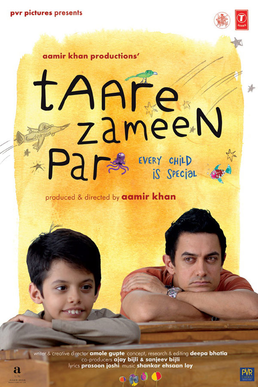
Behind the film
- Year
- 2007
- Director
- Aamir Khan
- Writers
- Amole Gupte
- Genres
- Drama, Children's, Musical
- Production
- Aamir Khan Productions, PVR Inox Pictures
- Country
- India
- Cast
- Aamir Khan, Darsheel Safary, Tisca Chopra, Vipin Sharma, Sachet Engineer, Tanay Chheda, Girija Oak, Meghna Malik
About the film
Contains story spoilers.
Eight-year-old Ishaan Awasthi struggles with schoolwork in Mumbai despite a vivid imagination and talent for painting. His father interprets the difficulties as laziness and sends him to boarding school, where isolation and harsh teaching leave him increasingly withdrawn. New art teacher Ram Shankar Nikumbh recognises signs of dyslexia, visits Ishaan's family and challenges their assumptions. With permission to tutor him, Ram offers patient support which helps his reading, writing and confidence improve. An art competition gives Ishaan public recognition: his painting wins, with Ram's portrait of him taking second place. His parents finally recognise the change and thank the teacher. Ishaan leaves for the holidays after an affectionate farewell, with the prospect of returning to a school that now understands him better.
The story begins with a painful mismatch between the life a child experiences and the explanation adults give it. Ishaan is being watched closely, yet the attention does not produce understanding. Every repeated mistake seems to confirm a judgment that has already been made. Amole Gupte's screenplay makes that cycle the source of the drama: once difficulty is interpreted as unwillingness, punishment can look like a sensible response even when it deepens the problem. The audience is invited to inhabit the gap between effort and visible achievement. A classroom result may be easy to record, while the struggle that produced it remains unseen by the people deciding what it means.
Darsheel Safary's central character has an imaginative world that does not fit the narrow measures being used around him. Art matters because it provides a way of expressing perception rather than simply an alternative route to a good mark. The film asks viewers to recognise that a person may have a rich inner life before anyone else discovers a talent worth applauding. That distinction gives the story emotional weight. Ishaan's value cannot reasonably depend on becoming an exceptional painter, even though the competition supplies a satisfying public moment. His creativity helps others see him, but the more basic claim is that being understood should not have to be earned through extraordinary performance.
The family gives those judgments a personal history. A father can want a secure future for his son while using a definition of success that makes the present unbearable. A mother can care deeply without knowing how to explain or change what is happening. Tisca Chopra and Vipin Sharma's characters keep that conflict close to home, where comparisons and expectations can feel more consequential than an impersonal school report. Love does not prevent misunderstanding, and concern may become another source of pressure when expressed through demands the child cannot meet. The film's family drama depends on allowing affection and harmful assumptions to exist together without treating the harm as insignificant.
Boarding school changes the meaning of the struggle by removing familiar sources of reassurance. The setting promises correction, but correction begins from the same account of the problem which has already failed. That makes authority itself part of the story. An institution can be organised, demanding and convinced of its purpose while remaining poorly equipped to notice the person in front of it. The emotional distance becomes visible through Ishaan's withdrawal: participation is harder when each attempt seems likely to produce another public judgment. The film's concern is therefore larger than identifying one individual difficulty. It asks whether a teaching environment is prepared to revise its own expectations when a child cannot fit them.
Aamir Khan's Ram offers a different model of attention. His importance comes from observing, asking and adapting, rather than announcing that enthusiasm alone can solve everything. Patience changes the conditions under which Ishaan is expected to work. That gives encouragement a practical dimension: the child needs more than a compliment delivered inside an unchanged system. The mentor relationship also redirects the audience's interest from discipline towards interpretation. Before deciding how to respond to behaviour, someone must understand what the behaviour is expressing. Ram's warmth matters because it makes that investigation possible without turning the child into a problem to be displayed before other people.
The film's emotional expression extends beyond ordinary conversation. Its musical form and emphasis on imagination give private feeling a scale which the classroom cannot provide. Shankar–Ehsaan–Loy's music belongs to a world in which separation, frustration and relief are central experiences, not minor interruptions of the learning process. The contrast between institutional measurement and expressive freedom is especially useful for a story about a child who finds some forms of communication difficult. Viewers can encounter the intensity of Ishaan's experience without requiring him to explain it in the language the adults expect. The film thereby makes emotional attention part of understanding the situation rather than a sentimental addition after the facts.
The ending offers recognition, but the larger change is a relationship with the world in which trying no longer feels automatically humiliating. That is a more substantial achievement than the discovery of a prize-winning ability. Taare Zameen Par asks what becomes possible when adults replace a fixed judgment with sustained attention. Its optimism depends on the willingness of a family and school to learn as well as the child's progress. The film remains a particular fictional story, with a teacher, parents and pupil finding a different way to understand one another. Its central question is simple enough to travel beyond that story: how much of a person's potential remains hidden when everyone is busy measuring the wrong thing?