
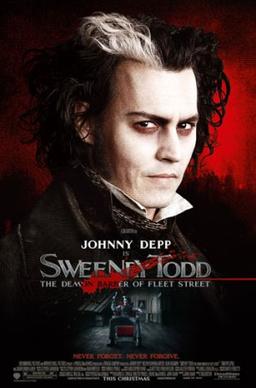
Behind the film
- Year
- 2007
- Director
- Tim Burton
- Writers
- John Logan
- Genres
- Gothic, Musical, Slasher, Drama
- Production
- DreamWorks, Warner Bros. Entertainment
- Country
- United Kingdom, United States
- Cast
- Johnny Depp, Helena Bonham Carter, Alan Rickman, Timothy Spall, Sacha Baron Cohen, Jamie Campbell Bower, Jayne Wisener, Ed Sanders
About the film
Contains story spoilers.
Benjamin Barker returns to London after sixteen years of false exile, now calling himself Sweeney Todd, and learns that Judge Turpin has taken his daughter Johanna and destroyed his marriage to Lucy. Reopened above Nellie Lovett’s failing pie shop, his barber business draws rival Pirelli, who recognizes him and is killed after trying to blackmail him. Todd’s chance to kill Turpin slips away when Anthony Hope’s attempt to reach Johanna alerts the judge, who sends her to an asylum. Todd and Lovett turn murder into a commercial scheme, using the barber chair and basement bakery to make the shop’s customers disappear. Anthony later gets Johanna out, while Tobias begins to suspect what is being baked. Todd kills Turpin, then realizes the beggar woman he has killed is Lucy. When Lovett admits she concealed the truth, he kills her; Tobias returns and cuts Todd’s throat. Johanna escapes, while Todd dies beside Lucy, with revenge having consumed the lives and business that grew around it.
That compact chain of events has the proportions of a fable, but Burton’s film makes its power depend on the texture of labor. The chair, chute, razors and oven are not vague symbols; they are tools that connect the barber’s skill to the pie shop’s production. Ordinary commercial gestures continue around the horror: customers wait, the pie counter serves a crowd, and Todd returns to his workbench. This overlap makes the violence feel socially absorbed rather than isolated in a supernatural corner of London.
Todd’s transformation matters more than his initial target. His desire to punish one corrupt judge gradually becomes permission to treat strangers as representatives of a city that wronged him. The barber shop’s repeated routine makes that expansion visible: a private grievance enters an ordinary appointment and leaves the room through a trapdoor. The film does not portray him as simply losing control in one sudden outburst. He chooses a method, refines it and returns to it, which makes the later discovery about Lucy devastating without excusing the many people he has killed.
Lovett’s role is different because she translates danger into domestic and commercial language. Her shop is struggling, and she responds to Todd’s violence with a practical plan that brings customers back. At the same time, she imagines a future with him that he cannot share. Her quick humour is not a shield that makes her harmless; it shows how easily she normalizes an arrangement that benefits her. Tobias gives that bargain a vulnerable human edge, because the boy she protects is also the person who sees through it.
The stage musical’s songs let the characters expose themselves in heightened form. Todd’s music pushes private anger toward grand, impersonal revenge; Lovett’s more buoyant numbers turn survival and desire into comic fantasy. When those styles share a scene, their partnership can seem briefly companionable even as its moral ground becomes indefensible. Depp’s muted physicality makes Todd difficult to read, while Bonham Carter’s more active, expressive performance lets Lovett adapt to each turn. The contrast prevents their relationship from becoming either a simple romance or a simple alliance.
Burton’s design makes London feel like an expression of the characters’ moral weather. The palette stays largely sooty and brown, interrupted by sharp red, while buildings and interiors compress people vertically into streets and rooms. This is a stylized Victorian world rather than a neutral historical survey. The film’s architecture also makes the two businesses legible as one machine: upper-floor grooming, a concealed passage downward, and baking below. The camera can move between these levels so that the audience understands how the public-facing shop depends on an unseen process.
The ending’s emotional force comes from recognition arriving too late. Todd finally understands that the beggar woman was Lucy only after killing her, and his response transfers his rage to Lovett rather than stopping it. Tobias’s return closes the chain with the same instrument Todd used against his victims. Johanna’s escape leaves a future outside the shop, but it cannot restore the family that the judge, Todd and Lovett have each damaged in different ways. The final image brings the film back to the human cost hidden beneath its elaborate machinery. Johanna’s departure with Anthony offers a possibility beyond this enclosed economy. Their escape runs against Todd’s obsession with returning to the past, suggesting a future that his revenge cannot provide.
The movie’s tonal balance is intentionally unstable: the songs can be witty, the production design fairy-tale-like, and the story gruesome within minutes. That collision follows the material’s theatrical lineage while using cinema’s ability to connect rooms and faces across cuts. Rather than asking the viewer to take London as literal period realism, Burton offers an enclosed imaginative city where class, appetite and authority shape daily life. The result is a musical whose formal pleasures are inseparable from its disturbing account of people treating other people as resources.