
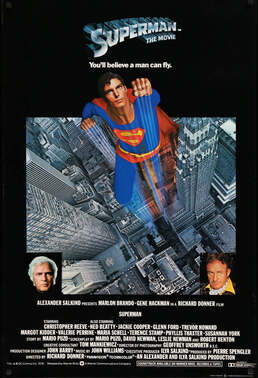
Behind the film
- Year
- 1978
- Director
- Richard Donner
- Writers
- Mario Puzo, David Newman, Leslie Newman, Robert Benton
- Genres
- Action, Science fiction, Superhero
- Production
- Warner Bros. Entertainment, Warner Bros. Pictures
- Country
- United States, United Kingdom
- Cast
- Christopher Reeve, Margot Kidder, Gene Hackman, Marlon Brando, Ned Beatty, Jackie Cooper, Valerie Perrine, Glenn Ford
About the film
Contains story spoilers.
Scientist Jor-El sends his infant son Kal-El away from Krypton before its destruction. Raised by Jonathan and Martha Kent as Clark, he later travels to Metropolis and works at the Daily Planet. Lex Luthor plans to use missiles to trigger an earthquake and reshape California’s coastline. Superman stops one, but another causes destruction and Lois Lane dies when her car is trapped. Grieving, Superman circles Earth at tremendous speed and travels back through time, changing events so he can save Lois. He captures Luthor and Otis. The crisis ends through a mythic intervention that places the hero’s power beyond ordinary limits.
The opening on Krypton gives the story a grand frame, but the Kent household supplies Clark’s moral education. Jonathan’s care and death give the hero a history of ordinary attachment, not simply a cosmic origin. Clark’s strength develops alongside restraint: being able to act does not mean preventing every loss. Christopher Reeve makes this tension visible through posture and timing. Clark slouches, pauses, and apologizes; Superman stands upright and speaks with calm assurance. The difference is clear without a radical transformation, suggesting identity is also a performance shaped for different audiences.
The Daily Planet is a human-scale arena where the superhero premise meets workplace comedy and romance. Lois Lane arrives with speed, curiosity, and a reporter’s appetite for a story. Margot Kidder plays her as someone who makes decisions rather than waiting for rescue. Clark’s interest in her is complicated by the identity he cannot share. Their conversations have playful asymmetry: she is confident and direct, he careful and seemingly awkward. His mildness is not a lack of intelligence; it is a mask with its own discipline, and Reeve lets the audience see how much thought goes into appearing unremarkable.
Lex Luthor is defined by theatrical scale. He wants recognition and money, but the scheme is also a performance of cleverness he expects the world to admire. Gene Hackman makes the underground lair feel like an extension of his vanity. Otis’s blundering and Miss Teschmacher’s reservations establish different responses to his ambition: comic dependence and an eventual moral limit. Missiles and geography present the danger, but Luthor’s personality keeps it from becoming an impersonal technical puzzle. He wants to prove he can outthink the world, and Superman interrupts that story.
Donner moves from alien spectacle to Kansas memory to Metropolis bustle, allowing each setting to teach a different part of the character. The score and effects lend flight a sense of wonder, but human reactions anchor it. People look upward; Lois asks questions; Clark chooses where to appear. The visual language does not merely show that Superman can fly. It presents flight as public presence, an ability that makes rescue imaginable at a distance no ordinary person could cross. The sincere treatment of this ability makes wonder a central part of the film’s tone, alongside the newsroom comedy and romance.
Lois and Clark’s flight above the city gives the romance an image specific to this hero. The sequence lifts them out of the noise of the Planet and Luthor’s danger. Its appeal depends on contrast: Superman can share the view, yet cannot reveal everything about himself. Kidder’s Lois remains active, asking and responding instead of becoming a passenger without a voice. The film lets the encounter be fantastical while connecting it to their workaday relationship, where curiosity and concealment still matter.
Clark’s first years on Earth and his later public life are linked by a question of belonging. He has a home in Kansas, an inheritance from Krypton, and a new social role in Metropolis, but these do not resolve into one simple identity. Reeve’s performance makes the transitions comic and humane: Clark is not pretending to be weak so much as trying to avoid overwhelming other people. The movie’s warmth comes from his effort to participate in ordinary life, even when he could dominate a room. His choices matter as much as his abilities.
Public attention makes the double identity more complicated than a convenient disguise. Superman can be admired at a distance, while Clark has to negotiate the embarrassment and uncertainty of ordinary conversation. Lois meets both versions, bringing the romance close to the question of whether being recognized is the same as being understood. The audience enjoys knowing what she does not, but the secret also places a limit on intimacy. Reeve's manner keeps that limit gentle instead of making Clark calculating or superior. His extraordinary ability does not supply an effortless way to belong. Donner gives equal seriousness to spectacular rescue and the smaller difficulty of finding a place among other people. The resulting fantasy is generous in scale and familiar in its emotional concerns. It imagines immense power guided by care, then keeps returning to the human relationships that give care a particular face. That combination allows wonder, comedy and loneliness to occupy the same story without requiring the hero to abandon his basic warmth.