
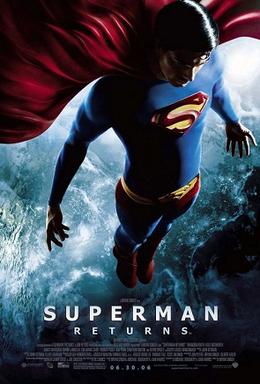
Behind the film
- Year
- 2006
- Director
- Bryan Singer
- Writers
- Michael Dougherty, Dan Harris
- Genres
- Action, Science fiction
- Production
- Warner Bros. Entertainment, Legendary Pictures, DC Comics
- Country
- United States
- Cast
- Brandon Routh, Kate Bosworth, Kevin Spacey, Frank Langella, Sam Huntington, James Marsden, Parker Posey, Eva Marie Saint
About the film
Contains story spoilers.
After five years searching for surviving Kryptonians, Superman returns to Earth and finds that Lois Lane has a son, Jason, and a fiancé, Richard. Lex Luthor steals crystals from the Fortress of Solitude and combines their power with kryptonite to grow a landmass that threatens billions. Superman saves Metropolis but is weakened and attacked on the new island. Richard and Lois rescue him. Recovering enough strength, he lifts the landmass into space, then falls into a coma. He awakens and visits Jason, recognising the child as his son. Luthor and Kitty are stranded after their escape. Superman's return has restored a protector without restoring his former personal life; the ending leaves him accepting a continuing place in a world that changed during his absence.
Superman Returns makes exceptional ability coexist with a very ordinary problem: coming back does not entitle someone to find everything waiting as it was. The public can welcome a saviour while the people close to him have built lives that cannot simply be rearranged. That distinction gives the title a melancholic undertone. Returning to a familiar city may confirm the hero's usefulness without resolving where he belongs inside it. Bryan Singer's film builds its emotional world around that gap between public recognition and private distance, letting the spectacle of an extraordinary body carry the loneliness of someone whose absence had consequences he cannot undo.
Brandon Routh gives Superman a poised physical presence that contrasts with Clark's social hesitation. The distinction is less about disguising a confident personality than about how power operates in different kinds of space. A rescue offers a clear task and an audience capable of understanding its result. An office conversation or an encounter with Lois offers no equivalent certainty. The same person who can bear an immense weight cannot force intimacy to resume. Routh's relative stillness lets the figure feel monumental while leaving something withheld beneath that monument, a quality that suits a story concerned with the difficulty of reconnecting rather than the excitement of discovering powers.
Kate Bosworth's Lois represents a world that has continued making demands in the hero's absence. Her responsibilities give her more to negotiate than the romantic image Superman might prefer to recover. James Marsden's Richard is important to that arrangement because treating him merely as an obstacle would make the central loneliness too easy to solve. The story allows practical human care to stand alongside spectacular heroism. A person need not be invulnerable to act courageously, and an admirable act does not automatically create a claim over someone else's affection. That difference complicates the fantasy that saving a life should settle every relationship within it.
Kevin Spacey's Luthor approaches enormous destruction with a proprietor's confidence. The scale of the plan exceeds ordinary greed, but its underlying imagination is recognisably possessive: the world appears as something to be rearranged around his advantage. Kryptonian knowledge becomes a means of acquisition rather than an invitation to responsibility. Parker Posey's Kitty gives that surrounding world a less settled moral rhythm, placing discomfort beside the villain's certainty. Their pairing supplies an abrasive comic register against Superman's solemnity. A grand design can be frightening and absurd at once when the person proposing it treats everyone else's existence as an inconvenient detail in a private opportunity.
Metropolis gives the film a place where extraordinary events become part of public life. The Daily Planet is particularly useful because its work concerns how that life is described and understood. A superhero can be both a person and a story that others circulate, and journalism becomes one of the ways his absence or presence acquires meaning. The city therefore offers more than buildings available for damage. It contains an audience with memories and expectations. Superman's return has to encounter those expectations rather than arriving in an empty setting that will accept any significance he gives himself.
The visual appeal of flight rests on a contrast between effortless movement and the difficulty of living among people. Open sky gives the body freedom from ordinary physical limits; human relationships continue to impose limits that cannot be flown over. The film's large rescue imagery lets weight, scale and vulnerability become immediately legible. Its slower emotional passages make another kind of exposure visible, without translating every feeling into a fight. This balance places it within superhero spectacle while giving it the temperament of a return story. The central question concerns the use of familiar power after familiar circumstances have disappeared.
The film follows the earlier screen mythology through Superman and Lois rather than presenting a fresh origin story. That choice asks the audience to approach the hero as someone with a history, even when the new performances give that history a different face. Its lasting tension lies in the difference between being needed and being able to belong. Service can remain meaningful after a private dream becomes unavailable, and fatherhood introduces a future that cannot simply reproduce the past. Superman Returns leaves its extraordinary figure with obligations as well as possibilities, bringing the immense scale of his powers back toward the intimate work of accepting what other people have lived through.