
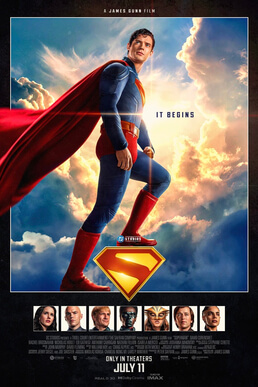
Behind the film
- Year
- 2025
- Director
- James Gunn
- Writers
- James Gunn
- Runtime
- 2h 9m
- Genres
- Fantasy, Adventure, Action, Science fiction
- Production
- DC Studios
- Country
- United States
- Cast
- David Corenswet, Rachel Brosnahan, Nicholas Hoult, Edi Gathegi, Anthony Carrigan, Nathan Fillion, Isabela Merced, Skyler Gisondo
About the film
Contains story spoilers.
James Gunn’s Superman begins with a hero who already has a public record, a job at the Daily Planet and a relationship with Lois Lane. Clark’s intervention in Boravia’s invasion of Jarhanpur has saved lives, but it also raises the film’s central civic question: who authorized him to cross a border and decide what justice requires? When the Hammer of Boravia defeats him, Krypto carries him to the Fortress of Solitude. The robots there heal Clark and play a damaged message from his Kryptonian parents. Lex Luthor restores the missing half and broadcasts it, making Superman appear to have been sent to conquer Earth. Clark surrenders, escapes Luthor’s pocket universe with Metamorpho’s help, and returns to stop Luthor’s engineered crisis. Lois and Jimmy expose the plot; Clark rejects the idea that ancestry dictates his purpose.
The film’s metropolis is crowded with extraordinary people before its title character enters a scene. The Justice Gang has its own public profile and internal chemistry, while reporters, politicians, online spectators and ordinary residents all interpret Superman’s choices from different angles. This creates a world where heroism cannot be communicated by feats alone. Saving people is visible, yet the decision to intervene remains debatable, and Clark must learn that earnest intentions do not settle every political consequence. The story gives that disagreement room through Lois’s interview, where intimacy does not spare Clark from pointed questions. Their romance is not a blanket endorsement of his conduct; it is a relationship between two people who can care for one another and still argue over evidence, power and accountability.
Clark’s professional identity is especially useful because journalism supplies a second method of responding to a crisis. Superman can lift debris or cross a battlefield, but the Daily Planet asks for sources, context and a public record. Lois’s skepticism is not a test Clark passes by declaring himself good; it makes his decisions legible to people who do not share his strength or access. Jimmy’s reporting later matters for the same reason: Luthor’s scheme is defeated partly by making its political machinery visible. The newsroom is a place where the film’s broad spectacle narrows into conversations over what can be proven. Clark’s two roles therefore work as more than disguise. They set physical intervention beside patient explanation, and the film lets both forms of service carry weight.
The alien message makes origin and moral authority pull in different directions. Learning where you came from is usually presented as a way of becoming more secure in yourself. Here, that promise turns dangerous: ancestry can be used to prescribe a purpose that the person receiving it has never chosen. Clark's distress is understandable without making the recording a verdict on his character. The question becomes whether a life of voluntary care can be invalidated by someone else's instruction. Family influence still matters, but influence and obedience are different things. The compassionate identity Clark has developed requires an answer in the present, through conduct toward other people, rather than a perfectly reassuring explanation of the past. That is a more demanding foundation for heroism than discovering a noble bloodline.
Luthor's opposition also makes admiration a political problem. A powerful person who wants the public's approval has an incentive to turn another person's popularity into a threat. Being respected stops looking like evidence of service and starts looking like a resource to seize. Clark's vulnerability is that he cares how his conduct affects people, including people who have misunderstood him. Luthor can exploit that concern, while a hero indifferent to others would be much harder to shame. This makes kindness costly instead of effortless. The conflict asks whether remaining answerable to people is worth the exposure it brings. It also distinguishes confidence from domination: Superman can defend his choices without demanding that everyone surrender their judgment to his strength.
Gunn sets bright comic-book color, kinetic movement and an unusually busy supporting cast against scenes that leave room for embarrassment and affection. Krypto’s unpredictable energy punctures Clark’s solemnity, while the robots make an alien refuge feel oddly domestic through their attentive routines. Metropolis is frequently framed as a lived-in place under strain rather than a blank arena for destruction; rescue work draws attention to people on the ground. Action is staged around competing goals: protect civilians, contain a threat, preserve a life, or stop an aggressor. That variety keeps the fights connected to the film’s ethical questions. The domestic warmth matters as much as the cosmic scale. An extraordinary identity can still depend on small habits of affection and on the security of having somewhere to return. Those changes in scale keep the character approachable without reducing what is at stake for the city.
Cooperation gives this version of Superman a useful answer to the problem of scale. Someone capable of almost unimaginable physical feats can still need another person's knowledge, courage or judgment. That need does not make the central hero less powerful; it makes power less complete. The hopeful part of the story is the possibility of combining different abilities without assigning every worthwhile action to one savior. It leaves room for ordinary responsibility beside the extraordinary body. Clark's goodness is therefore more interesting as a continuing practice than as a label attached to his costume. He has to remain willing to explain himself, accept help and make another decision when the last one has failed. Hope survives through that effort, rather than through certainty that the strongest person will always be right.