
Behind the film
- Year
- 1980
- Director
- Richard Lester
- Writers
- Mario Puzo, David Newman, Leslie Newman
- Genres
- Action, Science fiction, Fantasy
- Production
- Warner Bros. Entertainment
- Country
- United States, United Kingdom
- Cast
- Christopher Reeve, Margot Kidder, Gene Hackman, Terence Stamp, Sarah Douglas, Jack O'Halloran, Ned Beatty, Jackie Cooper
About the film
Contains story spoilers.
Superman II gives its hero something that strength cannot decide for him. Clark wants a life with Lois, but the life he imagines seems to require withdrawing the extraordinary ability through which other people depend on him. That makes the romance consequential beyond whether a secret can remain hidden. The character has to decide what kind of participation in the world his private happiness permits, while the world supplies a danger that makes withdrawal costly. The sequel's central pressure comes from bringing those decisions together: a person can sincerely want an ordinary life and still possess a responsibility that does not become ordinary merely because he wants it to.
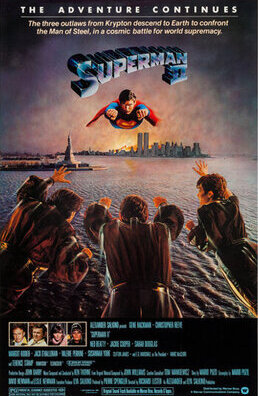
The theatrical film first released in 1980 is credited to director Richard Lester, with a screenplay by Mario Puzo, David Newman and Leslie Newman. Christopher Reeve plays Clark Kent and Superman, Margot Kidder plays Lois, Gene Hackman plays Lex Luthor and Terence Stamp plays General Zod. Sarah Douglas and Jack O'Halloran play Ursa and Non. This account concerns the theatrical version rather than the later Richard Donner Cut, which has different scenes and resolutions. Keeping that distinction visible matters because the film's questions about intimacy, power and consequence depend on the particular choices this version gives its characters.
Superman's disposal of a bomb frees Zod, Ursa and Non. Lois discovers Clark's identity, and he surrenders his powers to be with her. The trio takes control while Luthor seeks advantage through an alliance with them. Clark returns to the Fortress and regains his strength. He draws the villains there, reverses the effect of a depowering chamber and defeats them. Back in ordinary life, he removes Lois's memory of their recent relationship and reaffirms his public duty. The victory resolves the invasion while leaving a more difficult question about what he has decided another person should be allowed to remember.
The Kryptonian antagonists make the difference between ability and conduct unusually clear. Their strength resembles Superman's without carrying the same relation to the people around them. Power can protect or dominate, and possession of it cannot explain which purpose a person will choose. That gives the conflict more than a numerical problem of one hero against three opponents. The villains expose what would happen if extraordinary capability were treated as entitlement, while Superman's concern for bystanders becomes something they can exploit. His restraint is a weakness in the tactical contest and a central reason that his place in the world differs from theirs.
Lois's discovery changes the relationship because Clark's apparent ordinariness has concealed more than a second occupation. The person she knows and the public figure she admires become parts of the same life, forcing intimacy to take account of responsibilities previously kept separate. The film makes that revelation attractive and difficult at once. Being known more fully can offer relief, but it can also remove the separation through which a person has managed incompatible expectations. Clark's proposed solution treats the conflict as something that can be physically switched off. The surrounding crisis then makes the human cost of that solution impossible for him to keep outside the relationship.
Luthor's participation gives the invasion a calculating intermediary. He does not share the visitors' abilities, so his leverage depends on knowledge and the promise of usefulness. That makes his alliance another version of the film's concern with what power requires from other people. An apparently weaker person can influence stronger ones by supplying the route towards something they want, but usefulness does not guarantee secure partnership. His manoeuvring makes the final confrontation a contest of interpretation as well as strength. Information can be offered, concealed or misread, allowing the decisive advantage to depend on a plan rather than simply on who can strike harder.
The memory-erasing ending complicates the romantic sacrifice. Clark resumes a public role, but Lois loses knowledge of an experience in which she participated. That is not a neutral restoration of the old arrangement. It gives him control over the terms by which another person can understand her own recent life, and the film's reassurance can be considered alongside that unequal authority. The question is especially pointed because the larger story distinguishes protection from domination. A decision described as protective still needs attention to whose choice it removes, even when the character making it has defeated enemies whose use of power was openly oppressive.
The restored public duty brings the hero back into the world without making every private consequence disappear. Superman II uses a familiar costume and setting to test what the role means when the person inside it wants something the role seems to complicate. Its strongest contrast is between extraordinary capability and the obligations that give capability a purpose. The theatrical ending offers reassurance through renewed service while leaving Lois's position unsettled. That combination gives the sequel a more interesting shape than an uncomplicated return to normal: the planet is protected, but the way the protector manages intimacy remains a decision whose costs somebody else has also been made to carry.