
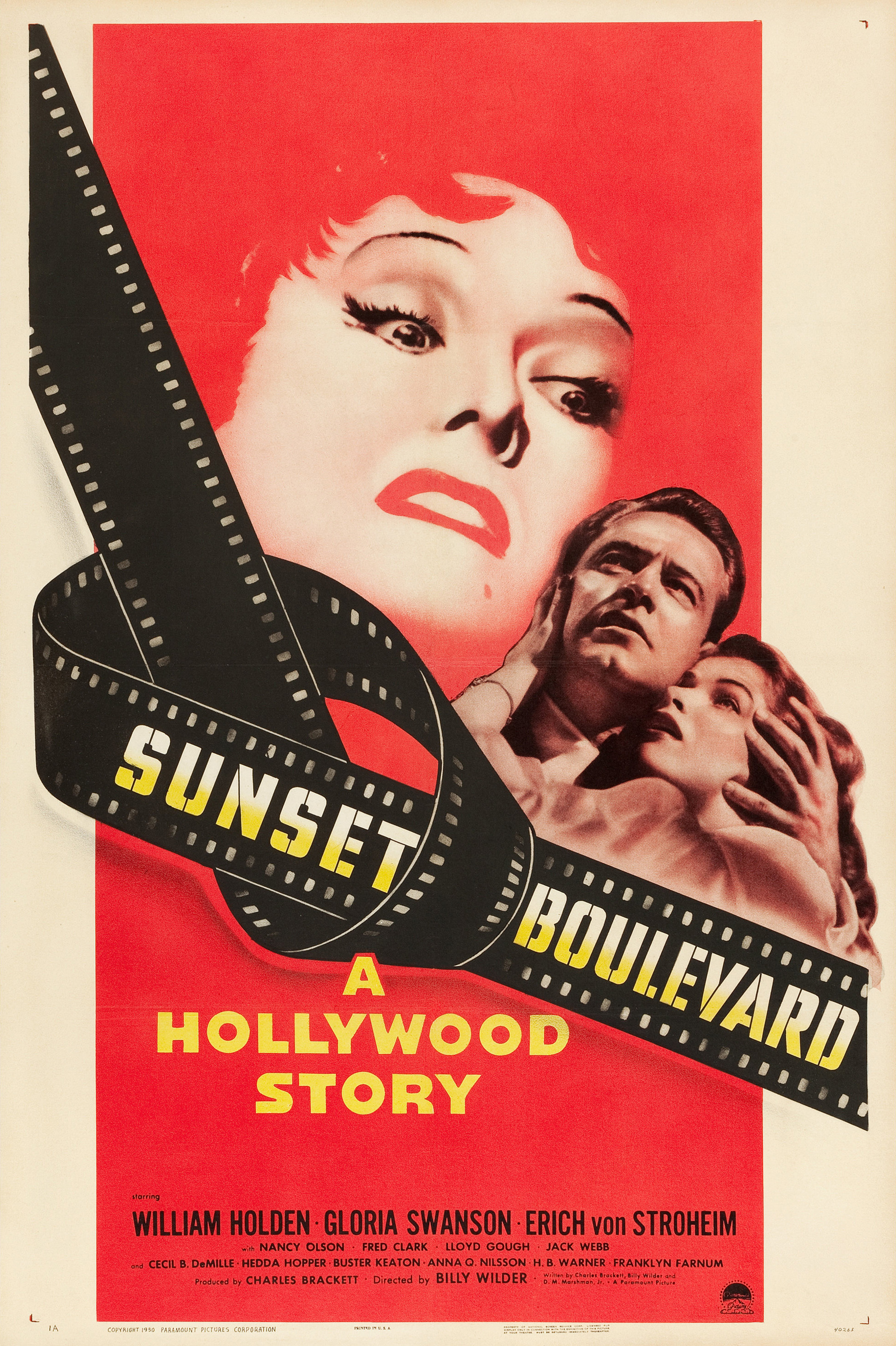
Behind the film
- Year
- 1950
- Director
- Billy Wilder
- Writers
- Charles Brackett, Billy Wilder, D. M. Marshman Jr.
- Genres
- Drama, Flashback, Film noir
- Production
- Paramount Pictures
- Country
- United States
- Cast
- William Holden, Gloria Swanson, Erich von Stroheim, Nancy Olson, Fred Clark, Jack Webb, Hedda Hopper, Buster Keaton
About the film
Contains story spoilers.
The film opens with screenwriter Joe Gillis’s body floating in a swimming pool, then lets the dead man narrate the events that led there. Six months earlier, Joe is behind on his car payments and unable to sell a script to a studio producer. He tries to evade the men sent to repossess his car, gets a flat tire, and hides in the garage of a large, neglected mansion on Sunset Boulevard. Its owner, Norma Desmond, mistakes him for a mortician summoned after her pet chimpanzee dies. When she learns he is a screenwriter, she hires him to revise a lengthy screenplay about Salome, convinced it will bring her back to the screen.
Norma was once a silent-film star and now lives among the evidence of the fame she cannot let go. She watches her old pictures projected at home and receives fan letters that Max, her butler, has actually written himself. Joe’s work is ostensibly to edit the Salome script, but Norma also settles his debts, moves his possessions into the mansion, and pays him weekly. The arrangement gives him a room and a reprieve from creditors while quietly changing his status from hired writer to kept companion. He knows the difference, resents it, and still accepts the comfort. The house’s old photographs, large rooms, and private screening space make Hollywood history feel preserved there in a form that cannot adjust to the present.
Joe grows increasingly uncomfortable as Norma’s attention narrows around him. She moves him into a bedroom beside her own and becomes possessive; Max explains that her despair has sometimes led to suicide attempts. On New Year’s Eve she stages an elaborate party for the two of them, and Joe reacts angrily to feeling trapped. He leaves for a party at his friend Artie Green’s home, where he reconnects with Betty Schaefer, a studio reader who once criticized his script but now believes one of his stories can be developed. When Max tells Joe that Norma has injured herself, Joe returns. Their reunion renews the arrangement, but the film keeps showing how his financial need and her loneliness make each person vulnerable to the other.
Norma sends her Salome screenplay to director Cecil B. DeMille, with whom she once worked, and eventually visits him on a studio set. The attention she receives there feeds her belief that a comeback is underway. In reality, Paramount’s call was about renting her car, not producing her screenplay. Joe learns this while on the lot, where he also agrees to work privately with Betty on a new script. The two projects create the film’s central double life: Joe tells Norma he has abandoned writing while rebuilding a career with Betty after hours. Max later reveals that he was once a director who discovered Norma and became her first husband; after her career declined, he returned to serve her, reinforcing the mansion’s closed loop of devotion and denial.
Joe and Betty fall in love while working together, but Joe does not leave Norma. Norma discovers their script and calls Betty to expose Joe as a paid companion. When Betty arrives, Joe finally explains his situation and refuses to go with her, partly because he feels he cannot simply walk away from what he has become. He returns Norma’s gifts and tells her the truth: there will be no Salome film, the studio wanted the car, and the fan letters are Max’s. The confession is harsh, but it ends the fiction on which their household has depended. Joe intends to return to Ohio, giving up both the security of the mansion and the possibility of making a life with Betty.
Norma shoots Joe as he walks away, and his body falls into the pool seen at the beginning. Police and reporters gather outside, but Max directs a newsreel crew to set up cameras inside the house and tells Norma that they have arrived. She descends the staircase imagining herself as Salome in a scene for the cameras, unaware that the crew is recording the aftermath of a murder. The frame-story thus closes on a cruel reversal: Joe’s narration has explained the crime, but Norma’s final movement turns the real event into the movie comeback she has been waiting for. Max’s actions preserve her fantasy even as the outside world finally watches her, though for reasons she cannot understand.
Billy Wilder’s film uses Joe’s voice-over and the poolside opening to make the outcome known before the story explains it, shifting suspense from “what happened?” to how the characters reached an ending already visible. The mansion is a world of still photographs, old films, and staged rituals, while the studio lot represents the current industry that Norma imagines is calling her back. The picture’s real former silent-film star, Gloria Swanson, plays Norma, while Erich von Stroheim—himself a director—plays Max, whose history echoes the fiction. That casting gives the story an extra layer without making Norma a portrait of Swanson. The ending keeps the collision between performance and reality in view: cameras roll, but they cannot give Norma the comeback she thinks is happening.