
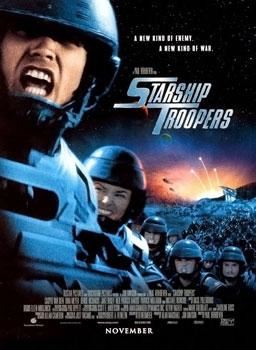
Behind the film
- Year
- 1997
- Director
- Paul Verhoeven
- Writers
- Edward Neumeier
- Genres
- Action, Thriller, Science fiction, Monster
- Production
- Touchstone Pictures
- Country
- United States
- Cast
- Casper Van Dien, Dina Meyer, Denise Richards, Jake Busey, Neil Patrick Harris, Patrick Muldoon, Clancy Brown, Michael Ironside
About the film
Contains story spoilers.
Starship Troopers builds a space war around a particularly dangerous kind of confidence: the belief that a society can explain every problem by identifying an enemy and sending young people to kill it. Paul Verhoeven directs, with Edward Neumeier adapting Robert A. Heinlein’s novel. The film’s fictional Federation presents service as an attractive route to belonging, distinction and citizenship. Its public face is bright, energetic and reassuring, even when the images beneath that reassurance are horrifying. The action offers the familiar pleasures of a military adventure, but the wider presentation keeps asking what those pleasures conceal. Victory, loyalty and sacrifice are constantly being packaged for an audience.
Rico enlists, hoping to stay close to Carmen, while his friends enter different military branches. After training goes wrong, he intends to quit; the destruction of Buenos Aires changes his mind. A disastrous invasion leads him into the Roughnecks, where love, promotion and devastating losses intertwine. Intelligence officer Carl sends the soldiers into a trap intended to expose an enemy Brain Bug. Rico later helps rescue Carmen, while Zim captures that creature. The conclusion celebrates the capture through another recruitment message, with Rico and Carmen still fighting. It ends with renewed confidence in the campaign, rather than with the war conclusively over.
That distinction matters because Rico’s development can look like a straightforward success story. He learns to endure punishment, protect comrades and assume responsibility. Within his immediate circle, those achievements are real: other people depend on him, and cowardice would have consequences for them. The more difficult question is whether becoming effective inside an institution proves that the institution deserves his loyalty. The film lets the soldier’s view and the viewer’s view pull apart. Rico can feel increasingly certain of his purpose while the surrounding propaganda makes that certainty increasingly suspect. His competence supplies no independent measure of the justice of the campaign that employs it.
The glossy early friendships establish the people before the military turns them into functions. Carmen’s ambition, Carl’s intelligence and Rico’s physical confidence point towards different forms of status, but they also expose the limits of the romantic reasons for enlistment. A uniform cannot preserve a school relationship, and choosing the same institution does not mean choosing the same life. Dina Meyer’s Dizzy adds another emotional connection within the fighting unit. Together, these relationships give the war intimate stakes without making those stakes an argument for the war itself. Caring about a soldier’s survival and endorsing the system that sends that soldier into danger are separate responses.
The Arachnids push that separation into the creature design. An opponent with an inhuman body is easy to describe as an infestation, and that description makes destruction sound hygienic rather than political. Yet the soldiers’ own bodies remain painfully vulnerable. Flesh does not become less fragile because a broadcast describes its owner as a hero. The contrast between the creatures’ overwhelming physical threat and the Federation’s buoyant public language keeps the violence from becoming a clean demonstration of superior technology. Military equipment can look impressive and still leave its users exposed. The film’s battlefield scale repeatedly overwhelms the tidy categories through which the war is explained.
The interruptions by public information are essential to the experience. Instead of keeping the viewer entirely inside Rico’s perspective, they place the battle story alongside its advertised version. Short messages reduce complicated questions to confident slogans and invitations to participate. Their cheerful surface makes the reduction easier to notice. The viewer is being shown both a violent system and the tools that make involvement in that system seem ordinary. This is why the tone can feel jarringly comic alongside gruesome action: the contradiction is the mechanism. A society able to smile through terrible images has learned to absorb them without allowing those images to disrupt its story about itself.
The military hierarchy also creates a gap between proximity and knowledge. The people physically closest to danger do not necessarily understand the decisions that put them there. Carl’s role makes that imbalance personal, since friendship provides no guarantee that the institution will value a familiar life differently. Decisions can become calculations about information, acceptable losses and future advantage. Rico’s battlefield loyalty therefore operates within a much colder framework. The film gives comradeship emotional weight while showing how easily command can use that weight. Soldiers keep going partly for each other, even when the strategic reasons for keeping them there remain beyond their control.
By the ending, the capture of one creature has become a picture of confidence suitable for public consumption. The continuing war is repackaged as momentum, and surviving characters become evidence that the machine works. Starship Troopers leaves its strongest question in that transformation: what happens when the ability to tell an exciting story about violence outruns the willingness to examine it? The film can be followed as an exuberant, bloody science-fiction adventure, but its recruitment framing changes the meaning of that adventure. Success inside the story is also a new advertisement for repeating it. The final enthusiasm is precisely what makes the conclusion uneasy.