
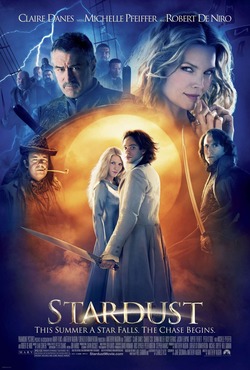
Behind the film
- Year
- 2007
- Director
- Matthew Vaughn
- Writers
- Jane Goldman, Matthew Vaughn
- Runtime
- 2h 8m
- Genres
- Fantasy, Children's, Drama, Ghost
- Production
- Paramount Pictures, Marv Studios, Ingenious Media
- Country
- United Kingdom, United States
- Cast
- Charlie Cox, Claire Danes, Michelle Pfeiffer, Robert De Niro, Sienna Miller, Ricky Gervais, Jason Flemyng, Mark Strong
About the film
Contains story spoilers.
Tristan leaves the village of Wall to fetch a fallen star for Victoria. Across the boundary in Stormhold, he finds Yvaine, a woman struck by the gem that the dying king cast into the sky to determine his successor. Princes seek the gem; Lamia seeks Yvaine's heart to restore her youth. Tristan and Yvaine shelter aboard Captain Shakespeare's flying ship and fall in love. Tristan discovers that crossing into his world would turn her to dust. At the witches' manor, Lamia kills Prince Septimus, but Yvaine's renewed light destroys her. Tristan's mother Una is Stormhold's lost princess, making him heir to the throne. He rules with Yvaine, and their final ascent into the sky completes a romance that began as his misguided attempt to impress someone else.
The village wall gives this sprawling fairy tale a wonderfully simple point of orientation. It separates what Tristan assumes he understands from experiences that refuse his expectations. Crossing it therefore changes more than the scenery. His confidence has been built inside a small social world where admiration seems to have clear rules, while the adventure exposes how little those rules explain another person's wishes. Matthew Vaughn and Jane Goldman's adaptation makes wonder inseparable from that education. The strange landscape is not simply a storehouse of marvels to be collected; it is inhabited by people whose needs can challenge the visitor's idea of what the journey is for. The boundary makes his growing understanding visible as movement.
The attraction between Tristan and Yvaine develops through friction rather than instant agreement. Claire Danes gives impatience a useful sharpness, allowing Yvaine to resist the flattering role Tristan's original fantasy would assign her. Charlie Cox's uncertainty makes his confidence feel provisional enough to change. Their relationship depends on each learning to respond to the person present rather than the story already imagined. The fantasy premise intensifies an ordinary romantic mistake: mistaking a grand gesture for understanding. An impressive effort can remain self-centred if its purpose is winning approval. The film's emotional direction asks Tristan to notice what his chosen gesture would cost someone else, and to accept that a different destination may matter more than completing the promise.
The film distributes its world-building through encounters rather than a large system of exposition. Wall’s single guarded opening makes passage an event; the stone’s fall then draws the kingdom’s political order into motion. The dead princes remain as ghostly commentators, turning succession into a comic chorus as each brother’s schemes reduce the number of claimants. Lamia’s magic offers a different sort of time: youth is something stolen and replenished, not a natural stage of life. The fantasy rules are understandable through what characters want from them, keeping the spectacle tied to motives.
Victoria’s role is important because Tristan’s initial quest is shaped by his projection of romance. She is beautiful and socially secure, and his promise is meant to prove that he can achieve something remarkable. But Yvaine is not a reward waiting at the end of his errand; she is the person whose peril and choices expose the thinness of his original plan. The film’s emotional shift comes as Tristan begins to ask what she needs, not simply whether he can return on schedule. Their partnership does not erase his feelings for Victoria; it gives him enough perspective to recognize the difference between admiration and reciprocal love.
The actors help the film move between broad comic fantasy and genuine menace. Michelle Pfeiffer’s Lamia combines elegance with predatory concentration, while Robert De Niro’s Captain Shakespeare turns a feared pirate into an unexpectedly careful host. The performance contrast is built into the costume, movement and crew’s reaction: a character who must project command also needs room to express a concealed gentleness. Claire Danes gives Yvaine a sharp watchfulness that keeps her from becoming a passive prize; Charlie Cox’s Tristan gradually changes from a naïve petitioner into someone able to choose without the promised approval of his village.
The story's competing desires give its magic a moral shape. Lamia treats vitality as something that can be seized, while the royal competition treats legitimacy as an object someone can possess. Affection offers a different relation to value, one that cannot be guaranteed through capturing its apparent source. These alternatives keep the spectacle tied to the choices inside it. Stardust is playful about inheritance and identity, but its central romance asks for a more personal discovery than finding the correct title. Tristan has to become capable of belonging beside someone without treating her as proof of his own achievement. The fairy-tale scale gives that discovery a luminous expression while keeping its emotional premise recognisably human.
The adaptation’s visual language favors storybook clarity without making every image soft. Stormhold’s costumes and interiors feel composed around titles and inherited power, while the moving ship and open road turn travel into a changing stage. The narrator’s presence gives the film a familiar fairy-tale frame, but the performances repeatedly interrupt solemnity with embarrassment, theatrical bravado or practical annoyance. That tonal flexibility matters because the story asks its characters to move from a village romance into danger without pretending that wonder removes fear. The fantasy looks handmade in spirit even when its effects widen the scale beyond the village wall.