
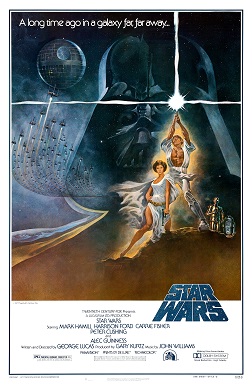
Behind the film
- Year
- 1977
- Director
- George Lucas
- Writers
- George Lucas
- Runtime
- 2h 1m
- Genres
- Space opera, Science fiction, Action, Adventure
- Production
- Lucasfilm
- Country
- United States
- Cast
- Harrison Ford, Alec Guinness, Carrie Fisher, Mark Hamill, Peter Cushing, Peter Mayhew, David Prowse, Anthony Daniels
About the film
Contains story spoilers.
Star Wars opens in the middle of a civil war. Rebel spies have stolen plans for the Death Star, a vast Imperial station capable of destroying a planet. Princess Leia carries the plans aboard her ship, but Darth Vader's forces capture it. Before she is taken prisoner, Leia hides the plans inside R2-D2, who escapes with C-3PO to the desert planet Tatooine. The droids are found by Luke Skywalker, a young man living with his aunt and uncle. Luke wants to leave the farm and see more of the galaxy, but his family expects him to stay. The droids' arrival connects that quiet life to a conflict that stretches across many worlds.
Luke discovers a message from Leia asking for help from Obi-Wan Kenobi. He meets the old hermit, who tells him that Luke's father was a Jedi and gives him his father's lightsaber. Obi-Wan explains the Force as an energy that connects living things and can be used by someone who learns to sense it. When Imperial troops kill Luke's aunt and uncle while searching for the droids, he has no reason to remain on Tatooine. He joins Obi-Wan and hires Han Solo, the pilot of the Millennium Falcon, and Han's Wookiee co-pilot Chewbacca to take him toward Leia. The group is practical and uneasy: Han wants payment, Luke wants purpose, and Obi-Wan is trying to carry out a mission whose larger shape Luke does not yet understand.
The Falcon reaches the location of Alderaan only to find the planet destroyed. The Death Star pulls the ship aboard, and the group sneaks into the station to rescue Leia. Han and Luke disguise themselves as stormtroopers, while Leia takes charge once she is freed and criticises their improvised escape plan. Obi-Wan moves separately to disable the tractor beam that prevents the Falcon from leaving. He encounters Vader, his former student, and allows Vader to strike him down so the others can escape. The station's power and scale make it difficult to fight directly; the rescue works because the small group uses disguises, maintenance passages and a distraction. Leia joins the crew as they fly to the hidden Rebel base with information about the Death Star.
The Rebels learn that the station has a narrow vulnerability in an exhaust port connected to its reactor. Their pilots launch an attack, but the Death Star begins preparing to fire on the base. Luke joins the assault, while Han initially leaves with his reward rather than risk his life. Vader's fighters destroy several Rebel ships, and Luke hears Obi-Wan's voice telling him to trust the Force. He switches off his targeting computer and makes the shot by relying on what he has learned. Han returns at the last moment, attacks Vader's formation and gives Luke the opening he needs. The torpedoes hit the reactor and the Death Star explodes. The victory is collective: Luke makes the decisive shot, but the mission depends on the people who protect and support him.
The ending brings the surviving Rebels together to celebrate. Luke and Han receive medals from Leia, and the group that began as strangers is now part of a shared cause. The Empire remains powerful, and the film does not pretend one battle has ended the war. It does, however, turn Luke's wish to leave home into a larger commitment. His new life has not come from abandoning every relationship; it has come from finding people whose goals he chooses to share. Han's return also suggests that loyalty can develop after a relationship begins as a paid job. The character arcs are simple enough to follow, but they give the large conflict a human scale.
George Lucas frames the story as a space adventure with a clear chain of goals: deliver the plans, rescue Leia, reach the Rebels and destroy the Death Star. Droids, ships and Imperial uniforms make the world understandable through action. The Force adds a spiritual dimension to Luke's skills, but the film does not detach it from practical obstacles. He learns to trust it while flying a fighter in a battle where his friends are under attack. The action is also balanced with humour from Han, Leia, C-3PO and R2-D2, whose bickering and different temperaments keep the journey from becoming solemn. The film's quick shifts between danger and character interaction make a very large galaxy feel navigable.
The Death Star is both a military threat and a physical setting for the rescue. Its enormous corridors and machinery dwarf the characters, while their small actions—stealing uniforms, hiding in a trash compactor, disabling the tractor beam—create openings. John Williams's score gives the separate strands a shared sense of momentum, carrying the story from the desert to the space battle. The film often presents information visually before dialogue clarifies it: the scale of the Death Star is demonstrated by its destruction of Alderaan, and its vulnerability is represented by a target small enough to challenge the pilots. This makes the stakes clear without needing every military detail explained.
Star Wars closes on celebration rather than a final resolution to the conflict. Leia's rescue and the Death Star's destruction give the Rebels a major victory, but Vader and the Empire remain at large. Luke's movement from farm life to the cockpit is only the start of his story, and Han's decision to return leaves open whether he will remain with the cause. What the film completes is the formation of its central group. A princess, a farm boy, an old Jedi, a smuggler and two droids contribute different skills that make the mission possible, even though not everyone survives it. The story's galaxy is broad, but its emotional centre is the change from separate motives to a small team prepared to take a risk together.