
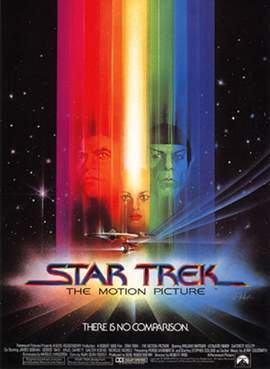
Behind the film
- Year
- 1979
- Director
- Robert Wise
- Writers
- Harold Livingston
- Runtime
- 132 min (original theatrical version)
- Genres
- Science fiction, Adventure
- Production
- Paramount Pictures
- Country
- United States
- Cast
- William Shatner, Leonard Nimoy, DeForest Kelley, Stephen Collins, Persis Khambatta, James Doohan, Nichelle Nichols, George Takei
About the film
Contains story spoilers.
An energy cloud destroys Klingon ships and a Federation station as it approaches Earth. Kirk takes command of the refitted Enterprise from Decker. A transporter accident kills two officers, and a wormhole nearly destroys the ship. Spock returns after sensing the cloud's consciousness. An intruder absorbs navigator Ilia and replaces her with a robotic probe seeking its Creator. Spock's mind-meld reveals a living machine with no purpose beyond its accumulated knowledge. Inside it, the crew finds Voyager 6, a human probe transformed by an alien machine civilisation. Decker joins with the Ilia replica and V'Ger, forming a new life that departs. Earth is saved, and the Enterprise resumes exploration, with discovery having required communication rather than a superior capacity for destruction.
The Enterprise feels like a place whose familiarity can encourage mistaken confidence. Kirk's attachment is real, but emotional recognition does not automatically supply up-to-date practical understanding. William Shatner gives that conflict a personal edge: a man can love a role and still need to reconsider how he occupies it. Stephen Collins's Decker has another claim to competence, one that cannot be dismissed simply because the older officer has a celebrated history. Their relationship lets the film make authority a working problem rather than an unquestioned attribute of its central hero. The ship's shared purpose requires room for knowledge held by different people, asking whether confidence can include the ability to listen without treating every correction as a loss of standing.
Its science-fiction scale comes from slowness and distance. Robert Wise lets the Enterprise glide through long stretches of darkness, and the camera holds on the ship as a physical object whose surfaces, lights and enormous interior spaces need time to register. The opening encounter with the cloud is built from gradual approach rather than quick explanation: the crew scans, waits, and discovers that familiar measures of size and danger do not apply. Jerry Goldsmith's music moves between spacious electronic textures and the recurring, more lyrical Enterprise theme. Instead of making every corridor a venue for action, the film uses the ship's quiet passages to suggest how small its crew is beside the phenomenon outside.
Spock brings a different kind of confidence to the question of how to encounter the unknown. Leonard Nimoy gives rational distance an emotional cost, making restraint feel like a position a person inhabits rather than a convenient absence of feeling. The story's large question about intelligence consequently has a human counterpart. Knowing enough to describe a situation does not necessarily establish what the situation means to someone inside it. Each officer's professional habit permits an approach while also setting a limit on that approach. The film finds its tension in the possibility of recognising those limits without abandoning the value of expertise. Understanding may require a broader response, rather than a victory for one supposedly complete method over all the others.
The probe that takes Ilia's shape makes the film's abstract puzzle intimate, while also giving it an unsettling edge. It can reproduce a person as an instrument without understanding the relationships that person carried. Decker's connection to Ilia becomes part of the encounter, but the film gives the artificial duplicate its own function in the larger search rather than treating it as a simple reunion. The crew must communicate with an intelligence whose vocabulary is built from data, purpose and completion. That setup lets the story connect the practical work of scanning and decoding with a more personal question: what does a machine need from its makers when its instructions have outlasted the world that sent it?
Voyager's enlarged existence gives technology a predicament usually associated with people: an accumulated capacity that cannot by itself explain why continuing matters. That is more unsettling than a machine whose only function is to attack. A goal may be pursued with perfect consistency and still cease to provide a satisfactory account of existence. The film's imagined encounter turns that difficulty into a question about recognition. Creators and creations may share an origin without sharing the same experience of what followed, and a relationship cannot be restored solely by identifying the correct names. A convincing response has to address what the other has become. The story makes that demand available on an immense scale while keeping its emotional shape recognisable.
The film's measured rhythm and visual emphasis make it distinct from a conventional space adventure. Dialogue often supplies coordinates and system status, but the images invite viewers to inspect the ship, the cloud and the machinery that bridges them. That attention to design is tied to the story's central image of technology pursuing purpose beyond its creators' reach. The Enterprise is newly rebuilt yet already shaped by memory; Voyager is an old instrument magnified into an intelligence that has forgotten its origin. By ending with departure rather than conquest, the film leaves its people and its machines oriented toward an immense universe that remains only partly legible.