
Behind the film
- Year
- 1986
- Director
- Leonard Nimoy
- Writers
- Steve Meerson, Peter Krikes, Nicholas Meyer, Harve Bennett
- Runtime
- 1h 59m
- Genres
- Science fiction, Science fiction comedy, Adventure, Time-travel
- Production
- Paramount Pictures
- Country
- United States
- Cast
- William Shatner, Leonard Nimoy, DeForest Kelley, James Doohan, George Takei, Walter Koenig, Nichelle Nichols, Catherine Hicks
About the film
Contains story spoilers.
Star Trek IV: The Voyage Home sends its space travellers somewhere unusually difficult to understand: the ordinary world familiar to the film’s audience. Leonard Nimoy directs and plays Spock, alongside William Shatner’s Kirk and the returning Enterprise crew. The mission involves a planetary emergency, but solving it requires practical movement through 1986 San Francisco rather than a conventional confrontation with an enemy ship. That change gives the adventure a comic perspective on both the visitors and the present. Advanced knowledge can become awkward when the person using it lacks the local habits needed to make it useful. A familiar street is suddenly another strange environment to explore.
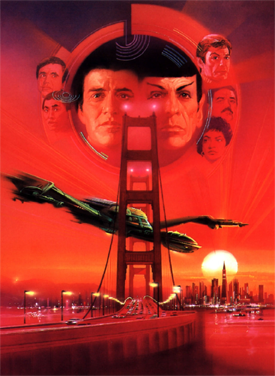
A probe disables Earth while attempting to communicate with humpback whales, extinct in the crew’s century. Using a captured Klingon ship, Kirk’s group travels into the past to find whales and repair the energy needed for the return. Kirk and Spock meet marine biologist Gillian Taylor, while the others acquire a tank and reactor energy. They rescue the injured Chekov and bring Gillian and two whales forward in time. The whales answer the probe, which leaves and reverses the damage. The crew then faces judgement for earlier offences; Kirk becomes a captain again, and the group receives the new Enterprise-A. The rescue restores a future while changing their own place within it.
The whale premise makes listening the decisive form of action. The probe is dangerous because its communication has no available answer, not because the crew identifies a familiar villain whose defeat will settle the crisis. That distinction changes the kind of ingenuity the film rewards. The response has to recognise what is missing from the world and find a way to restore the missing relationship. Human control of technology is insufficient when the communication concerns another species. The adventure’s ecological idea is therefore built into the mission rather than added as an observation afterwards. The future’s apparent sophistication has not prevented it from losing something it urgently needs.
The crew’s divided tasks give the ensemble room to operate through different strengths. Finding whales, obtaining energy and creating a transport space each demand a separate kind of improvisation. Familiar working relationships remain useful even when familiar equipment and institutions are unavailable. The film’s humour often emerges from that mismatch: someone capable of extraordinary technical work must first navigate a much smaller social difficulty. The characters’ expertise is not invalidated, but it has to pass through the conditions of another time. That allows the adventure to celebrate cooperation without making advanced travellers automatically competent at every encounter simply because they come from the future.
Spock’s recovery adds another layer to the visit. His effort to reconnect knowledge, memory and feeling places him in a position where ordinary social assumptions can be questioned rather than taken for granted. Nimoy’s restrained presence suits a comedy built around gaps in expectation. Kirk can attempt a persuasive explanation while Spock’s approach makes the explanation less conventional. Their partnership works through that contrast, giving the scenes a rhythm in which impatience, literalness and affection coexist. The film uses a relationship established across earlier adventures without requiring every comic exchange to depend on detailed recollection of those adventures.
Gillian gives the mission someone whose concern for the whales exists independently of the visitors’ emergency. Catherine Hicks’s character does not regard them merely as the components required to save a future planet. That difference is valuable: the crew’s need has to meet a person already responsible for the animals in the present. Her involvement makes the rescue more than a technical acquisition. She asks questions, judges explanations and brings knowledge of the creatures whose voices the future has lost. The film links the travellers’ extraordinary purpose with an existing commitment to care, allowing her to participate through expertise rather than through fascination with Kirk alone.
The return journey also prevents the contemporary setting from becoming a harmless holiday. The comic encounters happen while time and resources remain limited, and a member of the crew can be endangered by the very world providing the jokes. That underlying pressure keeps the everyday complications connected to the original emergency. The visitors need more than a successful search; they need to carry what they find back across time and survive arrival. The ship’s improvised role as a whale transport makes that practical difficulty tangible. A solution identified in principle still requires space, energy and a way to complete the journey without losing the lives entrusted to it.
The final judgement joins the ecological mission with the crew’s continuing story. Saving Earth gives their actions a new context without pretending previous disobedience never occurred. Kirk’s demotion also carries the pleasure of returning him to the role most closely associated with his work, while the new Enterprise restores a shared direction. Star Trek IV ends through answered communication, survival and renewed service. Its distinctive achievement is to make a large crisis depend on attention to a form of life the human future failed to preserve. The adventure’s humour keeps the visitors approachable, while its central problem asks what a technologically ambitious civilisation may overlook on the way to becoming advanced.