
Behind the film
- Year
- 2013
- Director
- J. J. Abrams
- Writers
- Roberto Orci, Alex Kurtzman, Damon Lindelof
- Runtime
- 2h 12m
- Genres
- Science fiction action, Science fiction, Adventure, Action
- Production
- Bad Robot Productions, Paramount Pictures, Skydance Media
- Country
- United States
- Cast
- Chris Pine, Zachary Quinto, Benedict Cumberbatch, Zoe Saldaña, Karl Urban, Simon Pegg, Alice Eve, Peter Weller
About the film
Contains story spoilers.
Star Trek Into Darkness opens with a rescue that is also a breach of the rules. On Nibiru, the Enterprise crew tries to prevent a volcanic eruption without revealing advanced technology to the people living there. Kirk chooses to expose the ship when Spock’s life is at risk, then expects his report to protect the decision from scrutiny. Spock gives an accurate account instead. Their disagreement establishes a problem that will run through the film: Kirk believes loyalty should support what he knows was the right action, while Spock regards honest procedure as part of that loyalty. Starfleet’s response removes Kirk from command before a much more dangerous test arrives.
A bombing in London draws senior officers into a meeting that becomes the target of a second attack. Christopher Pike, Kirk’s mentor, is killed, turning an institutional crisis into a personal loss. The attacker, known as John Harrison, escapes to the Klingon homeworld. Admiral Marcus restores Kirk to the Enterprise and equips him to strike the fugitive with special torpedoes from outside the planet’s immediate defences. The order offers Kirk a mission shaped around his anger, but also asks Starfleet to execute someone without a trial inside hostile territory. The risk extends beyond one man: a strike could produce the confrontation with the Klingons that the Federation claims to be avoiding.
The crew’s objections prevent the mission from remaining a simple pursuit. Scotty refuses to accept unexplained weapons aboard his ship and resigns when Kirk overrules him. Spock questions the planned killing, while Uhura has her own anger about Spock’s readiness to treat his survival as expendable. Kirk eventually decides to capture Harrison rather than use the torpedoes. A landing party encounters Klingons, and Harrison intervenes with a display of strength far beyond an ordinary human’s. His subsequent surrender seems inconsistent with that advantage until the weapons aboard the Enterprise become part of the conversation. The fugitive is responding to information Kirk has carried without understanding.
Harrison reveals himself as Khan, a genetically engineered man awakened from suspended animation by Marcus. His fellow survivors have been hidden inside the torpedoes, turning apparently impersonal military equipment into hostages. McCoy and Carol Marcus examine one of the weapons and discover the human body within. Carol, the admiral’s daughter, has joined the ship under a concealed surname because she suspects her father’s activities. Khan explains that Marcus used his abilities to develop weapons and prepare for war. His account makes the admiral’s plan intelligible, but does not make Khan trustworthy. A person subjected to coercion can still pursue revenge that places everyone outside his own circle at risk.
Marcus arrives aboard the much larger Vengeance, a warship whose design expresses the policy he has concealed behind Starfleet authority. He demands Khan and attacks the Enterprise when Kirk resists. Scotty’s independent investigation brings him inside the new ship, allowing a temporary interruption of its assault. Kirk then forms an uneasy partnership with Khan to cross the space between the vessels and reach Marcus. Chris Pine’s Kirk has to work beside someone whose strength and knowledge are useful without confusing that usefulness with shared principles. The sequence makes cooperation a matter of immediate survival, with every apparent success creating a new opportunity for betrayal.
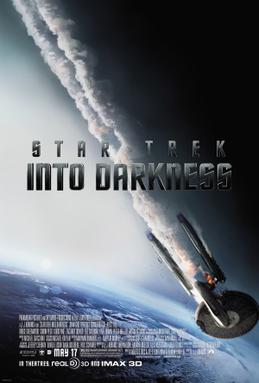
Khan takes control of the Vengeance and kills Marcus. Spock, now responsible for the Enterprise’s response, must handle an enemy who believes the crew can be threatened through the torpedoes containing his companions. He has the sleepers removed before returning the armed weapons, creating a reversal that buys the damaged Enterprise another chance. That chance is still physically precarious. The ship’s systems fail as it falls towards Earth, and Kirk enters the radiation-filled reactor area to restore power. Having begun the film by assuming he could always find a way out, he now undertakes a task whose cost he understands. His death separates the captain from the crew at the moment his action saves them.
Spock’s response draws on the emotion he has repeatedly tried to contain. Khan’s damaged vessel crashes into San Francisco, and the pursuit continues through the city rather than ending with the space battle. McCoy discovers that Khan’s blood may allow Kirk to be revived, giving Uhura a reason to stop Spock from killing the fugitive. Khan is captured, Kirk recovers, and the surviving enhanced humans are returned to suspended animation. The ending restores the Enterprise’s mission of exploration after a conflict in which its leaders nearly turned the institution into an instrument of pre-emptive war. Survival alone is insufficient; the crew also has to recover a purpose that the crisis has displaced.
J. J. Abrams directed from a screenplay by Roberto Orci, Alex Kurtzman and Damon Lindelof. Zachary Quinto’s Spock moves between precise language and sudden physical urgency, while Benedict Cumberbatch gives Khan a measured voice that can make an explanation sound like a threat. Karl Urban and Simon Pegg anchor the crew’s resistance in practical concerns about bodies, machines and responsibility. The film’s gleaming institutional spaces contrast with the damage produced by the policies conceived inside them. It also revisits relationships and situations associated with earlier Star Trek within the newer films’ altered timeline, making recognition part of the experience without requiring this crew’s choices to reproduce the older story exactly.