
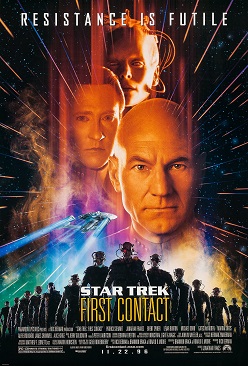
Behind the film
- Year
- 1996
- Director
- Jonathan Frakes
- Writers
- Brannon Braga, Ronald D. Moore
- Runtime
- 1h 52m
- Genres
- Action, Science fiction, Adventure, Time-travel
- Production
- Paramount Pictures
- Country
- United States
- Cast
- Patrick Stewart, Jonathan Frakes, Brent Spiner, LeVar Burton, Michael Dorn, Alfre Woodard, James Cromwell, Alice Krige
About the film
Contains story spoilers.
Captain Jean-Luc Picard joins the defence of Earth against the Borg despite orders to keep the Enterprise away. When a Borg sphere travels into the past, the crew follows it to 2063, just before Zefram Cochrane's first warp flight. The attack threatens to prevent the encounter with Vulcans that will shape humanity's future. Riker's team helps Cochrane repair and launch his spacecraft, while surviving Borg invade the Enterprise. Picard's former assimilation makes him increasingly unwilling to abandon the ship, until Lily Sloane confronts his obsession. He orders evacuation but stays to rescue Data, whom the Borg Queen has tempted with human sensation. Data pretends to cooperate, then releases coolant that destroys the Borg's organic components. Cochrane completes his flight and meets the visiting Vulcans. With the future restored, the Enterprise returns to its own century.
First Contact places two versions of technological progress beside one another. The promise of reaching another civilization shares the film with the threat of being absorbed into a collective that permits no independent choice. Both involve crossing boundaries, but only one makes room for the people on the other side. That distinction gives the science-fiction machinery a clear emotional purpose. The Borg are frightening because contact with them erases the possibility of a relationship between equals. The film can celebrate exploration while treating compulsory sameness as a nightmare, allowing its action and its more hopeful view of the future to arise from the same question about how different beings meet.
Patrick Stewart's Picard carries authority so naturally that the film can make authority itself a source of tension. His knowledge of the enemy is valuable, but knowledge gained through trauma is not necessarily a reliable guide to every decision. Stewart lets that complication appear through changes in the captain's composure rather than simply announcing an entirely different personality. The crew's respect makes disagreement difficult, because a challenge to his judgment can sound like a challenge to the experience that informs it. This is a particularly useful pressure for a command story. Competence and injury exist in the same person, and the others must work out when loyalty requires questioning him rather than following him.
Lily brings a perspective that does not depend on that command structure. Alfre Woodard gives her alarm and curiosity a directness that cuts through the Enterprise's habitual deference. She has reasons to be frightened without sharing the crew's assumptions about who must be trusted. Her exchanges with Picard make the larger conflict readable through an immediate human relationship. She can respond to the person in front of her rather than to the reputation he carries in his own century. The film gains something from that unfamiliarity: a future presented as admirable still has to justify itself to someone living through a much harsher present.
Cochrane complicates the future crew's admiration in a different way. James Cromwell makes him an awkward fit for the heroic image they bring into the past. The contrast produces humour, but also exposes the distance between a person and the historical meaning attached to his work. Knowing that an achievement will matter does not tell the crew exactly how to deal with the person capable of making it. Their reverence can become another form of pressure. The film treats the making of history as practical, impatient and imperfect, giving its optimistic mythology an ordinary human texture. A hopeful future does not require every person at its beginning to resemble a monument.
Data's encounter with the Queen gives the struggle a more intimate scale. Brent Spiner and Alice Krige make the exchange feel like a contest over desire rather than just access to machinery. The Queen's appeal depends on treating a longing as an opening she can exploit. That places the android's individuality close to the film's central distinction between connection and possession. An experience offered as a gift may still be part of a demand to surrender choice. The scenes use their confined setting effectively, making attention and temptation as important as the battles elsewhere. The danger lies partly in how closely an enemy can approach something a person genuinely wants.
Frakes keeps the film's two environments in productive contrast. The Enterprise, usually associated with order and capability, becomes a place where familiar corridors no longer promise safety. Earth offers a rougher, more improvised setting with an achievement still to be made. Movement between them creates a rhythm between survival and possibility. Each strand needs the other: hope is difficult to sustain without protection, while protection has a clearer purpose when something worth preserving is visible. This gives First Contact an emotional range beyond its invasion story. It can bring an established future close to destruction while showing that the future began with people who did not have its certainties, making cooperation an achievement rather than an automatic condition of progress.