
Behind the film
- Year
- 1986
- Director
- Rob Reiner
- Writers
- Bruce A. Evans, Raynold Gideon
- Genres
- Teen, Coming-of-age, Adventure, Comedy
- Production
- Columbia Pictures
- Country
- United States
- Cast
- Wil Wheaton, River Phoenix, Corey Feldman, Jerry O'Connell, Kiefer Sutherland, Richard Dreyfuss, Gary Riley, Bradley Gregg
About the film
Contains story spoilers.
Stand by Me begins with the kind of adventure children can make sound exciting before they have really understood what it means. Finding a body promises importance: the boys could become the people everybody talks about instead of the children everybody overlooks. The journey steadily changes that expectation. Death ceases to be a distant fact capable of supplying a good story and becomes something they have to stand beside. What gives the film its emotional shape is the gap between the adventure they think they are undertaking and the conversations, fears and loyalties that emerge while they are trying to undertake it.
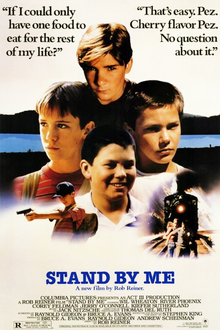
Rob Reiner directs the 1986 film from a screenplay by Bruce A. Evans and Raynold Gideon, adapting Stephen King's novella The Body. Wil Wheaton plays Gordie, with River Phoenix as Chris, Corey Feldman as Teddy and Jerry O'Connell as Vern. Richard Dreyfuss supplies the adult Gordie's perspective. That framing gives the friendship an unusual double life. The boys experience the trip without knowing what it will mean later, while the older narrator remembers it from a position that cannot return to their freedom or their closeness. Childhood therefore feels immediate without being treated as something permanently available.
In 1959 Oregon, the four boys leave Castle Rock to find the body of Ray Brower. Gordie is grieving his brother Denny, while Chris carries the stigma attached to his family. Their trek brings a frightening railway crossing, arguments and private disclosures. Chris encourages Gordie's writing and comforts him when grief breaks through. At the body, older boys led by Ace try to take control; Gordie resists. The friends abandon the prospect of claiming public glory and arrange an anonymous report instead. Their return ends the expedition, but the adult account reveals that their lives and friendships subsequently took different paths.
Gordie's difficulty is that the loss of his brother has also changed his place among the living. Grief has made the household a place where he struggles to feel noticed, so the journey gives him a different audience. Among friends, his ability to tell a story can become a recognised strength rather than another thing passing without much attention. His imagination matters because the film is itself being shaped by the adult he becomes. The child who needs somebody to believe his words are worth hearing will eventually be the person preserving the others through words, giving encouragement a consequence neither boy can yet measure.
Chris understands how heavily a name can weigh before somebody has done much to earn it. The family reputation around him threatens to make his future seem already decided. That is why his support for Gordie has more substance than an uncomplicated declaration that friends should follow their dreams. He recognises the damage done when the adults around a child cannot imagine a different outcome. His own hopes and his friend's talent belong to the same argument: circumstances can restrict somebody without providing a complete description of their abilities. The friendship makes room for possibilities that the town's assumptions have made difficult to express.
Teddy and Vern prevent the group from becoming simply a conversation between the two boys most able to discuss their feelings. They bring their own anxieties, noise and ways of proving themselves, so companionship also involves irritation and misjudgment. The boys are not consistently gentle with one another. That roughness makes the moments of care more distinctive, because affection has to appear inside a relationship that includes embarrassment, bravado and unkind remarks. Their ordinary exchanges keep childhood from turning into a polished adult ideal. These are people learning how to be loyal before they have reliably learned how to recognise what somebody else needs.
The confrontation over the body changes what would count as success. At first, recognition seems like the point; by the end, turning a dead child into a trophy would betray what the journey has taught them. The anonymous report marks a refusal to let their adventure become somebody else's humiliation. It also separates standing up to intimidation from winning a public contest. Gordie's resistance matters, but the more consequential choice is what follows it. The boys can return without the status they imagined and still have done something important, because the discovery has acquired a weight that cannot be settled by ownership.
The adult Gordie remembers that Chris became a lawyer and later died while trying to break up a fight. The other friendships loosen with time. Those outcomes keep the summer from functioning as a promise that everything will work out for children who care about one another. Its significance survives a future it could not control. Reiner's film lets a short journey contain a period of extraordinary closeness without suggesting that closeness can stop separation or loss. What remains is the narrator's ability to describe who these boys were to each other before life carried them elsewhere, preserving their company without pretending he can recover it.