
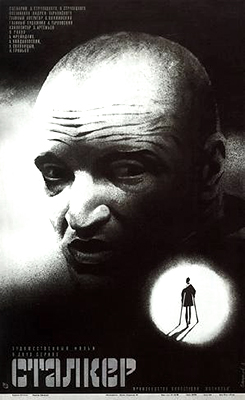
Behind the film
- Year
- 1979
- Director
- Andrei Tarkovsky
- Writers
- Arkady Strugatsky, Boris Strugatsky
- Genres
- Science fiction, Art, Drama, Arthouse science fiction
- Production
- Mosfilm
- Country
- Soviet Union
- Cast
- Alexander Kaidanovsky, Anatoly Solonitsyn, Alisa Freindlich, Nikolai Grinko, Natasha Abramova
About the film
Contains story spoilers.
Stalker begins in a colourless, worn-down world where the Stalker prepares to leave his wife and daughter for another journey into the forbidden Zone. A Writer and a Professor hire him as their guide. The setting is not a spectacular wasteland so much as an ordinary, exhausted industrial landscape: a bar, a guarded boundary, abandoned structures and railway equipment. The Zone is fenced off by the authorities, and anyone caught guiding visitors there risks prison. The guide treats its dangers seriously, but its rules remain elusive, so the Stalker insists that the visitors must follow his directions rather than trust a map or straight line.
The destination is a Room said to grant the deepest wish of anyone who enters. Each visitor appears to have a reason. The Writer is afraid of losing his inspiration; the Professor hopes to study the Zone and win recognition; the Stalker says he guides desperate people because he wants to help them. His wife fears another imprisonment and understands the cost of his calling better than the clients do. He speaks about the Zone with the reverence of a person who believes it still offers hope in a world that has forgotten how to believe.
The men sneak across the guarded boundary by following a train and riding a small railway work car into the Zone. Their surroundings change gradually: industrial ruins and abandoned machinery open onto wet vegetation, still water and quiet spaces that feel less controlled than the grey world they left. The Stalker tests routes by tossing cloth-wrapped nuts ahead of them and watching how they land. Even when nothing visibly supernatural happens, the group follows his circuitous path. The suspense comes from not knowing whether a wrong step is dangerous, or whether the guide’s rituals are the only thing keeping them safe.
As they travel, each man reveals what he hopes the Room will give him. The Writer’s joking cynicism hides anxiety about his ability to create. The Professor is measured and rational, but his composure does not explain why he has come so far. The Stalker treats their motives as dangerous because the Room may answer a person’s hidden desire rather than the wish they can explain. He tells them about Porcupine, his mentor, who returned from the Room wealthy and later hanged himself. The story complicates the promise of fulfilment: receiving what one wants may reveal something the person cannot live with.
The journey’s central passage, the Meat Grinder, is a long, dark route the Stalker says kills those the Zone judges unworthy. The Writer is chosen to go first by lot and emerges unharmed, but the experience unsettles him. The Stalker then explains that Porcupine’s brother died in that passage, intensifying the question of what the guide has withheld. Their conversation turns the trek into an argument about knowledge, faith and judgement. A telephone unexpectedly rings in an antechamber, a mundane interruption that makes the site stranger rather than less mysterious.
Near the Room, the Professor reveals that he has carried a powerful bomb. He intends to destroy the place so no one can use it for selfish or destructive purposes. The Stalker breaks down, insisting that the Room is the last source of meaning for people who have lost hope. The Writer suggests that Porcupine’s suicide followed the discovery that the Room granted him wealth rather than the return of his dead brother: the deepest desire may not match the conscious wish. The Professor abandons his plan and dismantles the bomb. None of the three enters the Room; they sit outside it in silence.
Back at the bar-café, the Stalker is met by his wife and daughter. He returns home distressed and tells his wife that people have lost the faith needed to find their way through the Zone. She answers in a long direct address about accepting a difficult life with him rather than an easier but empty one. Their relationship is not an aside to the expedition; it shows the cost of his vocation and the loyalty that sustains it. In the final scene, their daughter sits at a table as a poem is heard; she appears to move glasses with her mind while a passing train shakes the room.
Andrei Tarkovsky builds the film through long takes, slow camera movements and patient attention to surfaces: water, rust, leaves, damp concrete and the changing colour of light. The pace makes the characters’ movements through the Zone feel deliberate, and leaves room for arguments to unfold without being broken into quick explanatory cuts. The movie adapts the Strugatsky brothers’ Roadside Picnic, but its plot, characters and world are its own screen construction, centered on the guide, his clients and the Room. Its final image does not explain whether the Zone’s power has extended into the apartment; it leaves the daughter’s small act open to interpretation.