
Behind the film
- Year
- 1939
- Director
- John Ford
- Writers
- Dudley Nichols
- Runtime
- 1h 36m
- Genres
- Western, Drama, Action
- Production
- United Artists
- Country
- United States
- Cast
- John Wayne, Claire Trevor, Thomas Mitchell, Andy Devine, John Carradine, Louise Platt, George Bancroft, Donald Meek
About the film
Contains story spoilers.
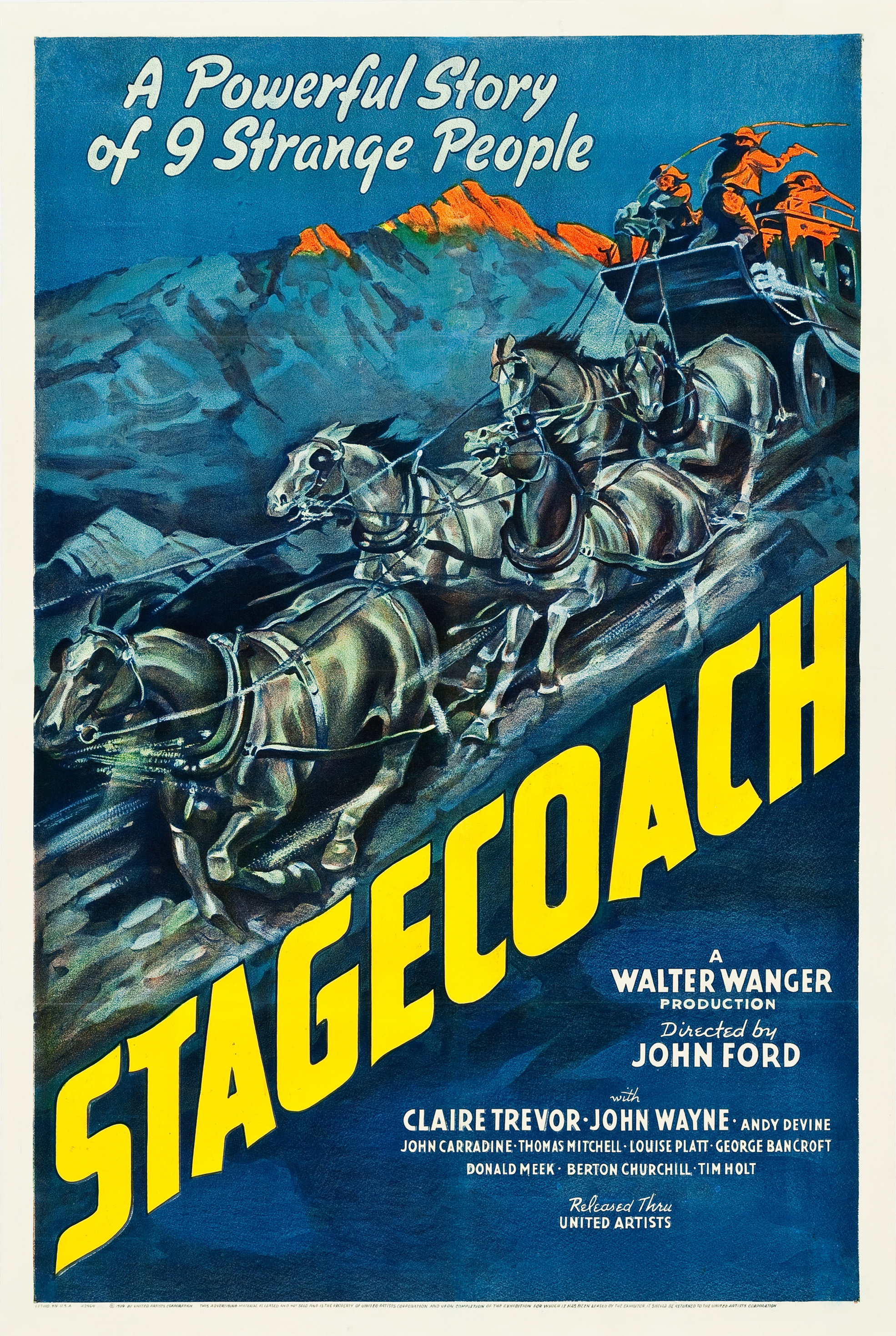
In 1880, a stagecoach leaves Tonto for Lordsburg with driver Buck and a group of passengers who have little in common. Dallas has been driven out by respectable townspeople; Doc Boone drinks heavily; Lucy Mallory is traveling to join her cavalry husband; gambler Hatfield boards to protect her; and banker Gatewood carries a secret. Marshal Curley joins the journey while searching for the escaped Ringo Kid, whose family was killed by Luke Plummer. Ringo and Dallas grow close, but the coach is attacked before it reaches town. Ringo later confronts the Plummers, then escapes custody with Dallas after Curley and Boone let them ride away together.
The coach is a small social world whose members carry their reputations with them. Dallas has been expelled by a reform-minded crowd, while Lucy’s status initially earns courtesy without requiring her to prove anything. Doc Boone’s drinking makes him easy to dismiss, and Peacock’s mildness leaves him overlooked. The cramped seating forces these people into shared space before they have any reason to trust one another. Conversation, glances and practical needs gradually expose how quickly their assumptions change once each passenger depends on the others for safety.
Claire Trevor’s Dallas is introduced through other people’s judgment, but she is not defined by the town that rejects her. Her concern for Lucy during childbirth and her attention to the group’s vulnerable members give her a moral steadiness the so-called respectable passengers have not shown. John Wayne’s Ringo enters as an escaped prisoner with a clear grievance, yet the film makes his initial energy less about swagger than about a young man determined to confront the people who destroyed his family. Their connection develops in pauses during travel rather than in a separate romantic world.
The journey also rearranges masculine authority. Curley is both lawman and old friend to Ringo, a combination that lets him enforce custody without treating the younger man as a stranger. Boone’s professional identity appears almost lost beneath drink until Lucy goes into labor; then he can make himself useful and sober enough to deliver the baby. Hatfield’s old-fashioned chivalry is less secure: his protective gestures reveal a past connection with Lucy, but the journey tests whether his self-image can help anyone in the present.
Ford’s use of landscape gives the passengers’ enclosure a visual counterweight. The coach moves across broad stretches of open country, yet the route narrows the characters toward stations, water crossings and the destination they cannot simply choose to leave. Monument Valley’s cliffs and mesas create a scale larger than the travelers, while close views return attention to faces inside the vehicle. The geography is cinematic construction rather than a reliable map of a single continuous route, but that shifting terrain makes the trip feel exposed and precarious.
The attack on the coach is staged as a change in the group’s practical roles. The cavalry escort has already departed, ammunition becomes finite, and the same passengers who were strangers must respond together. Buck’s driving and Boone’s presence matter as much as the gunmen’s aim. The film’s action is tied to this particular vehicle and its fragile protection, not to an abstract battlefield. When the cavalry arrives, survival has depended on endurance and collaboration, but the rescue does not erase the cost of the passage.
The film’s Western conventions carry a historical limit that should remain visible. Its Apache characters are largely framed as a faceless threat to the travelers, a familiar Hollywood device that tells us more about the film’s period conventions than about Native people or history. Recognizing that framing does not require pretending the film depicts a balanced encounter. The passenger drama and frontier imagery can be discussed as crafted fiction while keeping its representation distinct from any account of Indigenous communities.
Lordsburg gathers the separate threads into direct outcomes: Lucy learns her husband will recover, Gatewood is exposed for stealing from his bank, and Ringo finally faces the Plummer brothers. His surrender to Curley appears to return him to the law, but the marshal and Boone arrange a last act of mercy by sending him and Dallas toward the border together. The film closes on that ride rather than on a declaration about what their life will become. The ending preserves the couple’s choice while leaving the journey ahead outside the frame. That modest escape is important to the film’s scale: its characters do not remake the town’s hierarchy or settle the larger frontier’s conflicts. They gain a short stretch of road beyond immediate authority. Ford lets the comic complicity of Curley and Boone soften the final image, though that warmth does not undo the earlier distinctions between who was welcomed aboard and who had to earn acceptance. The coach has functioned as a temporary community, but its passengers do not leave with equal reputations or prospects; the closing freedom belongs specifically to the pair the town had cast out.