
Behind the film
- Year
- 2015
- Director
- Tom McCarthy
- Writers
- Josh Singer, Tom McCarthy
- Genres
- Drama, Biographical
- Production
- Anonymous Content, Participant
- Country
- United States
- Cast
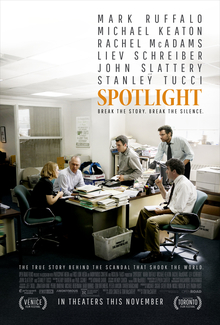
- Mark Ruffalo, Michael Keaton, Rachel McAdams, Liev Schreiber, John Slattery, Stanley Tucci, Brian d’Arcy James, Billy Crudup
About the film
Contains story spoilers.
Spotlight is set largely inside the Boston Globe newsroom in 2001, where incoming editor Marty Baron asks the paper’s investigative team to revisit allegations that Cardinal Bernard Law knew about abuse by priest John Geoghan. Walter “Robby” Robinson leads the Spotlight unit, whose reporters Sacha Pfeiffer, Michael Rezendes and Matt Carroll work over months rather than racing toward a single dramatic scoop. The investigation grows from an earlier Globe article about lawyer Mitchell Garabedian. Rezendes pursues an interview, and after Garabedian initially refuses, he identifies himself as a Spotlight reporter and wins the lawyer’s cooperation.
The reporters first approach the case as a story about one priest who had repeatedly been moved among parishes. Interviews with survivors and advice from Phil Saviano, who leads a victims’ group, help them see the pattern may be much wider. Psychotherapist Richard Sipe gives them an estimate of the number of abusive priests in Boston, and the team begins compiling names and checking them against church records and public documents. The investigative work is shown as sorting, cross-referencing and corroborating: a name on a list is not enough, and the reporters need a defensible account of how the archdiocese responded to allegations. The team’s different reporting styles create productive friction. Rezendes is persistent with reluctant sources, Pfeiffer earns access through repeated interviews, and Carroll works the documentary trail that can support what people tell them. Robby has an editor’s responsibility to let the investigation move while still examining the newspaper’s own earlier choices. The group has to turn an accumulation of separate accounts into a public explanation without flattening the people behind those records into statistics.
The story becomes more difficult as the scale expands. Carroll discovers a church facility near his own home used to house and treat priests accused of abuse, but he cannot tell his neighbors why he is asking questions. Pfeiffer finds that the reporting changes how she participates in her Catholic family life. Rezendes worries that a competing paper may publish a thin version of the story before they can establish the pattern. Robinson, who has personal ties to prominent Catholics, faces pressure from friends and acquaintances who want the investigation softened or stopped. Their private conflicts do not replace the evidence; they show the local relationships the reporters must navigate while keeping the work independent.
The Globe’s institutional choices matter too. Baron has come from outside Boston and does not share the same web of local connections, so he presses the team to follow the evidence even when it implicates respected figures. The investigation pauses when the September 11 attacks dominate the newsroom, then resumes after Garabedian points Rezendes to public court records and a letter warning Law about Geoghan. The team seeks to unseal more legal filings, and a judge’s decision gives them documentary support for a story about a broader cover-up rather than a set of disconnected accusations.
Before publication, Robinson remembers that a plaintiffs’ lawyer had given him a list of twenty accused priests in 1993, before he joined Spotlight. At the time he wrote only a smaller piece and did not pursue the larger implication. He admits the lapse to Baron, who does not pretend that journalists always get things right, but urges the team to finish the investigation they are now equipped to prove. The scene places institutional self-scrutiny inside the newsroom: the reporters are investigating failures by powerful organizations while also acknowledging that their own paper had previously missed an opportunity.
The articles run in January 2002 with links to source documents and a phone line for people with relevant experiences to contact the Globe. The newsroom is flooded with calls the next morning, revealing that readers have been waiting for a public space to tell what happened. The film ends with the paper’s reporting entering the community rather than with a private victory for the journalists. A textual coda records Bernard Law’s later resignation and lists other communities where major scandals came to light, widening the frame beyond Boston without diminishing the individual stories the team gathered.
Tom McCarthy’s film uses the rhythms of reporting as its central dramatic form: conversations, courthouse files, directories, phone calls and edits gradually change what the team thinks it knows. The city itself is part of the story, because the reporters encounter people they know through church, law, politics and family. The film is based on the Globe’s real investigation, but it is a scripted drama with compressed and arranged events; its characters are portraying real journalists and survivors, not serving as a complete record of every person or proceeding. Its focus stays on how evidence became publishable and how publication opened the door for more testimony. Michael Keaton’s measured approach and Mark Ruffalo’s more visibly urgent manner give the argument over publication a human shape. Both want the story told, but the difference between exposing a document and establishing a system creates pressure inside their shared purpose. Plain offices and crowded files keep that conflict close to the work, while interviews require the reporters to listen before deciding what an account means. The film’s tension therefore comes from whether the evidence will be understood and acted upon, rather than whether one journalist can produce a spectacular confrontation.