
Behind the film
- Year
- 2016
- Director
- M. Night Shyamalan
- Writers
- M. Night Shyamalan
- Genres
- Thriller, Horror, Psychological thriller, Crime
- Production
- Blumhouse Productions, Blinding Edge Pictures
- Country
- United States
- Cast
- James McAvoy, Anya Taylor-Joy, Betty Buckley, Haley Lu Richardson, Jessica Sula
About the film
Contains story spoilers.
Split puts its captives inside an environment where recognising their captor does not tell them how he will behave next. The danger includes physical confinement, but it also includes uncertainty about which encounter might provide an opportunity and which might make the situation worse. Casey has to observe without possessing a complete explanation, making attention an immediate survival skill. The film's suspense depends on that imbalance of knowledge. An audience receives information through several routes, while a teenager trying to escape must decide what a particular voice or response means before she can know whether acting upon that decision will help her.
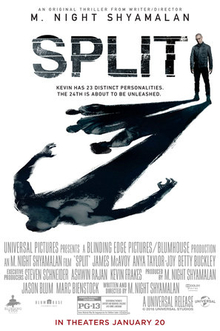
M. Night Shyamalan wrote and directed the film, which premiered in 2016 before its wider release in 2017. James McAvoy plays Kevin and his different identities, Anya Taylor-Joy plays Casey and Betty Buckley plays Dr Karen Fletcher. Haley Lu Richardson and Jessica Sula play the other captives, Claire and Marcia. The movie uses dissociative identity disorder within a supernatural thriller premise, eventually assigning abilities that belong to fantasy. It is not a reliable account of the condition or of people who live with it. The distinction is essential to understanding the story without generalising its violence or invented physical transformations into real-world claims.
Kevin abducts Casey, Claire and Marcia while Dr Fletcher becomes concerned about changes in her patient. The emerging Beast kills the therapist and the other captives, but spares Casey after recognising signs of suffering. She is found, although Kevin remains at large. A final diner scene introduces David Dunn from Unbreakable, placing the events within that film's fantastical world. The escape resolves Casey's immediate captivity without defeating the antagonist or supplying a complete answer to her situation. The ending also changes the larger framework in which the preceding threat is understood.
The captive scenes make cooperation difficult because the characters are not facing a single, consistently readable response. A possibility that looks useful can disappear when the next encounter follows different rules. This gives the story its immediate tension without making uncertainty itself a diagnosis. The useful dramatic question is how people act when they cannot predict the person controlling their surroundings. Casey's approach depends on listening and looking for an opening, while other approaches try to create one more directly. The narrative can show different responses to fear without establishing that a particular response would always be right for a real person in danger.
Dr Fletcher provides an outside perspective that is also incomplete. Her professional relationship supplies familiarity, but familiarity can become misleading when information is concealed. The film places her concern alongside the captives' urgent need, allowing viewers to see how separate encounters might connect before the characters can coordinate them. That arrangement makes recognition a race against time. It does not turn the invented outcome into a lesson about psychiatric practice. Within the thriller, an adult's attempt to understand a change is drawn into a danger that exceeds the movie's initially ordinary setting and belongs to its eventual supernatural explanation.
Casey's past introduces a sensitive connection between earlier harm and present survival. The film gives that connection a specific narrative use, but it should not be converted into a claim that suffering makes a person superior, more authentic or destined to survive. The Beast's judgement belongs to the antagonist's distorted moral system. Being selected by that system does not make the system valid, and being harmed does not confer an obligation to derive strength from it. Keeping those distinctions visible allows Casey's story to remain an account of a particular fictional survivor, rather than a general explanation of what abuse does or what victims should become.
The underground setting concentrates those pressures by restricting ordinary contact with the outside world. A conversation can feel like an opening because there are so few other ways to gather information or ask for help. The space therefore shapes the meaning of apparent intimacy. Knowing something about a captor does not turn captivity into a relationship freely chosen by both participants. The film's exchanges are best understood under that constraint: the teenager's attention is directed towards staying alive, and any sympathy or recognition occurs within an arrangement in which she has not been allowed to leave. Her situation remains coercive even when an encounter becomes less immediately hostile.
The Unbreakable connection reclassifies the story as part of a world where extraordinary physical possibilities are already fictional premises. That final shift is important, but it cannot by itself remove the implications of using a real condition to frame the earlier threat. Split needs both aspects kept in view: the mechanics of its survival thriller and the boundary between its fantasy and lived mental-health experience. Casey's escape offers a limited resolution, while the antagonist's continued presence leaves the larger conflict open. The movie's suspense can be explained without endorsing his ideas about purity, treating trauma as a reward or mistaking supernatural invention for a clinical possibility.