
Behind the film
- Year
- 2001
- Director
- Hayao Miyazaki
- Writers
- Hayao Miyazaki
- Runtime
- 2h 5m
- Genres
- Fantasy, Fantasy anime and manga, Children's, Coming-of-age
- Production
- Studio Ghibli
- Country
- Japan
About the film
Contains story spoilers.
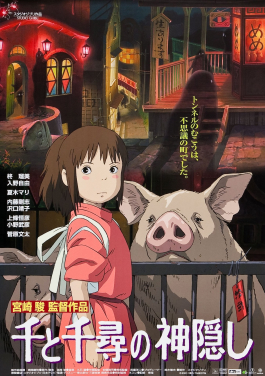
Chihiro is a ten-year-old girl on the way to a new home when her parents take a wrong turn and stop at what looks like an abandoned amusement area. They leave her behind to inspect the place, then find food laid out at an empty stall and begin eating. Chihiro wanders toward a huge bathhouse and meets Haku, a boy who tells her to cross the river before nightfall. By then spirits have begun to appear, and the way back has flooded. Her parents have become pigs. Chihiro is stranded in a world where humans are unwelcome, and she has to act quickly before she fades from view.
Haku helps Chihiro survive by telling her to ask Kamaji, the many-armed boiler worker, for a job. Kamaji sends Lin, one of the bathhouse workers, to take her to Yubaba, the sorceress who runs the business. Yubaba is intimidating and tries to frighten Chihiro away, but the girl persists until she is given a contract. Yubaba takes most of Chihiro’s name and renames her Sen. Haku warns that people who forget their names can lose the memory of who they were and remain in the spirit world. The name change turns a work agreement into a form of control: Sen can earn food and shelter only while remembering the identity her employer has reduced.
The bathhouse is a busy workplace with its own pecking order. Lin helps Sen learn the routines, and Kamaji keeps the boiler room running while soot sprites carry coal. Sen’s first major assignment is serving a foul-smelling customer who turns out to be a polluted river spirit clogged with debris. After she and the workers pull a bicycle and other rubbish from its body, the spirit leaves a healing dumpling for her. The bathhouse rewards this effort with a burst of celebration. Meanwhile, a quiet masked being called No-Face has followed Sen inside. She believes he is a customer and lets him in, unaware that the place’s appetite for gold and approval will soon change how he behaves.
No-Face offers gold to the workers, and their eagerness encourages him to demand more food and attention. He grows by consuming what the bathhouse gives him, then swallows workers who disappoint him. Sen refuses his gold and leaves to help Haku, who has been badly wounded while carrying a stolen seal. He appears in dragon form, pursued by paper spirits, and crashes into Yubaba’s rooms. One paper charm becomes Yubaba’s twin sister Zeniba, who explains that Haku stole her seal and is under a deadly curse. Sen feeds Haku part of the river spirit’s dumpling; he spits out the seal and a black slug that Sen crushes. She decides to return the seal and apologize to Zeniba herself.
Sen’s journey to Zeniba’s home is a quiet train ride over water, a striking change from the crowded bathhouse. No-Face and Boh, Yubaba’s baby transformed into a mouse, travel with her. At the cottage, Zeniba welcomes the group, accepts Sen’s apology and makes a hair tie with the help of the others. No-Face settles into a calmer role there, away from the bathhouse’s competition for wealth. Haku arrives to take Sen and Boh back. As she rides on his back, Sen remembers falling into a river as a child and being carried safely to shore. She recognizes Haku as the spirit of the Kohaku River, giving him the name he had forgotten and breaking Yubaba’s hold over him.
Back at the bathhouse, Yubaba sets one final condition before she will release Sen and her parents: Sen must identify them among a group of pigs. Sen looks carefully and says that none of them are her parents. Yubaba accepts the answer, the contract disappears and Sen’s real name is returned. Haku walks her to the dry riverbed, where he promises they will meet again. Chihiro crosses to the human side and finds her parents restored, though they have no memory of what happened. Their car is dusty and surrounded by leaves, suggesting that the passage of time has not been ordinary. Chihiro leaves with her family, still wearing the hair tie Zeniba gave her.
Miyazaki gives the spirit world practical routines: bathing, sweeping, serving food, carrying coal and following the house rules. That grounded work makes the fantastic feel inhabited rather than arranged as a series of tests for Chihiro. Spirits arrive with different shapes and needs, from the towering Radish Spirit to the river spirit hidden beneath mud and trash. The bathhouse’s scale lets the film move between crowded, noisy interiors and the broad stillness of the train crossing open water. These shifts also track Chihiro’s experience: at first she is overwhelmed by every new room and creature, while later she can travel through the same world with a clear purpose and steady attention.
Chihiro’s growth is visible in small decisions instead of speeches. She learns to ask for work, remembers her name when Yubaba wants her to forget it, and refuses the gold that makes No-Face more dangerous. She also notices people whom the bathhouse treats as problems: the river spirit, Haku, and eventually No-Face himself. The film does not explain every spirit or settle every question about how this place works. Its story stays with a child discovering that careful attention and kindness can matter even when no adult is there to guarantee a safe outcome. When she looks back at the tunnel, Chihiro carries a memory of the spirit world that the people around her cannot share.