
Behind the film
- Year
- 1994
- Director
- Jan de Bont
- Writers
- Graham Yost
- Runtime
- 1h 56m
- Genres
- Action thriller, Action, Adventure, Crime
- Production
- 20th Century Studios
- Country
- United States
- Cast
- Keanu Reeves, Sandra Bullock, Dennis Hopper, Jeff Daniels, Joe Morton, Alan Ruck, Beth Grant, Hawthorne James
About the film
Contains story spoilers.
Speed begins with a confined rescue before moving its danger into traffic. Los Angeles police officers Jack Traven and Harry Temple are called to an office building where an elevator full of people has been rigged to fall. The bomber is seeking money, but also wants to control the choices the officers make. Jack’s willingness to take an unexpected risk allows the trapped passengers to escape and frustrates the demand. During the confrontation that follows, Harry is taken hostage and Jack wounds his own partner to undermine the bomber’s leverage. The man appears to die in an explosion, leaving the officers with a celebrated success that proves less final than they believe.
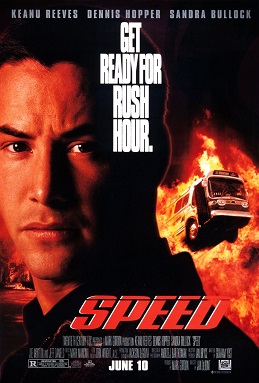
The bomber, Howard Payne, survives and devises a new situation specifically for Jack. A bus explodes nearby as a demonstration, followed by a warning about another vehicle carrying passengers. Its bomb will arm when the bus reaches fifty miles an hour and detonate if the speed drops below that threshold. Payne also forbids Jack to remove the people aboard. The premise turns the most ordinary features of city travel into potential causes of disaster. A traffic queue, sharp corner or red light no longer represents an inconvenience. Jack has to reach a moving vehicle, explain an almost unbelievable threat and keep people from acting on the reasonable instinct to stop.
The first complication comes from a passenger who assumes the arriving police officer is there to arrest him. His panic produces a gunshot that wounds the driver, forcing Annie Porter to take the wheel. Sandra Bullock’s Annie is neither a trained operative nor a passenger willing to become background to Jack’s work. She asks immediate questions, complains when a plan sounds impossible and keeps driving while the answers are incomplete. Keanu Reeves plays Jack with concentrated urgency, leaving explanations short because the next obstacle is already approaching. Their developing trust depends on doing separate tasks well: he can investigate the bomb and coordinate assistance only if she can keep the vehicle moving.
Payne’s control extends beyond the speed trigger. He follows the rescue through news coverage and reacts when someone tries to escape. Permission to remove the wounded driver briefly suggests negotiation might be possible, but another passenger’s desperate attempt to leave ends in death. The incident makes the people aboard conscious that improvisation has consequences beyond Jack and Annie’s intentions. Graham Yost’s screenplay keeps those passengers present through reactions, questions and moments of assistance, so the bus remains a shared predicament. Fear can spread through it quickly, but the same enclosed space also allows cooperation once the group understands what has to happen.
The city repeatedly creates problems that cannot be answered by courage alone. Jack and Annie need clear routes, help from officers outside and enough fuel to continue. A missing section of freeway forces an extraordinary jump, while the airport offers space to circle away from ordinary congestion. Jan de Bont’s direction keeps the vehicle’s movement visible against those surroundings, allowing the audience to understand why a particular turn or stretch of road matters. Jack’s attempt to reach the bomb from beneath the bus puts him close to the mechanism without giving him control of it. When the attempt damages the fuel tank, the open runway ceases to offer unlimited time.
Harry’s investigation identifies Payne as a former bomb-squad officer embittered by his retirement and the recognition he believes he was denied. Dennis Hopper gives that grievance a conversational ease that makes Payne’s violence more unsettling: he treats the rescue as a professional contest whose rules he has written. Harry leads a team into the bomber’s house, but a trap kills them. Jack’s loss is therefore personal as well as operational. His eventual recognition of a camera inside the bus supplies another possibility. By feeding Payne a repeated recording, the rescuers create a short period in which his apparent access to the passengers no longer reflects what is actually happening.
The passengers are moved to safety, leaving Jack and Annie to make their own escape before the empty bus crashes and explodes. The film does not end at that apparent release. Payne discovers the deception around the ransom exchange, abducts Annie and forces another confrontation in the subway. His attention remains fixed on Jack even when the original plan has failed. Their fight on the train kills Payne, but the damage to its controls leaves Jack with a further problem and Annie still unable to get free. He chooses to force a derailment rather than let the train continue towards the unfinished track. Their survival finally gives them room to acknowledge the attraction formed during the crisis.
De Bont and Yost organise the film around changing forms of confinement: the elevator, the bus and the train each restrict movement differently. Reeves’s Jack advances through practical decisions rather than elaborate declarations, while Bullock lets Annie’s humour coexist with a clear awareness of danger. Jeff Daniels makes Harry’s partnership with Jack feel established before the plot separates them, giving his later death weight beyond a new setback. Payne’s technical knowledge creates the traps, but his need to watch and control the response also becomes a vulnerability. The bus sequence sustains that contest through small adjustments in position, information and trust, making the passengers’ ordinary journey the centre of an unusually prolonged emergency.