
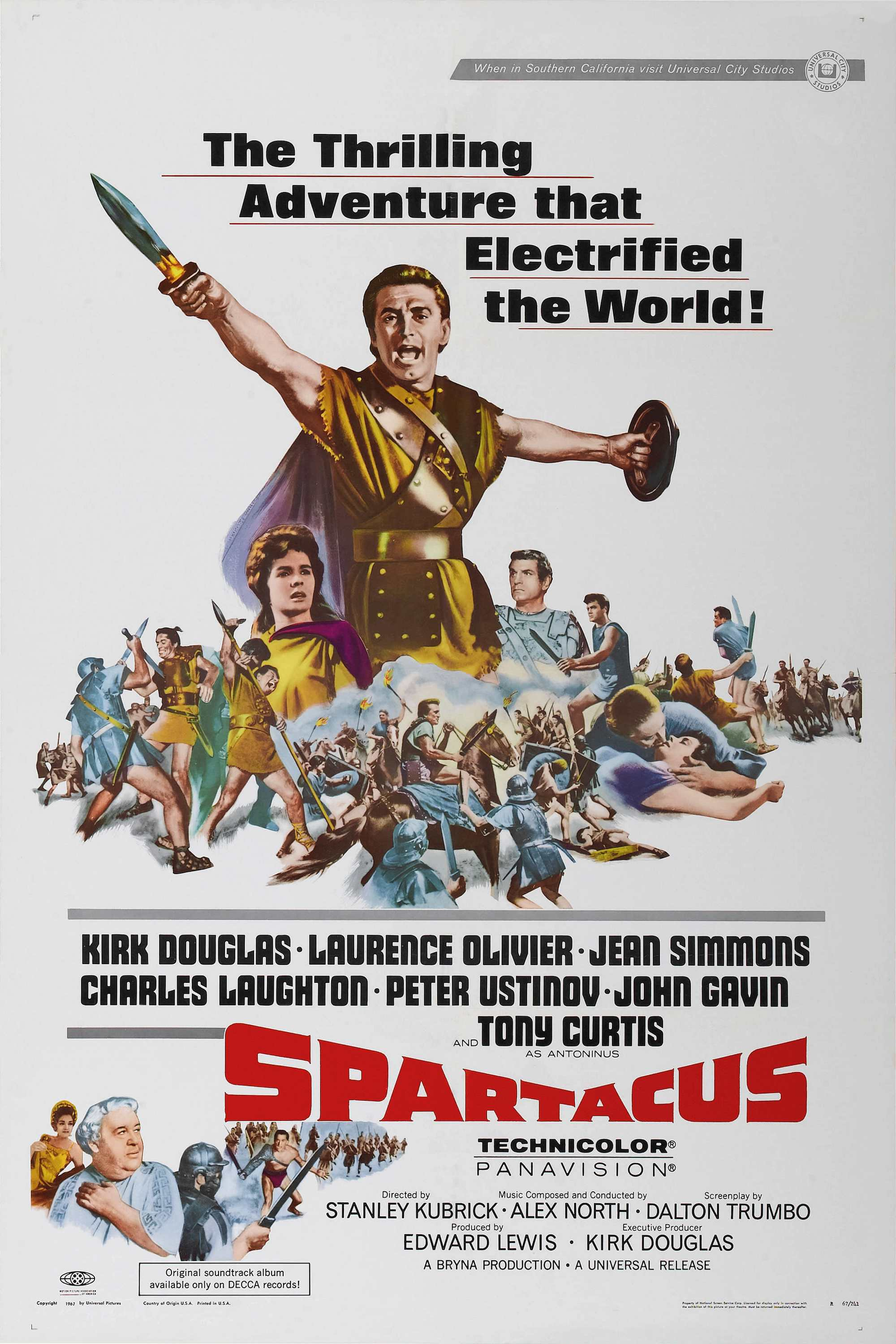
Behind the film
- Year
- 1960
- Director
- Stanley Kubrick
- Writers
- Dalton Trumbo
- Genres
- Drama, Romance, Historical, War
- Production
- Bryna Productions
- Country
- United States
- Cast
- Kirk Douglas, Laurence Olivier, Jean Simmons, Charles Laughton, Peter Ustinov, John Gavin, Tony Curtis, Nina Foch
About the film
Contains story spoilers.
The film begins in the Roman Republic, where a Thracian slave named Spartacus is sentenced to die of starvation after resisting the work imposed on him in a mining pit. A gladiatorial school owner, Lentulus Batiatus, sees a fierce fighter in him and purchases him for training at Capua. The school’s routines are meant to strip the men of choice and turn them into performers for Roman spectators. Spartacus forms a quiet bond with Varinia, a serving woman, and refuses to use her when she is sent to his cell for the amusement of others. Their affection begins as an act of mutual respect inside a system designed to deny it.
The wealthy senator Crassus visits Batiatus and buys Varinia, then arranges a private combat for his guests. Spartacus is paired against Draba, an Ethiopian gladiator. When Spartacus is disarmed, Draba refuses to kill him, attacks the Roman audience, and is killed by a guard and then Crassus. Varinia is sent to Rome, and the school’s tension breaks when trainer Marcellus taunts Spartacus about her. Spartacus drowns him in a pot of soup, setting off a riot. The gladiators overpower their guards and flee into the countryside, turning a personal act of rebellion into a mass escape.
The fugitives choose Spartacus as their leader. His aim is to get them out of Italy and back to their homes, so the growing group raids estates, collects resources, and negotiates for sea passage with Cilician pirates. More enslaved people join, including Varinia, who escaped while being taken to Crassus, and Antoninus, who fled Crassus’s service. Spartacus worries about his lack of education, yet proves able to organize people from different backgrounds into a self-sufficient community. Varinia becomes pregnant. The movement has become more than escape: its survival now threatens Roman authority, and the Senate’s argument over who should command the response turns the rebellion into a political contest.
Crassus wants the crisis to give him control of the Roman army, while his rival Gracchus tries to channel power through the young Julius Caesar. Gracchus has bribed the pirates to carry Spartacus away, but Caesar rejects the maneuver as dishonorable and shifts toward Crassus. Crassus then bribes the pirates himself and directs the legions to push the rebels inland, away from the coast. Rome fears that Spartacus will sack the city, and the Senate grants Crassus extraordinary authority. Surrounded, Spartacus tells his followers that resisting slavery has already shown their humanity. Most of the rebel army is killed in battle, but Rome cannot make the survivors identify their leader.
When the Romans offer pardon in exchange for identifying Spartacus, Antoninus cries that he is Spartacus, and the other captives repeat the declaration. Crassus orders them crucified along the Appian Way. He captures Varinia and her newborn son, and forces Spartacus and Antoninus to fight so the survivor can be crucified. Spartacus kills Antoninus to spare him that fate. Gracchus, seeing Rome sliding into tyranny, arranges through Batiatus for Varinia and the child to escape. As she passes Spartacus on the cross, Varinia shows him their son and promises he will grow up free and know his father. This fictional ending differs from the historical Spartacus’s death in battle.
The story keeps its intimate focus on choices inside spectacle: a gladiator spares an opponent, a slave refuses to dominate another, and a mass of condemned men refuses to save itself by naming one leader. Large battle scenes and crowded Roman spaces widen that moral conflict without replacing it with a documentary account of the ancient revolt. Varinia and Antoninus are fictional characters, and the film shapes historical figures into a drama about enslavement, loyalty, and political power. Its final image connects personal family love with the public violence of Roman punishment, leaving Spartacus physically defeated but present in the story his son will inherit.
Antoninus brings something different to the fugitives' camp. He is an entertainer rather than an experienced warrior, which puts the value of his abilities in question when survival appears to depend on fighting. Spartacus himself feels the limits of an upbringing without education. Their friendship opens a space for knowledge and feeling within a group Rome recognizes only as labor or weapons. That matters to the larger idea of liberation: being free would mean more than exchanging a slave's work for a soldier's duty. It would allow these people to decide what kind of lives their skills and relationships might sustain.
Kirk Douglas gives Spartacus a physical directness that sits against Laurence Olivier's controlled, possessive Crassus. Peter Ustinov's Batiatus occupies a smaller, more slippery position: he profits from the same system but lacks the command of the men who can determine Rome's future. Those differences keep the opposing interests recognizable when the film moves from cells and baths to massed armies. Its widescreen battle formations show the discipline and resources of the state; the closer scenes make power feel personal. A captive can be watched, bought, separated from someone he loves, or forced into violence even before a legion reaches him.