
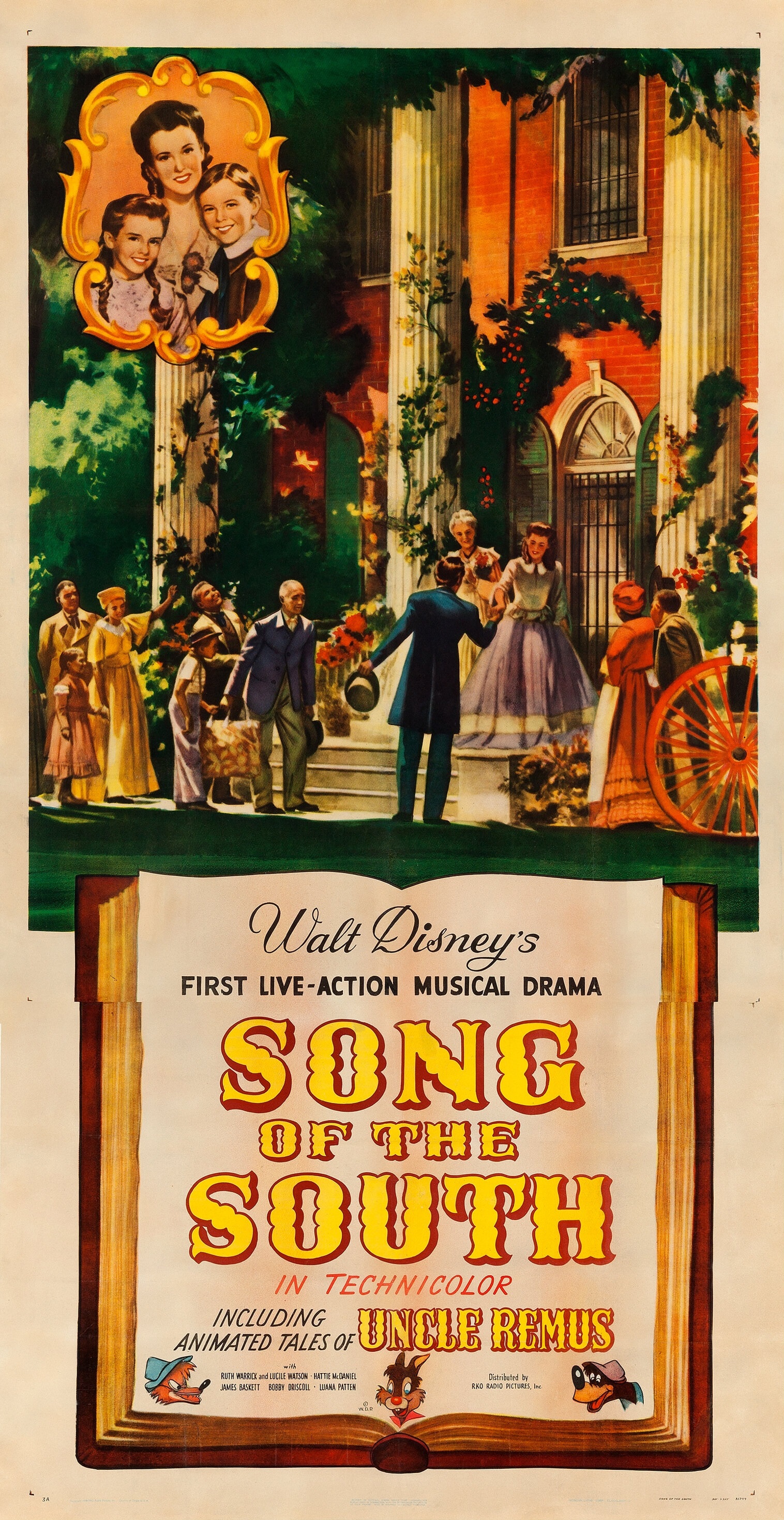
Behind the film
- Year
- 1946
- Director
- Harve Foster, Wilfred Jackson
- Writers
- Dalton Reymond, Morton Grant, Maurice Rapf, Bill Peet, George Stallings, Ralph Wright
- Runtime
- 1h 34m
- Genres
- Musical, Family, Live-action/animated, Drama
- Production
- Walt Disney Productions
- Country
- United States
- Cast
- James Baskett, Bobby Driscoll, Ruth Warrick, Luana Patten, Hattie McDaniel, Lucile Watson, Glenn Leedy, Mary Field
About the film
Contains story spoilers.
Song of the South brings storytelling into a child's family distress, using animated animal adventures to offer comfort within a live-action setting. The stories make frightening or confusing experiences easier to approach indirectly. A child can hear about a creature encountering trouble and begin to think about his own trouble without being required to explain everything first. That relationship gives the film its basic structure: one world contains the listeners, and another contains the tales they share. The connection between the two is central to its appeal, but the reassuring world of the listeners is also the source of its most serious limitations.
The 1946 Disney film combines live-action direction by Harve Foster with animation direction by Wilfred Jackson. James Baskett plays Uncle Remus and Bobby Driscoll plays Johnny, with Ruth Warrick, Luana Patten and Hattie McDaniel also in the cast. The animated stories draw on Joel Chandler Harris's Uncle Remus material. That adaptation creates a particular film version rather than a neutral presentation of folklore. Storytelling can carry imaginative value while the frame around it introduces its own assumptions about race, authority and whose problems deserve the narrative's fullest attention. Understanding the movie requires looking at that frame as well as at the animal adventures.
Johnny stays at his grandmother's plantation after his parents separate. Uncle Remus tells him Br'er Rabbit stories, and Johnny befriends Toby and Ginny. Misunderstandings lead Johnny's mother to restrict his contact with Remus. When Remus leaves, Johnny runs after him and is injured by a bull. His father returns, Remus visits and Johnny recovers, leading to reconciliation. The plot treats renewed storytelling and family reunion as sources of restoration. That outcome resolves the boy's immediate distress, but it should not be allowed to resolve questions about the social world the film has arranged around him.
The plantation is presented through a nostalgic and racially unequal frame. Warmth between selected characters does not establish that the wider arrangement is fair or benign. This is the distinction a responsible account must keep visible. A film can show affection while omitting the conditions that make some people's position subordinate to others'. It can also make a setting feel timeless by leaving its conflicts outside the view. The resulting reassurance should not be mistaken for historical knowledge. The movie's constructed picture of Black life and plantation relations is an object to examine, rather than an account to accept as the way that world was.
Uncle Remus's importance exposes the same imbalance at the level of character. His knowledge and storytelling are valued largely through what they offer Johnny, whose family crisis drives the live-action narrative. That position can give the storyteller a warm presence while restricting the independent life the audience is invited to imagine for him. The question is not whether his kindness has meaning inside the fiction. It is whether kindness has been made to stand in for a complete account of a person. Attending to that limitation allows Baskett's role to remain visible without using the character's affection to endorse the social frame surrounding it.
The animated tales work through a different scale of conflict, where ingenuity and an opponent's mistaken assumptions can change an outcome. That makes them useful to a child who has little control over adult decisions. A small figure can find a way through a situation that seems dominated by someone larger. The film links that possibility to Johnny's attempts to respond to his own circumstances. Yet advice drawn from a tale does not necessarily travel cleanly into another setting. The live-action misunderstandings show why an imaginative lesson and an actual relationship are not identical systems whose rules can simply be transferred.
The blend of animation and live action makes those transfers emotionally vivid. A listener's response can carry the tale back into everyday experience, while the appearance of animated figures beside live performers makes the boundary seem briefly permeable. Reading that formal device is useful because it explains how the film seeks to unite fantasy and reassurance. It also reveals why the frame deserves scrutiny: the imaginative charm does not remain in a sealed compartment. It lends warmth to the surrounding world, including elements of that world whose presentation is selective and whose implications cannot be settled by a happy ending.
Song of the South consequently needs an account that can hold artistic construction and racial representation together. Its songs, storytelling structure and combination of media explain what kind of film it is, while the plantation frame explains why a purely nostalgic description would be incomplete. The child's reconciliation is a fictional resolution, not evidence that the society around him was harmonious. Approaching the film through that distinction allows discussion without either reproducing its reassuring assumptions or pretending its imaginative methods are irrelevant. The central question becomes how entertainment can make a selective view of the past feel natural, and what a viewer needs to notice beyond that feeling.