
Behind the film
- Year
- 2001
- Director
- Karan Johar
- Writers
- Karan Johar, Sheena Parikh
- Genres
- Musical, Romance, Comedy, Drama
- Production
- Dharma Productions
- Country
- India
- Cast
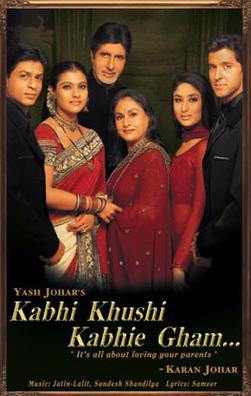
- Amitabh Bachchan, Jaya Bachchan, Shah Rukh Khan, Kajol, Hrithik Roshan, Kareena Kapoor, Farida Jalal, Rani Mukerji
About the film
Contains story spoilers.
Rahul, the adopted elder son of a wealthy family, falls in love with Anjali, whose background differs from his father Yash’s expectations. Rahul marries her and leaves home after Yash disowns him. Years later, younger brother Rohan learns what happened and goes to London, where Rahul has built a family life. Rohan’s attempt to reconnect the brothers eventually brings their parents into the same space, and Yash and Rahul reconcile. The film closes with the family reunited around new marriages.
The film treats the family home as both a private refuge and a public institution. Its rooms, ceremonies and rules give Yash’s authority a visible form, so the conflict between father and son is never only a disagreement in dialogue. Household order becomes a language: who is welcomed, who is expected to obey, and whose wishes can be spoken without consequence. The story’s emotional argument develops through this domestic architecture, where small gestures carry the history of a larger rupture. This makes domestic space a quiet participant in scenes where no one openly names the family hierarchy.
Rahul’s adoption adds a specific pressure to his relationship with his father. His gratitude and devotion are bound up with the secret he learned as a child, making obedience feel like a way to secure belonging. The film does not reduce him to that history, but it helps explain why a choice that seems ordinary to him can feel like a profound disloyalty to Yash. Shah Rukh Khan plays the adult Rahul with a controlled warmth that makes his independent life feel real rather than a temporary protest. The adopted-child detail gives the conflict emotional specificity without making Rahul’s gratitude his only trait.
Anjali’s Chandni Chowk background is staged as a vivid contrast to the Raichand household. The film uses bustle, comedy, food, crowds and domestic informality to give her family a distinct rhythm. That contrast can make class difference immediately legible to viewers, although the story remains centered on the experiences of an affluent family rather than offering a broad social portrait. Kajol’s energy keeps Anjali from being only a symbol of that difference: she carries humor and authority into spaces where others would prefer her to be quiet. The film values Anjali’s vitality while still framing her arrival through a wealthy household’s point of view.
Nandini provides the film’s emotional countercurrent. Jaya Bachchan’s performance often lets longing register before anyone explains it, and her connection to Rahul does not disappear when he leaves. She embodies the cost of Yash’s decision without taking over the story’s central conflict. The mother’s silence has texture: it can be a form of endurance, but it also shows the limited power she has within a household where the father’s word determines what counts as family loyalty. Her performance allows the family’s pain to register in ordinary gestures instead of extended explanation. This gives recognition a different rhythm from obedience. A mother can recognise a son through feeling while the household’s formal rules insist that his place is conditional. The contrast makes belonging both an emotional experience and a contested exercise of power.
Rohan’s role brings a younger, more playful energy to the reunion story. Hrithik Roshan’s physical confidence and Kareena Kapoor’s flamboyant Pooja help the London passages move with a lighter pace. Their songs and comic exchanges create a bridge to the melodrama rather than a break from it. The younger pair’s style is more openly performative, making generational change visible in clothes, music and movement. Yet their romance is not allowed to replace the older family wound; the reunion still depends on Rahul and Yash confronting what divided them. Their scenes use contrast in pace and style to make changing generations visible without abandoning the central rupture.
Music and dance turn private feeling into shared spectacle. Songs can shift from intimate emotion to a full ensemble, allowing family members and audiences to inhabit a feeling together. The film’s grand sets and coordinated choreography support that scale, but its most important emotional changes remain legible in faces and pauses. Karan Johar’s direction gives that emotional scale a polished visual frame. Characters can belong to an elaborate ensemble while a held expression makes one relationship the scene’s centre. The choreography turns collective emotion into a defining feature of the film’s family melodrama.
The title's paired feelings describe the movie's method: happiness is repeatedly shadowed by absence, while sadness is framed as something a family might carry together. Its extended melodrama gives recognition time to build through ceremony, repetition and heightened expression. The ending matters less as a claim that a family can return unchanged to its former order than as an acknowledgment that its members have suffered under that order. Affection has survived separation, but surviving is not the same as being respected. By bringing those two ideas back together, the conclusion asks parental authority to recognise the relationship it had tried to define entirely on its own terms.