
Behind the film
- Year
- 2018
- Director
- Ron Howard
- Writers
- Lawrence Kasdan, Jonathan Kasdan
- Runtime
- 2h 15m
- Genres
- Speculative fiction, Science fiction, Space western, Action
- Production
- Lucasfilm
- Country
- United States
- Cast
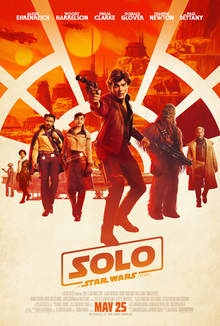
- Alden Ehrenreich, Emilia Clarke, Donald Glover, Woody Harrelson, Joonas Suotamo, Thandie Newton, Paul Bettany, Phoebe Waller-Bridge
About the film
Contains story spoilers.
On industrial Corellia, Han and Qi’ra try to escape the White Worms, the local gang that controls their lives. Han gets away but she is captured, so he joins the Imperial military and promises to return. Years later, on Mimban, he meets smuggler Tobias Beckett and the Wookiee Chewbacca; after escaping together, Han joins a coaxium theft that goes wrong when Enfys Nest’s Cloud Riders attack and Beckett’s partners Val and Rio die. Reunited with Qi’ra, now serving crime lord Dryden Vos, Han proposes stealing coaxium from Kessel. Lando Calrissian lends the Millennium Falcon, and the crew escapes the mines through the dangerous Kessel Run, though L3-37 is fatally damaged. On Savareen, Enfys reveals her rebel cause and Beckett betrays the group. Qi’ra kills Dryden and contacts his superior Maul, while Han kills Beckett, gives the coaxium to Enfys, and wins the Falcon from Lando before leaving with Chewbacca.
The origin story is interested in how confidence develops before experience can justify it. Han’s willingness to take a chance looks useful, but it also leaves him vulnerable to people who understand the surrounding world better than he does. That makes the adventure an apprenticeship in judgment. Freedom is attractive partly because he has known constraint, yet acquiring freedom requires relationships that can impose new obligations. The contradiction prevents independence from being a simple matter of leaving one place behind. Read through Han’s changing position, the film asks whether a person can learn caution without losing generosity, and whether becoming harder to deceive must also mean becoming less willing to trust.
Chewbacca supplies a different foundation for that learning. Their developing partnership can be understood as a practical demonstration that cooperation need not begin with identical backgrounds or ambitions. What matters is the willingness to recognise another person’s agency and respond when it is needed. That makes friendship more useful than an abstract assurance that somebody is loyal. The pair’s relationship develops through action, allowing shared capability to become a reason for shared confidence. In a world where arrangements are often temporary, that continuity gains weight. Han’s freedom does not require solitude; it can depend on a companion whose judgment remains distinct from his own and whose presence makes more possibilities reachable.
Beckett’s influence offers the appeal and danger of an experienced guide. Practical advice can explain how to survive while quietly defining what survival is allowed to cost. If distrust is treated as the only intelligent response, abandoning another person can begin to look like foresight rather than betrayal. Read in relation to Han’s uncertainty, that lesson is especially tempting because it promises protection from disappointment. The emotional question is whether the young man can accept the usefulness of caution without accepting its most corrosive conclusion. An apprenticeship does not have to end in imitation. The film makes experience a resource to examine, leaving its protagonist responsible for deciding which parts of another person’s code he will carry forward.
The heist structure gives those relationships a practical test. A crew exists because no individual has every ability an operation requires, and that dependence creates openings for both trust and exploitation. Everybody contributes while remaining capable of imagining a separate reward. The result is a useful world for a character still learning how promises work. A plan can align interests without making them identical, so apparent cooperation may conceal incompatible futures. The adventure’s momentum comes partly from that instability. Each successful step can bring the group closer to an objective while making the question of ownership more urgent. Getting something valuable is only the beginning of deciding who has the right to keep it.
Qi’ra complicates Han’s hope that an old connection can restore an old future. Their shared past remains meaningful, but it cannot guarantee that they now understand safety or ambition in the same way. That distinction makes reunion emotionally uncertain before any practical problem intrudes. He can recognise the person he remembers without knowing the life she has had to create since then. Read through their relationship, the film asks whether affection can survive the discovery that someone’s choices no longer lead towards the destination once imagined together. Qi’ra’s importance lies in retaining a direction of her own. She is not simply a reward for Han’s persistence, and his growing independence cannot require her future to become its proof.
The film’s look connects a wide space-fantasy setting to the tactile language of a western caper. Corellia’s enclosed industrial passages, Mimban’s muddy battlefield, the Falcon’s worn interior, and Dryden’s carefully composed yacht all express different forms of constraint. The spacecraft are not anonymous transport: the Falcon’s modifications and L3’s integration of navigation data become visible histories. The Kessel sequence makes the ship’s familiar silhouette feel earned through a tight flight through an uncharted route, balancing practical cockpit work with the scale of the surrounding danger.
The ending leaves freedom connected to a choice about generosity. Han can decline a larger commitment while still deciding that a particular cause deserves help, and that distinction preserves his uneven relationship with idealism. The story does not need to turn him into a fully committed hero for his judgment to matter. His future can remain open while an individual decision exposes something more hopeful than the caution he has been taught. Read this way, the origin story concerns the boundaries of cynicism. A person may learn that promises are unreliable and still find reasons to act for somebody else. Han’s emerging identity carries that possibility alongside his appetite for the next opportunity.