
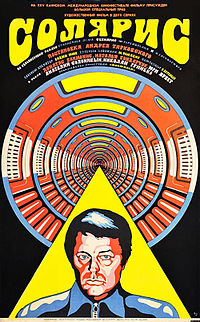
Behind the film
- Year
- 1972
- Director
- Andrei Tarkovsky
- Writers
- Andrei Tarkovsky, Friedrich Gorenstein
- Genres
- Science fiction, Adventure, Art, Drama
- Production
- Mosfilm
- Country
- Soviet Union
- Cast
- Donatas Banionis, Natalya Bondarchuk, Jüri Järvet, Anatoly Solonitsyn, Nikolai Grinko, Vladislav Dvorzhetsky, Olga Barnet, Sos Sargsyan
About the film
Contains story spoilers.
Solaris makes an encounter with an alien world inseparable from an encounter with a human conscience. The planet is covered by an ocean that resists the researchers’ attempts to understand it, but the film spends much of its time with people who are equally difficult for one another to understand. Andrei Tarkovsky’s 1972 adaptation of Stanisław Lem’s novel, scripted with Friedrich Gorenstein, follows psychologist Kris Kelvin into that double uncertainty. Kelvin arrives with a professional task: assess a research station whose work has become troubled. His own memories soon become part of the situation he is supposed to evaluate. The film’s question is therefore larger than whether the ocean is intelligent. It asks what a person does when private thoughts acquire a presence that can look back, speak and suffer.
Kelvin leaves his father’s country home and reaches a station where Gibarian has died by suicide and Snaut and Sartorius are dealing with unexplained visitors. One appears to Kelvin as Hari, his wife who died years earlier. He sends her away in a spacecraft, but another Hari appears. The scientists believe the visitors are generated from memory through the ocean’s activity. This Hari develops awareness of her situation and seeks death, yet her body can regenerate. She eventually asks the scientists to destroy her while Kelvin is ill. Afterwards the visitors stop appearing, and islands develop on Solaris. The final image seems to return Kelvin to his father’s house until the camera reveals the home standing on one of those islands.
Hari’s presence prevents the film from treating a materialised memory as a simple wish fulfilled. Natalya Bondarchuk plays a being whose connection to Kelvin gives her an identity before she has had a chance to discover it for herself. The original woman’s history is something other people can tell her, but that does not make it her own experience. Kelvin’s feelings combine recognition with awareness of the difference, placing affection beside responsibility and guilt. A familiar face can invite him to repeat an old relationship instead of asking what the person now before him needs. As Hari becomes more conscious of her circumstances, the problem moves beyond Kelvin’s personal loss. The visitor has a position in the present that cannot be fully explained by the memories from which she came.
The scientists respond to that problem in different ways. Sartorius approaches the visitors through their physical composition and the possibility of removing them. Snaut is more entangled in the uncomfortable everyday reality of living beside them. Kelvin finds it harder to maintain the professional distance with which he arrived. The station becomes a place where scientific language and emotional experience keep failing to account for one another. Determining that a body is unusual does not settle whether its suffering matters. Feeling love for that body does not settle whether the relationship is free or fair. The film allows those questions to remain in the room during ordinary interactions, so uncertainty becomes part of daily life rather than a single revelation that the characters can process and leave behind.
Tarkovsky establishes Earth at length before moving into space, giving Kelvin a home to lose and an audience a set of textures to remember. Water, vegetation and the familiar country house offer a different kind of space from the station’s enclosed interiors. The contrast makes a journey across an enormous distance feel like a narrowing of the world. On the station, the past remains available through images, objects and returning people, yet those traces cannot reproduce an ordinary life without distortion. The rooms must accommodate research and the private disturbance of its researchers at once. An investigation that might have promised access to something wholly unfamiliar keeps producing reminders of what its investigators brought with them. Home becomes part of the mystery rather than a stable point outside it.
The film also gives human culture a place inside that unfamiliar setting. Paintings, remembered scenes and music carry associations that scientific instruments cannot record. Bach and Eduard Artemyev’s electronic music provide different kinds of sound around a world suspended between recollection and discovery. Long passages and deliberate movement give the characters’ hesitation time to become visible. Donatas Banionis’s Kelvin is often trying to respond to an event whose emotional meaning arrives before its explanation. The pace makes room for a look, a silence or a change in physical proximity to alter the relationship. The result is a space story in which waiting and staying with someone can matter as much as travelling somewhere new. Understanding is presented as an unstable activity, with the person attempting it changed by the attempt.
The final return to the house brings those strands together without supplying a reassuring explanation. A familiar image can be real as an experience and still exist in conditions Kelvin does not understand. The camera’s withdrawal changes the apparent scale of the moment: an intimate reunion sits within the alien ocean’s wider activity. It leaves open whether this is reconciliation, refuge or another expression of his need, rather than certifying that the past has been repaired. This entry concerns Tarkovsky’s Soviet film, not the later Steven Soderbergh adaptation. Its distinctive territory is the relationship between memory and obligation: what people seek in another world, what they carry into it, and whether recognising something they love gives them the right to decide what it is.