
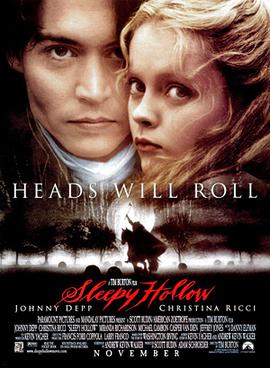
Behind the film
- Year
- 1999
- Director
- Tim Burton
- Writers
- Andrew Kevin Walker
- Runtime
- 1h 45m
- Genres
- Gothic, Fantasy, Mystery, Slasher
- Production
- American Zoetrope, Paramount Pictures, Mandalay Entertainment
- Country
- United States
- Cast
- Johnny Depp, Christina Ricci, Miranda Richardson, Michael Gambon, Casper Van Dien, Jeffrey Jones, Christopher Walken, Ian McDiarmid
About the film
Contains story spoilers.
In 1799, New York constable Ichabod Crane investigates a series of decapitations in Sleepy Hollow. He doubts the villagers' belief in a headless Hessian horseman until he witnesses the killer himself. Staying with Baltus Van Tassel, he grows close to Katrina and gains an assistant in young Masbath. The murders lead towards an inheritance conspiracy, while a missing skull explains how someone can command the Horseman. Ichabod suspects Baltus, then Katrina, but discovers that her charms are protective and that her stepmother has faked her death. Lady Van Tassel reveals a revenge scheme aimed at taking the estates whose owners dispossessed her family. She summons the Horseman against Katrina. Ichabod recovers the stolen skull and returns it, breaking Lady Van Tassel's control. The restored Hessian takes her into the supernatural realm, and Ichabod leaves for New York with Katrina and Masbath.
Sleepy Hollow makes the investigator's confidence an entertainingly fragile instrument. Ichabod believes a better method should produce a better answer, but his body does not always cooperate with the composure that belief seems to require. Johnny Depp gives him a careful, fastidious manner interrupted by alarm and embarrassment. This allows the mystery to be frightening without treating its lead as a fearless guide. Inquiry becomes an effort someone makes despite fear rather than a condition in which fear has been eliminated. Burton finds humour in that effort, bringing an unusually delicate hero into a world whose violence is visually blunt.
The village's Gothic appearance gives uncertainty a physical setting. Buildings, woods and interiors seem to keep parts of the world hidden even when they are plainly in view. Space can be richly detailed while refusing to feel fully knowable. That is a useful match for a story in which social respectability conceals conflicting interests. Ichabod arrives expecting to distinguish a credible account from a superstition, but the environment encourages unease before either has been settled. The film's design does more than decorate the investigation. It makes the audience share the difficulty of deciding which visible detail is evidence, which is a warning and which belongs to somebody's performance of authority.
Katrina offers another way of relating to that environment. Christina Ricci gives her a composure that contrasts with Ichabod's anxious attention, making confidence something that need not take the form of scientific explanation. Their attraction develops through different habits of understanding rather than through simple agreement. Ichabod has to distinguish unfamiliarity from danger if he is to understand her properly. This connects the romance to the mystery's larger problem: an interpretation can be orderly and still be mistaken. Burton gives their exchanges a softer register than the murders around them, letting curiosity become a means of attachment as well as a professional task.
The town's leading figures make secrecy feel institutional rather than purely supernatural. Their status gives them reasons to expect control over what an outsider sees, while their competing interests complicate the story they present together. The investigation therefore has to move through relationships as well as bodies and objects. Respectability is an uncertain clue. A person can occupy a role associated with knowledge or moral authority without deserving the trust that role invites. The film uses that possibility to give its fantastic threat a human setting, connecting the frightening apparition to ordinary desires for security, wealth and the ability to decide what another person is permitted to know.
The Horseman supplies a very different kind of presence from the nervous investigator. His violence is direct and physical, while his incomplete form makes purpose harder to read. The contrast allows action and mystery to support each other: a visible attacker does not automatically explain the pattern of attacks. Burton stages the encounters with an exaggerated clarity that suits the film's nightmare quality, keeping their brutality close to elaborate visual invention. The result is a fairy-tale scale of horror rather than a restrained crime reconstruction. Its world can be attractive, absurd and appalling within the same sequence, making fascination an important companion to fear.
Ichabod's memories also complicate the claim that reason operates entirely outside personal history. What he chooses to believe is connected to what he has suffered and to the authority he has learned to distrust. The film makes that connection emotional without requiring him to abandon careful observation. His method becomes more useful when it allows for a world larger than his first explanation. Sleepy Hollow adapts Washington Irving's story freely, giving it a new murder mystery and a differently shaped protagonist. Its appeal lies in that mixture of inquiry and nightmare: a person determined to explain everything enters a richly imagined world that forces him to reconsider what explanation can include, and whom he is prepared to trust while seeking it. The contrast between Ichabod’s delicate manners and the Horseman’s force keeps their encounters visually distinctive, making intellectual uncertainty feel physically dangerous.