
Behind the film
- Year
- 1993
- Director
- Nora Ephron
- Writers
- Jeff Arch, David S. Ward, Nora Ephron
- Genres
- Romantic comedy, Comedy drama, Drama
- Production
- TriStar Pictures
- Country
- United States
- Cast
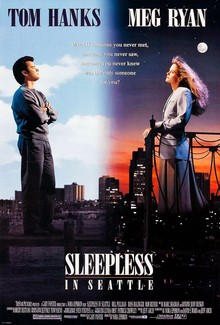
- Tom Hanks, Meg Ryan, Bill Pullman, Ross Malinger, Rosie O’Donnell, Victor Garber, Rita Wilson, Rob Reiner
About the film
Contains story spoilers.
After losing his wife Maggie, architect Sam moves from Chicago to Seattle with his son Jonah. Jonah calls a radio programme, drawing Sam into talking about his loss. Baltimore reporter Annie hears him and questions her engagement to Walter. Inspired by An Affair to Remember, she writes proposing a Valentine's Day meeting at the Empire State Building; friend Becky secretly sends it. Sam dates Victoria, while Jonah and Jessica answer Annie on his behalf. Annie travels to Seattle but mistakes Sam's sister for a girlfriend. Jonah later flies to New York, and Sam follows. Annie amicably ends her engagement, reaches the observation deck and finds Jonah's forgotten backpack. Returning for it, Sam and Jonah meet her. The three leave together, with the relationship's future still unwritten.
The film's unusual romantic arrangement is that longing develops before the central couple can build much shared experience. Nora Ephron makes that distance the foundation of the comedy rather than something to hurry past. Annie has a voice, an idea and her own response to both; those are powerful, but they do not amount to knowing a whole person. Sam, meanwhile, has a life whose emotional weight exists independently of what a stranger imagines about him. The two stories can therefore remain interesting on their own. Their possible connection gives the film direction, yet the immediate substance comes from people negotiating ordinary attachments, making embarrassing decisions and trying to understand what they actually want before they can sensibly offer it to anyone else.
Tom Hanks gives Sam a reserve that makes grief feel like something lived around rather than continuously announced. His affection for Maggie does not become a problem a new romance is required to erase. There is a difference between making room for the future and pretending the past no longer matters, and the film's emotional structure depends on that distinction. Sam can be funny, impatient and practical while carrying a loss that affects his sense of possibility. Parenthood also means he is never dealing with that uncertainty entirely alone. His private feelings have consequences inside a small household, where another person is watching, worrying and interpreting what he does. That makes the romantic question part of a family story rather than a simple search for a replacement partner.
Jonah's determination gives that household a restless energy. Ross Malinger's character wants to improve his father's life, but a child's desire for an answer does not provide an adult's understanding of how relationships form. The gap creates comedy without making his concern meaningless. A family can be full of affection and still contain incompatible ideas about what will help. Sam has to hold authority and vulnerability together: he is responsible for Jonah while also being someone Jonah wants to protect. Their exchanges make room for that reversal without permanently handing the child control of the parent's emotional life. It is an appealing fantasy of intervention, surrounded by enough friction to show why real care is more complicated than arranging the outcome you prefer.
Annie's problem is different because her existing life is not presented as an obvious catastrophe. Bill Pullman's Walter is a decent man, and that matters. If he were merely cruel or ridiculous, her uncertainty would have an easy explanation. Instead, Meg Ryan plays someone confronted by a more uncomfortable possibility: a sensible relationship may still leave her wanting something she cannot neatly defend. The comedy can notice her romantic projections without treating them as proof she is foolish about everything. She is trying to interpret a feeling while knowing how unconvincing its origins may sound. Her circumstances ask whether being able to explain a choice logically is the same as believing in it, and whether kindness between two people is sufficient grounds for promising a shared future.
Radio makes that question intimate in a peculiar way. Someone speaking without seeing the audience can sound unusually open, while listeners supply whatever picture of the speaker their own lives encourage. A mediated connection can feel private even when thousands of people receive the same words. That paradox suits a romance built around distance: Annie's response is particular to her, although its occasion is public. The film uses the situation to explore imagination as an active part of desire. People rarely approach love without stories, expectations or remembered examples already shaping what they notice. The danger is that those stories can become substitutes for attention; the possibility is that they can also expose a dissatisfaction someone has been politely refusing to acknowledge.
The old-film references make that process visible rather than hiding it inside the plot machinery. An Affair to Remember offers an image of romance with its own emotional authority, something that can be revisited, discussed and borrowed. Sleepless in Seattle allows characters to be moved by such images while leaving room to smile at how readily life gets measured against them. The conversations with friends give the fantasy a social setting: romantic certainty is debated, encouraged and punctured instead of existing only inside one person's head. That mixture helps the film avoid solemnity. A grand feeling can coexist with a ridiculous conversation, and neither automatically cancels the other. Love remains something people talk about through borrowed language while struggling to recognise their own experience.
The conclusion offers the pleasure of possibility without the evidence of a completed partnership. That distinction is easy to miss because romantic staging can make a beginning feel like an answer to everything. Here the accumulated distance makes recognition emotionally satisfying, but recognition is still the start of learning another person. Sam brings a history and a child; Annie brings decisions and responsibilities she cannot simply leave outside the frame. The film's generosity lies in allowing hope to matter before it can be proved correct. Its account of romance is less about demonstrating that perfect knowledge has arrived than about finding enough courage and openness for a new conversation. The uncertainty remains, now attached to people who can finally respond to each other directly.