
Behind the film
- Year
- 1996
- Director
- Barry Levinson
- Writers
- Barry Levinson
- Runtime
- 2h 30m
- Genres
- Crime, Neo-noir, Buddy, Rape and revenge
- Production
- PolyGram Filmed Entertainment, Propaganda Films, Baltimore Pictures
- Country
- United States
- Cast
- Kevin Bacon, Robert De Niro, Vittorio Gassman, Dustin Hoffman, Jason Patric, Brad Pitt, Brad Renfro, Minnie Driver
About the film
Contains story spoilers.
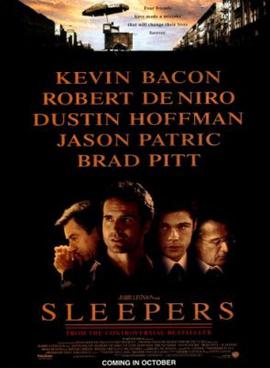
Barry Levinson wrote, produced and directed Sleepers, the 1996 crime drama adapted from Lorenzo Carcaterra's book. The film follows four childhood friends from New York's Hell's Kitchen into separate adult lives and a shared revenge scheme. Jason Patric plays Lorenzo, known as Shakes, and Brad Pitt plays Michael. Ron Eldard and Billy Crudup play John and Tommy, the friends whose encounter with a former guard triggers the adult story. Robert De Niro is Father Bobby, Dustin Hoffman is defence lawyer Danny Snyder and Kevin Bacon plays Sean Nokes. Their parts connect the neighbourhood, the institution that abuses the boys and the court where its consequences become public.
The boys' crime begins with a stolen hot-dog cart and ends with a stranger seriously injured when it rolls down subway stairs. Their punishment takes them away from the streets and relationships they know and sends them to Wilkinson Home for Boys. There, guards use their authority to subject them to physical and sexual abuse. The institution that is supposed to correct their behaviour instead gives its staff control over children who cannot safely resist. Years later, the accidental encounter with one of those guards brings the earlier violence back into the men's lives, turning a remembered childhood experience into the cause of a new crime.
John and Tommy have become criminals, while Michael works in the district attorney's office and Shakes works for a newspaper. When John and Tommy find Nokes in a restaurant, they confront him and shoot him dead. Witnesses see the killing, giving the subsequent case evidence that appears straightforward. Michael and Shakes nevertheless set out to save their friends and retaliate against the surviving guards. Carol, who knew them as children, and Father Bobby become involved, as does Snyder, the troubled lawyer defending the killers. The case reunites people who have followed different paths but remain connected by the childhood that preceded Wilkinson.
Michael prosecutes while secretly helping the defence. He prepares questions for Snyder, turning the formal opposition between the two lawyers into a coordinated plan. The aim is to undermine the murder evidence and bring the guards' abuse before the court. Ferguson, a former guard called as a witness, admits what happened at Wilkinson. Shakes also tells Father Bobby what the boys endured. The priest must decide whether to remain within the demands of truthful testimony or give the friends the alibi they need. The hearing depends on decisions prepared outside the courtroom.
Father Bobby testifies that John and Tommy were with him at a basketball game when Nokes was killed, supporting the invented alibi with ticket stubs. They are acquitted. The surviving guards face further consequences, while the friends meet with Carol to celebrate their victory. That gathering is their last together. Michael leaves the district attorney's office and becomes a carpenter in England; Shakes remains in the neighbourhood and begins reporting. John dies from alcohol poisoning and Tommy is murdered by rival criminals, both before thirty. The acquittal saves them from the immediate trial but does not give the group a lasting reunion or a shared future.
Michael Ballhaus designed a different approach for each period of the story. Hell's Kitchen has warm colour and longer lenses, presenting their surroundings as familiar and secure even when family life is difficult. Wilkinson reverses that scheme with short lenses, dark interiors and cool, blue tones. The adult section moves towards a more neutral appearance, between the warmth of childhood and the hostile institution. These changes distinguish the stages without relying only on the actors' ages. The friendships pass through spaces whose light and distance change as the boys lose the protection of their neighbourhood and enter adult life.
The courtroom uses a cool background with warmer light on the actors, and smoke makes beams of light visible. Flashbacks also interrupt testimony: a scene of Ferguson's abuse, originally filmed in colour, was projected and photographed again in black-and-white with handheld movements. That material became part of the trial sequence, placing an image of the past beside the guard's present account. Elsewhere, changes of camera speed extend the recognition of Nokes in the restaurant. The photography therefore marks both broad periods and individual moments when the men cannot experience the present without the intrusion of what happened to them as children.
Carcaterra's book was published as nonfiction, but its account was disputed. The church and school he attended and the Manhattan district attorney's office reported that they could find no records of a case matching it. Levinson said he believed Carcaterra after speaking with him, while describing his interest in how the prank, institutional abuse and adult revenge followed one another as a story. Producer Steve Golin brought him the book; Levinson first agreed to attempt the screenplay and then to direct. The film's dramatized events therefore belong to an adaptation of a contested account, whose claim to document actual lives remains separate from its narrative.