
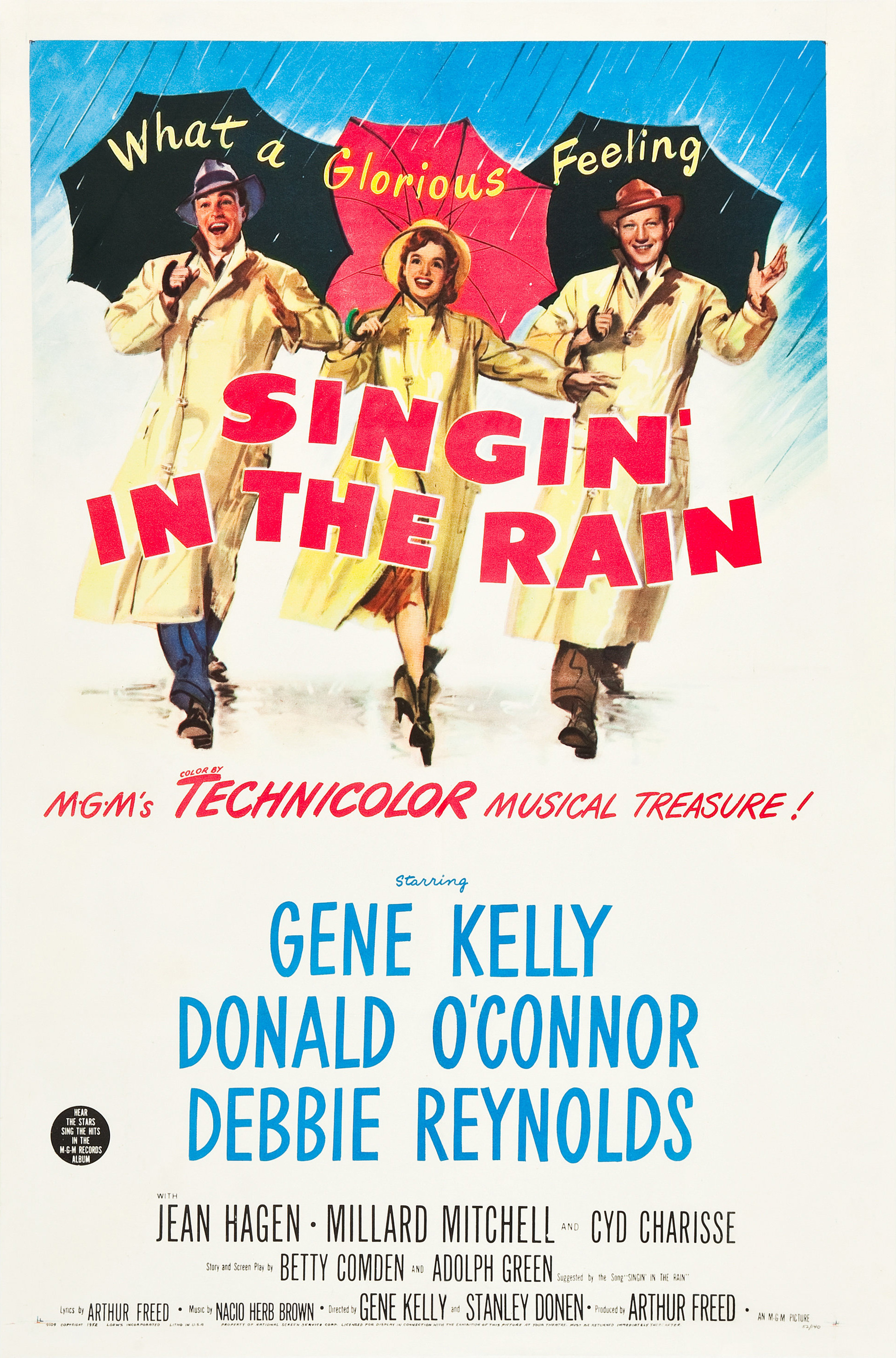
Behind the film
- Year
- 1952
- Director
- Gene Kelly, Stanley Donen
- Writers
- Betty Comden, Adolph Green
- Genres
- Romantic comedy, Musical, Comedy
- Production
- Metro-Goldwyn-Mayer
- Country
- United States
- Cast
- Gene Kelly, Donald O’Connor, Debbie Reynolds, Jean Hagen, Millard Mitchell, Cyd Charisse, Rita Moreno, Douglas Fowley
About the film
Contains story spoilers.
Singin' in the Rain takes place in a Hollywood where the machinery of fame suddenly needs a new kind of performer. Its studio stars have learned how to look convincing in silent films, while publicists manufacture romances and polished histories around them. Then recorded dialogue becomes a commercial necessity, exposing voices, habits and working methods that the silent screen could conceal. Gene Kelly and Stanley Donen direct this 1952 musical as a comedy about that transition, with a screenplay by Betty Comden and Adolph Green. Kelly plays Don Lockwood, a leading man whose elegant public biography bears little resemblance to the rougher apprenticeship that made him employable. The industry is already making stories about itself before sound arrives to complicate the process.
Don's screen partner Lina Lamont assumes their advertised romance is real. He falls instead for aspiring actress Kathy Selden, while his musician friend Cosmo Brown helps him navigate the studio. Their silent swashbuckler, The Duelling Cavalier, becomes a disastrous talking picture because of recording problems and Lina's voice. Don, Kathy and Cosmo propose remaking it as the musical The Dancing Cavalier, with Kathy dubbing Lina. Lina discovers the arrangement and uses her contract to demand that Kathy remain her concealed voice. At the premiere, a request for live singing forces the deception into public view: Kathy sings behind a curtain while Lina mouths the words, until the men raise the curtain. Don identifies Kathy as the real performer. The ending pairs Don and Kathy on a new film's billboard, giving her the visibility Lina intended to deny.
That hidden voice is the central professional problem, rather than simply a trick that makes Lina sound different. Kathy wants a career of her own, and accepting work behind somebody else's image risks making that career disappear. Lina understands the commercial power of her established name and tries to make another woman's labour permanently support it. Jean Hagen's performance gives this conflict both a comic surface and a contractual mechanism. Lina's misunderstanding of the romance does not prevent her understanding what leverage she has over the studio. The revelation at the premiere therefore changes more than Don's romantic circumstances. An audience is finally allowed to identify the person whose performance it has been enjoying, and Kathy can be recognized as an artist rather than an invisible repair to an existing star.
Don has his own relationship with manufactured appearances. The opening account of his dignified background is contradicted by images of vaudeville and stunt work. That difference establishes a distinction between having a talent and possessing the biography a studio can sell. His early encounter with Kathy unsettles him because she questions the status he takes for granted. Yet the film does not leave him stranded between a false public persona and a supposedly pure private self. His dance, physical control and experience really are abilities, even when publicity wraps them in invented gentility. Making the new musical allows him to use those abilities in a form that suits him. Sound disrupts his career, but it also creates an opportunity to make the labour behind his image visible.
The recording scenes give technological change an immediate physical shape. A microphone cannot simply be added to the old working routine without altering where an actor stands, how a costume behaves and what a scene sounds like. The failed preview turns that adjustment into public embarrassment. Problems that might seem small on a set become impossible to hide once an audience hears them together. Cosmo's role is to treat the failure as something that can be redesigned. Donald O'Connor makes him an inventive colleague as well as a comic partner: his musical and physical energy belongs to the work of finding another way through a problem. The film's studio consequently feels like a place where performance depends on technicians, collaborators and repeated experiments, even when the finished product advertises individual stars.
Its musical numbers let those ideas occupy space instead of remaining dialogue about an industry. Don's solo in the rain transforms an ordinary street into somewhere his happiness can take physical form. Water, pavement and an umbrella become things to play with rather than obstacles to getting home. 'Good Morning' makes a shared room the setting for the trio's movement together, while 'Make 'Em Laugh' gives Cosmo an environment he can turn into a physical comedy routine. The extended Broadway ballet goes further into an imagined performance, with Cyd Charisse appearing inside Don's proposed musical world. That sequence is not another event in his off-screen romance. It shows the scale of fantasy he wants the studio to put on screen, expanding a production discussion into its own theatrical experience.
The songs themselves connect the film's new story to an older catalogue associated with producer Arthur Freed and composer Nacio Herb Brown. Reworking existing material suits a plot in which a studio must remake what it already possesses to meet a changed audience. The result can criticize manufactured stardom while taking pleasure in the resources that manufacture makes available: designed spaces, coordinated movement, costumes and carefully organized sound. The final billboard does not suggest that Don and Kathy have escaped the film industry. They have found a different position within it, with Kathy's name and image acknowledged. Singin' in the Rain ends by presenting another piece of publicity, but now the person behind the voice has a place on the surface. The story's happy ending depends on changing who gets seen.