
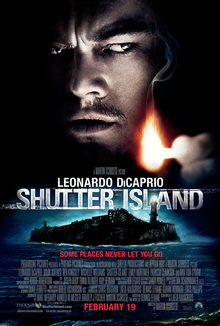
Behind the film
- Year
- 2010
- Director
- Martin Scorsese
- Writers
- Laeta Kalogridis
- Runtime
- 2h 18m
- Genres
- Thriller, Drama, Crime thriller, Crime
- Production
- Paramount Pictures, Columbia Pictures, Phoenix Pictures
- Country
- United States
- Cast
- Leonardo DiCaprio, Mark Ruffalo, Ben Kingsley, Michelle Williams, Emily Mortimer, Patricia Clarkson, Max von Sydow, Jackie Earle Haley
About the film
Contains story spoilers.
Shutter Island begins in 1954 aboard a ferry bound for a hospital on a remote island in Boston Harbor. U.S. Marshal Teddy Daniels and his new partner Chuck Aule are headed to Ashecliffe to investigate Rachel Solando’s disappearance. She was confined after drowning her children, yet apparently left a locked cell without a trace. The staff, led by Dr. Cawley and Dr. Naehring, give the marshals limited access to patient records, and Teddy quickly suspects they are concealing something. He also has a private reason for taking the assignment: he believes the arsonist who killed his wife Dolores may be a patient on the island. From the outset, the case combines official procedure with personal grief.
The investigation is complicated by the hospital’s strict routines and the storm approaching the island. Teddy and Chuck question staff and patients, but their answers do not settle the matter. A note left by Rachel asks where the sixty-seventh patient is, though the hospital insists that its count does not match that number. Teddy suffers migraines and vivid memories of the Dachau liberation, where he saw the aftermath of Nazi crimes, alongside dreams of Dolores. Those images blur with his present suspicions. He believes the doctors may be testing mind-control methods or preparing patients for lobotomies, and he treats each inconsistency as evidence of a conspiracy. Chuck, meanwhile, tries to work with him while the storm makes a return to the mainland impossible.
Teddy breaks into the restricted Ward C and meets George Noyce, a patient who warns him not to trust the doctors or Chuck. Noyce says Teddy has been manipulated and urges him to think about what the investigation is meant to accomplish. After the storm peaks, Teddy and Chuck make their way toward a lighthouse, believing it may hold evidence about the missing woman. Separated during the climb, Teddy believes he sees Chuck’s body below the cliffs. He instead finds a cave and meets a woman who claims to be the real Rachel Solando, a former psychiatrist who says the hospital committed her after she uncovered experiments. Her story seems to confirm Teddy’s fears, but the film keeps asking whether he is receiving evidence or encountering another piece of his own fractured understanding.
Teddy returns to the hospital and finds that staff deny Chuck ever came to the island. He pushes toward the lighthouse, convinced his partner is being held there, and overpowers Naehring when the doctor attempts to sedate him. In the lighthouse, Cawley finally explains that the Rachel Solando disappearance and Chuck partnership were part of an elaborate role-play designed to reach Teddy. “Teddy” is actually Andrew Laeddis, a former marshal who killed his wife Dolores after she drowned their three children. The real Chuck is Dr. Sheehan, his psychiatrist; the hospital staff had played along in hopes the investigation would let Andrew confront his memories and return to reality. His supposed conspiracy, including the missing patient clues, was built out of his own delusion.
Andrew initially recognizes what happened and recounts the truth, giving the doctors hope that the treatment has worked. Cawley says he had reached this point before and then relapsed. The last test comes later, when Andrew sits with Sheehan in the hospital grounds and appears to call him Chuck again. He says they must leave the island. Sheehan signals to Cawley, who orders the lobotomy because Andrew’s violent behavior toward patients and guards has made him dangerous. Before walking away with the orderlies, Andrew asks whether it is worse to live as a monster or die as a good man. His apparent confusion may be a return to the delusion, or a conscious choice to accept the operation rather than live with the truth; the film leaves that final motive for viewers to weigh.
The story’s design makes setting part of the mystery. The ferry, hospital wards, stormbound grounds, cliffs and lighthouse restrict Teddy’s movement while giving him new spaces to interpret as he searches for proof. The film’s flashbacks to war and his marriage arrive in vivid fragments rather than a calm chronology, mirroring the way he reconstructs his identity from grief and fear. A classical music soundtrack and the severe hospital architecture heighten the sense that each conversation may conceal a second meaning. These choices support the twist without turning every earlier scene into a simple trick: the investigation has emotional stakes even when its premise is revealed to be a treatment staged by the doctors.
The revelation changes the significance of the memories that have accompanied the investigation. Dolores’s appearances initially seem to express Teddy’s grief for a wife lost in a fire, but the recovered account includes the lakehouse, the drowned children and his own act of violence afterward. Andrew had failed to secure treatment for her, making his guilt larger than the moment in which he shot her. His imagined investigation gives him a different role: he can pursue somebody responsible for a death rather than acknowledge his place within the family’s catastrophe. Martin Scorsese’s adaptation of Dennis Lehane’s novel uses the hospital’s fictional procedures to bring those incompatible accounts together. The explanation supplies a coherent past, while the final conversation leaves the future less certain. Knowing what happened and choosing to continue living with that knowledge are separate questions, and Sheehan cannot be sure which one his patient’s last words have answered.