
Behind the film
- Year
- 2007
- Director
- Antoine Fuqua
- Writers
- Jonathan Lemkin
- Runtime
- 2h 4m
- Genres
- Action, Vigilante, Mystery, Political thriller
- Production
- di Bonaventura Pictures, Paramount Pictures
- Country
- United States
- Cast
- Mark Wahlberg, Danny Glover, Ned Beatty, Michael Peña, Kate Mara, Elias Koteas, Rhona Mitra, Rade Šerbedžija
About the film
Contains story spoilers.
Shooter builds its conspiracy around the usefulness of somebody who knows how an attack could be carried out. Bob Lee Swagger is approached because his experience can help identify a threat, but that same experience makes him a plausible person to blame when the threat becomes real. The invitation to protect a public figure conceals an arrangement in which protection and accusation have already been joined. Once the trap closes, he has to work against a version of himself that has been supplied to the authorities, making the pursuit a struggle over who gets to explain what his knowledge means.
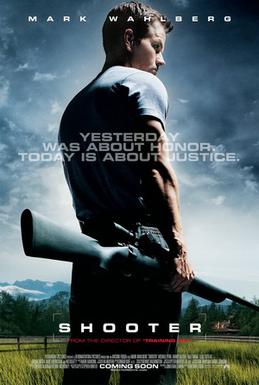
Antoine Fuqua directs the 2007 thriller, with Mark Wahlberg as Swagger, Michael Peña as FBI agent Nick Memphis, Danny Glover as Colonel Isaac Johnson and Kate Mara as Sarah Fenn. Jonathan Lemkin wrote the screenplay from Stephen Hunter's novel Point of Impact. The film makes a veteran's withdrawal from military service the starting point for his return to a world of compromised authority. His specialised competence is important to the action, but the story's larger interest is the separation between possessing information and having an institution willing to act honestly on it. The conspiracy depends on controlling both the event and its explanation.
Swagger is recruited to assess an apparent threat to the president. During the event, an Ethiopian archbishop is killed, Swagger is wounded and the blame is directed towards him. He escapes and receives help from Sarah, his dead partner's widow. Memphis becomes suspicious of the official account and joins him. Their investigation connects the killing to the suppression of evidence about a massacre serving commercial interests. Swagger eventually demonstrates that his supposed murder weapon could not have fired, clearing his name. The principal conspirators remain protected, however, and he kills them outside the legal process at the film's end.
The accusation works because the facts that make Swagger valuable can be reorganised into facts that make him suspicious. Expertise, preparation and presence become pieces of an apparently coherent story once somebody else controls their meaning. That creates a particularly frustrating position for the protagonist: he understands enough to see the trap, yet the surrounding system is being asked to understand him through the trap. His flight is therefore more than an effort to avoid arrest. It is an attempt to remain able to investigate while an official narrative threatens to remove every opportunity to challenge it.
Memphis provides a route towards that challenge from inside the pursuing institution. His suspicion matters because Swagger cannot simply supply a denial and expect it to outweigh the accusation. Somebody has to notice the account's weaknesses without first accepting that the wanted man must be telling the truth. The relationship develops through the investigation, connecting one man's knowledge of the operation with another man's willingness to question how it is being explained. Their cooperation gives the thriller an alternative to complete isolation, but it remains fragile because the people directing the cover-up can act against an investigator as well as a fugitive.
Sarah's involvement ties the present betrayal to a loss Swagger already carries. Seeking her help brings the conspiracy into a relationship shaped by his dead partner rather than leaving it confined to officials and operatives. It also makes helping him a decision with consequences for somebody who did not choose the assignment that trapped him. The film's pursuit expands through that exposure, showing how a conspiracy can threaten people connected to the person it wants to silence. His ability to survive does not mean that the people around him can remain safely outside the struggle while supporting him.
The commercial interests behind the operation change the apparent scale of the assassination. A public attack presented as an isolated act becomes part of an effort to prevent another story being told. That connection gives the investigation a larger moral object than Swagger's reputation alone. Clearing him would matter, but it would not automatically acknowledge the people whose deaths made the cover-up necessary. The film lets that distinction drive the later conflict, because the evidence needed to refute an accusation and the evidence needed to make powerful people answer for their conduct do not receive the same protection.
The ending separates exoneration from justice in an especially stark way. Swagger can defeat the account accusing him while remaining unable to secure an institutional reckoning with its authors. The revenge that follows is the film's fictional resolution of that failure, not a legal remedy or an endorsement of real-world vigilantism. Fuqua's action story finishes by allowing the protagonist to act where the system will not, leaving the pleasure of a conspiracy being defeated attached to a troubling condition: the truth has become clear enough to release its victim, but the powerful people who arranged the lie have still expected to escape its consequences.