
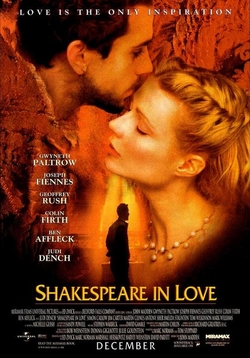
Behind the film
- Year
- 1998
- Director
- John Madden
- Writers
- Marc Norman, Tom Stoppard
- Runtime
- 2h 2m
- Genres
- Romantic comedy, Comedy drama, Drama, Biographical
- Production
- Universal Pictures, Miramax
- Country
- United Kingdom, United States
- Cast
- Gwyneth Paltrow, Joseph Fiennes, Geoffrey Rush, Judi Dench, Tom Wilkinson, Colin Firth, Ben Affleck, Rupert Everett
About the film
Contains story spoilers.
Shakespeare in Love imagines William Shakespeare as a working playwright in 1593 London, writing for Philip Henslowe’s Rose theatre and suffering from a block that has left him with the unpromising comedy Romeo and Ethel, the Pirate’s Daughter. Henslowe owes money to Fennyman, a lender with a direct stake in the theatre, and begins auditions before the play is ready. Shakespeare seeks help from Christopher Marlowe and tries to persuade rival impresario Richard Burbage to buy the script. The theatrical world is a business of debts, actors, patronage and censorship as much as inspiration.
Viola de Lesseps, a wealthy merchant’s daughter who has seen Shakespeare perform at court, disguises herself as Thomas Kent and auditions for a role women are barred from playing. Her speech from The Two Gentlemen of Verona impresses Shakespeare, though she runs before he can question her. He follows Kent to her home and begins rehearsals. At a ball, he meets Viola without recognizing her disguise at first; their attraction develops while her parents arrange her marriage to Lord Wessex, an aristocrat seeking money. Once Shakespeare discovers Kent’s identity, he and Viola begin an affair, and the blocked comedy changes into the story of Romeo and Juliet.
The play’s development draws the lovers into competing loyalties. Shakespeare and Viola rehearse with Ned Alleyn and Henslowe’s company, while Viola must appear at court to secure approval for her marriage. Shakespeare disguises himself to accompany her and persuades Wessex to wager fifty pounds that a play can capture the nature of love. Queen Elizabeth agrees to judge. Meanwhile, Burbage learns Shakespeare has seduced Rosaline and cheated him out of payment for a play, then storms into the Rose with his company. News that Marlowe has been murdered makes Shakespeare fear Wessex ordered the killing, though the film’s mistaken assumptions briefly send both lovers into imagined grief.
The Master of the Revels, Edmund Tilney, discovers that a woman has been acting at the Rose and closes the theatre. Viola’s identity is exposed, the company loses its stage and Shakespeare loses his Juliet. Burbage offers the Curtain, but the lawful marriage to Wessex remains in place. On the day of the wedding, Viola learns the play is being performed and runs to the theatre. The boy cast as Juliet has lost his treble voice, and Henslowe asks Viola to take the part. She appears opposite Shakespeare’s Romeo before a packed audience.
Tilney arrives after the performance to arrest the company for indecency, but Queen Elizabeth is in the audience and prevents him. She accepts Viola’s appearance as a remarkable resemblance to a man and awards Shakespeare the wager, while recognizing that she cannot undo Viola’s marriage. The Queen’s solution is a public fiction that lets the actors leave without rewriting the law that sent Viola toward Virginia. Viola must sail with Wessex to Virginia. Shakespeare and Viola say goodbye, and he imagines a new play beginning with a woman stranded after a voyage. Their separation supplies the final turn: the relationship ends, but the story transforms it into theatrical material.
The rehearsals reveal an unlikely company forming around the unfinished play. Ned Alleyn arrives as an established star and takes Mercutio, bringing professional pride into a room where the script is still changing. Fennyman, who initially regards the theatre as a debt to recover, becomes excited by the chance to act himself. His small part puts the financier inside the spectacle he wanted to profit from. Thomas Kent is originally Romeo, so the eventual performance requires more than exposing a disguise: Shakespeare moves into that role while Viola becomes Juliet. Their private relationship can be spoken openly only through characters whose lives are heading toward tragedy.
Shakespeare’s own circumstances complicate the romance beyond Viola’s engagement. A drunken Henslowe tells her that he is already married, although separated from his wife. Rosaline, the earlier object of his pursuit, has been sleeping with Tilney, connecting his frustrated personal life to the official who can close the theatre. Shakespeare also gives Wessex Marlowe’s name when challenged at Viola’s ball, which helps turn the later murder report into an apparent threat against the wrong man. At the church, his reappearance reassures Viola and terrifies Wessex, who thinks he is seeing a ghost. The comedy depends on concealment that repeatedly escapes the control of the people inventing it.
A boy called John Webster spies on Shakespeare and Viola together and reports them to Tilney, giving the censor a reason to close the Rose for violating the ban on women actors. At the Curtain, Webster later reveals that Wessex has followed Viola to the performance. After the Queen awards Shakespeare his wager, she tells him to write something more cheerful next time; the film imagines him picturing a woman called Viola shipwrecked in a strange land, the opening of Twelfth Night. That final link folds the fictional romance into the playwright’s future work while keeping the separation between Viola and Shakespeare intact.