
Behind the film
- Year
- 1943
- Director
- Alfred Hitchcock
- Writers
- Thornton Wilder, Sally Benson, Alma Reville
- Runtime
- 1h 48m
- Genres
- Thriller, Film noir, Drama, Mystery
- Production
- Universal Pictures
- Country
- United States
- Cast
- Teresa Wright, Joseph Cotten, Macdonald Carey, Patricia Collinge, Henry Travers, Wallace Ford, Hume Cronyn, Edna May Wonacott
About the film
Contains story spoilers.
Shadow of a Doubt makes the hoped-for interruption of ordinary life become its greatest threat. Young Charlie wants something to change, and her uncle's arrival appears to offer exactly that. His familiarity makes novelty reassuring: this is somebody who belongs to the family, so excitement seems able to enter without bringing the risks associated with a stranger. The film turns that expectation against her. Knowing a person's place within a household is not the same as knowing what they have done elsewhere, and the warmth through which they are welcomed can become an obstacle to recognising information that would make the welcome impossible to continue unchanged.
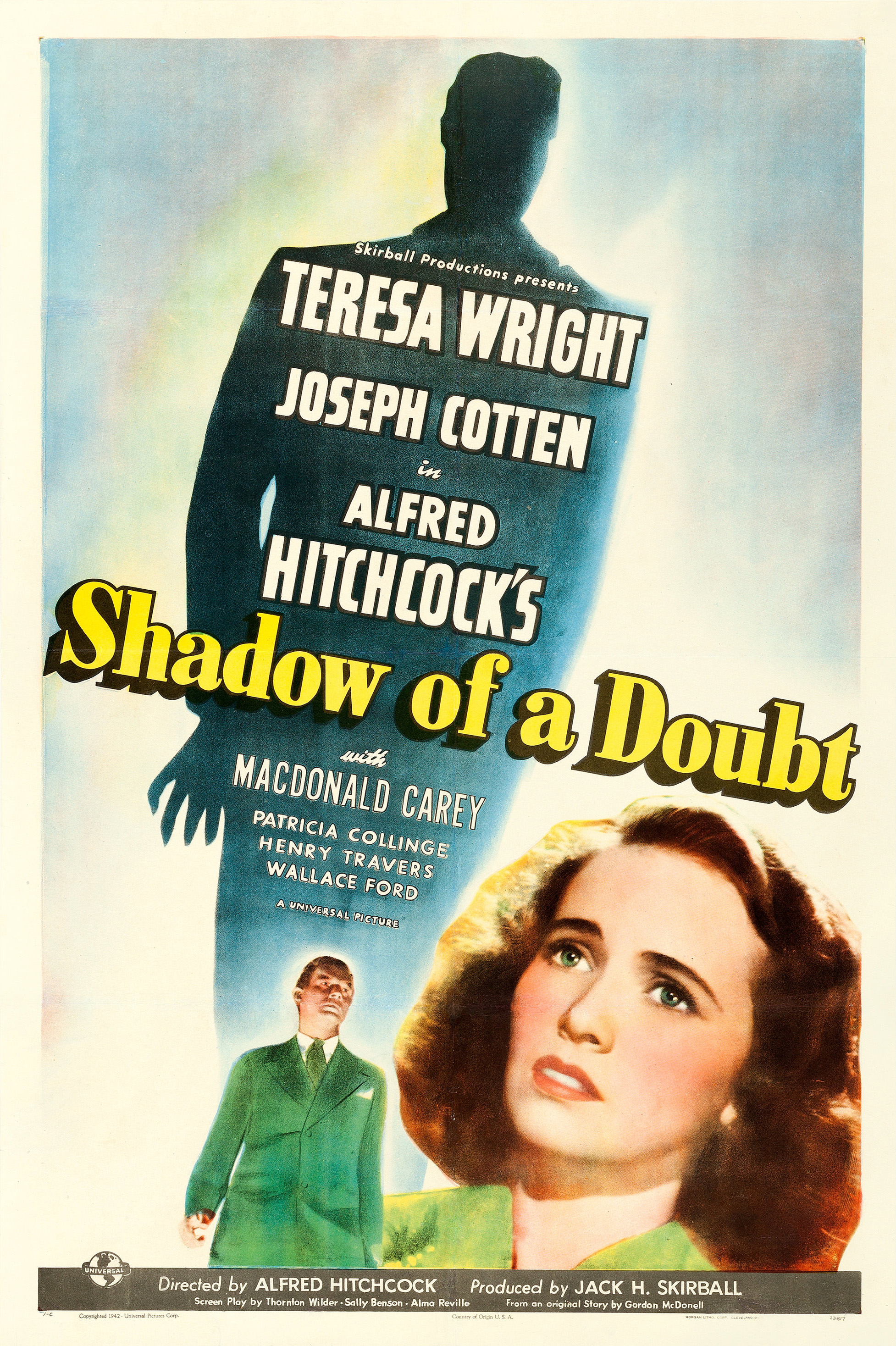
Alfred Hitchcock directs the 1943 thriller, starring Teresa Wright as the younger Charlie and Joseph Cotten as Uncle Charlie. Thornton Wilder, Sally Benson and Alma Reville wrote the screenplay from Gordon McDonell's story. Santa Rosa gives the danger an everyday environment of family life and neighbourhood attention. The setting matters because the criminal possibility does not arrive in a world already defined by crime. It has to be understood through a place whose ordinary habits encourage the assumption that familiar people are safe, making a dinner conversation or a gift carry a significance nobody initially expects it to contain.
Uncle Charlie arrives while evading detectives and gives his niece a ring with troubling initials. She connects it to a murder victim and grows convinced he is the wanted killer. He appeals to her wish to protect her mother, then tries to eliminate her when she continues to threaten his safety. During his departure, a struggle on a moving train ends with his death. The town honours him at the funeral, while the niece and a detective keep his crimes private. The ending leaves the public account intact even though the person who most admired him can no longer believe it.
The shared name makes the relationship unusually close before suspicion begins. Young Charlie can see her uncle as someone whose arrival confirms an affinity she already wants to believe in, which gives later recognition a cost beyond fear. She is not simply identifying a dangerous outsider. She is separating herself from a person whose importance has helped define her own expectations. The film makes that separation an education in the limits of identification. Feeling connected can encourage attention, but it can also make contradicting evidence harder to accept because the evidence threatens the account through which the connection first became meaningful.
The ring gives discovery a small, intimate scale. An object presented as generosity carries a history that does not belong to the household receiving it. That changes what possession means: a gift can bring another person's harm into a room while continuing to look like an expression of affection. The younger Charlie's attention matters because the contradiction is not announced by an obvious threat. It appears through something that should have been pleasing. The film uses that change to make looking more carefully feel dangerous. An explanation cannot be safely requested when the person who supplied the object has a reason to fear what the questioner might understand.
Protecting her mother gives secrecy an emotional justification that the uncle can exploit. Family loyalty appears to require shielding someone from distress, even when the distress would arise from learning a truth they have a stake in knowing. That is a difficult pressure because disclosure can genuinely hurt a person without making concealment harmless. The uncle's appeal turns affection into leverage, asking his niece to bear the consequences of knowledge so that the person he deceived can continue believing in him. The conflict makes the home a place where care and coercion can become entangled, rather than assuming that danger is confined to the world beyond its door.
The town's ordinary sociability also supplies an audience for the uncle's preferred image. Charm works through repeated small confirmations, making the familiar person appear more convincing than an accusation arriving from outside. The film does not have to portray every neighbour as foolish for that process to be disturbing. People usually know one another through limited encounters, and a consistent public performance can fill the gaps with reassurance. The niece's experience gradually breaks that reassurance for her without automatically changing what everyone else sees. Knowledge becomes isolating because the social world continues to recognise the person through the very appearance she has learned she cannot trust.
The funeral makes the separation between public honour and private truth explicit. Removing the immediate threat has not produced an honest shared account of the life being commemorated. Young Charlie remains within the community while carrying a knowledge that distinguishes her from its collective reassurance. Shadow of a Doubt builds its suspense through that difference, using a family visit to expose how affection can make evil harder to identify rather than guaranteeing protection against it. The ordinary world survives, but its meaning has changed for the person who looked closely enough to discover what the welcome contained, leaving safety and innocence as different outcomes rather than the same restored condition.