
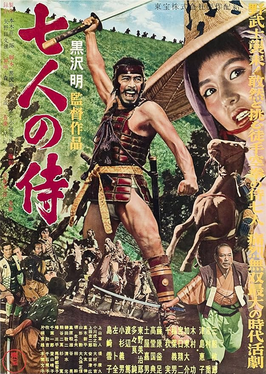
Behind the film
- Year
- 1954
- Director
- Akira Kurosawa
- Writers
- Akira Kurosawa, Shinobu Hashimoto, Hideo Oguni
- Runtime
- 3h 27m
- Genres
- Drama, Samurai cinema, Epic, Action
- Production
- Toho
- Country
- Japan
- Cast
- Takashi Shimura, Toshiro Mifune, Seiji Miyaguchi, Minoru Chiaki
About the film
Contains story spoilers.
Akira Kurosawa’s Seven Samurai is set in sixteenth-century Japan, where a village of farmers learns that bandits plan to raid it again after the next harvest. The threat is seasonal and material: the crops they grow are precisely what the armed riders intend to take, and the villagers have little means to resist. They decide to hire samurai, though they can offer only food rather than money. Their search leads them to Kambei, an experienced ronin who shaves his topknot and disguises himself as a monk to rescue a child held by a kidnapper. The farmers witness a man willing to risk his life for someone else, and ask him to lead their defense. That rescue introduces the film’s moral centre before its main battle begins: Kambei is skilled, but the quality the villagers need is judgement, an ability to see beyond status and act under pressure.
Kambei recruits a varied group of masterless warriors. The young Katsushiro follows him, eager to become a samurai; Gorobei proves a capable second-in-command; Shichiroji is an old companion; Heihachi and Kyuzo bring distinct temperaments and skills. Kikuchiyo, played by Toshiro Mifune, is an unruly man whose claim to samurai status is complicated by his peasant origins. The seven are not a perfectly coordinated unit from the start. They need to learn the village’s layout and assess which paths the bandits can use, while the farmers have to decide whether to trust men from a class associated with power and violence. The recruitment episodes give each warrior a distinct entrance and allow the film to broaden from a single leader’s decision into a collective story. The group’s shared purpose forms gradually, through observation and risk rather than instant fellowship.
When they reach the village, the samurai teach the residents how to defend themselves. Kambei’s plan uses the terrain: they strengthen selected boundaries, close vulnerable approaches and prepare barriers that can channel the attackers toward guarded points. The villagers are told to rally and work together, though fear and old grievances keep surfacing. Kikuchiyo becomes a bridge between the two groups because he understands the peasants’ suspicion and their capacity for courage. His anger at the samurai is not abstract; he points to their historical role in producing the hardship from which farmers suffer. That accusation complicates the familiar image of the warrior as automatic saviour. The seven may defend this village, but their social position has helped create the conditions in which the villagers are helpless. Kurosawa gives the preparation real narrative weight, so the audience can understand why a wall, a ditch or a decision about who stays behind matters once the attack begins.
The first clash tests the plan and teaches the bandits that the village will not surrender without resistance. The fights are not presented as elegant duels in clean space. Riders move through narrow lanes and villagers work beside the samurai; in the final battle, rain and mud make movement hazardous for everyone. The defenses impose a pattern on the action, but losses make clear that strategy cannot make war painless. Gorobei, Heihachi and Kyuzo are among those killed; Kikuchiyo is shot in the final struggle but kills the bandit leader before dying himself. The film keeps returning to the civilians who must live through the battle, not just the warriors whose deaths can be made heroic. The bandits’ horses and firearms grant them force, but the villagers’ numbers and carefully prepared ground help make resistance possible. The decisive victory comes from coordination across a community, not from a single swordsman’s brilliance.
When the fighting ends, the survivors bury their dead and the farmers return to planting rice. Kambei, Shichiroji and Katsushiro remain, but the village’s daily life moves forward without them. Kambei observes that the samurai have again lost while the farmers have won: the line captures the group’s position outside the future they helped secure. Katsushiro, who has fallen in love with Shino, cannot simply remain with her as if their relationship could dissolve class boundaries. The final image of the farmers working the fields, singing, places collective continuity against the samurai’s itinerant lives. Their victory is real, but it does not produce a lasting place for the men who won it. The ending resists a triumphal celebration and a tragic claim that the sacrifice was meaningless; the village is alive, and the warriors carry what they have lost.
Kurosawa’s staging makes the scale of the conflict legible through geography and movement. The recruiting section has an ensemble rhythm, with brief character introductions building a sense of distinct abilities before the group reaches the village. Once there, the map of roads, gates and fields becomes a practical framework for the defense. Multiple cameras capture the horse-bound attacks from different distances, allowing movement to remain readable even when the weather and bodies create visual chaos. The rain in the final battle is not simply dramatic decoration: mud slows the riders, blurs clean distinctions between planned and accidental movement, and makes the physical cost visible. The film was an unusually expensive production of its period, and its locations, reconstructed village and weaponry create a world that feels inhabited rather than ornamental. Its long duration gives recruitment and preparation as much room as the final combat.
The film’s influence is easy to see in the group-assembly structure later adopted by action stories, but its moral texture is harder to reduce to a template. These samurai have different motives, and the villagers are not a passive audience waiting to be saved. Their fear is rooted in vulnerability, but their actions become essential to the defense. Kikuchiyo exposes how a heroic warrior story can conceal social violence, while Kambei’s leadership is measured by his ability to organize people whose interests do not naturally align. The end brings the film back to the harvest the bandits wanted, now protected by those who will tend it. That return to work is a quiet victory, and it leaves the samurai outside the community they made possible.