
Behind the film
- Year
- 1995
- Director
- David Fincher
- Writers
- Andrew Kevin Walker
- Runtime
- 2h 6m
- Genres
- Crime, Mystery, Buddy cop, Drama
- Production
- New Line Cinema
- Country
- United States
- Cast
- Brad Pitt, Morgan Freeman, Gwyneth Paltrow, Kevin Spacey, R. Lee Ermey, John C. McGinley, Richard Roundtree, Richard Schiff
About the film
Contains story spoilers.
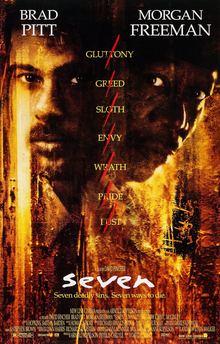
William Somerset is a homicide detective close to retirement in a city whose relentless violence has worn down his faith in the work. His new partner, David Mills, has moved there with his wife Tracy and arrives with more energy than patience. Their first case together is a grotesque murder in which an obese man has been forced to eat until he dies. The word “gluttony” at the scene suggests the killing is staged around an idea. Somerset sees a case that may be beyond ordinary police procedure; Mills sees a crime that can be solved if they push hard enough.
A second victim, a criminal lawyer, has been forced to cut a pound of flesh from himself, and the word “greed” links the crime to the first. Somerset recognizes that the killer is building a sequence around the seven deadly sins. Clues lead the detectives to a man restrained in an apartment for a year, emaciated and barely alive, the apparent embodiment of sloth. Photographs show that the killer has watched the victim for a long time. The case has become a plan, and each crime scene appears arranged to make the police read it as one.
The partnership is not smooth. Mills is quick to anger, and Somerset knows that a temper can become a danger in a case where the killer may be anticipating the detectives’ reactions. At home, Tracy is isolated in the unfamiliar city. She invites Somerset to dinner, giving him and Mills a chance to move past their hostility. Later she meets Somerset alone and tells him she is unhappy and pregnant. She has not told Mills. Somerset shares his own regret about a past decision and advises her to tell her husband only if she intends to keep the child, a quiet exchange that gives the family stakes a life outside the investigation.
A remark by Mills points Somerset toward library records and books about the seven sins. Their inquiry brings them to the apartment of John Doe, but Doe returns while Mills is there. He strikes Mills with a tire iron, holds him at gunpoint, then chooses to leave him alive and escapes. Inside, the detectives find hundreds of notebooks and photographs, including pictures of themselves. They realize that Doe has been studying the case and the people pursuing it. His call to the apartment and his expressed admiration for Mills make the investigation feel less like a search and more like a relationship Doe is trying to control.
The next murders continue the pattern. The lust victim is a prostitute killed with a custom-made bladed device, while the pride victim is a model Doe has disfigured. Unable to live with her altered appearance, she takes her own life. The detectives can identify the intended sin in each scene, but the framework offers no comfort or clear way to predict what comes next. Doe has chosen victims and constructed scenes to serve his own argument. Somerset’s methodical reading and Mills’s urgency remain useful in different ways, yet neither gives them control over the killer’s timetable.
Doe then arrives at the police station covered in blood and surrenders. He threatens to plead insanity unless Somerset and Mills escort him to an undisclosed location, where he says they will find the final two victims. During the drive, Doe presents himself as a messenger chosen by God, without remorse for the murders. He claims society has grown so numb to sin that only something extreme will make people pay attention. The detectives are forced to transport him because refusing could leave the final victims undiscovered, but doing so gives Doe the audience and control he wants.
At the remote destination, a delivery van approaches. Somerset intercepts it and discovers a package intended for Mills; its contents are not shown directly, but Doe reveals that it contains Tracy’s severed head. He says he envied Mills’s life with her and tells Mills that she was pregnant, a fact Mills did not know. Doe urges him to become wrath. Somerset begs Mills to lower his gun, but Mills shoots Doe, completing the killer’s design. Police take the devastated detective away, while Somerset tells his captain he will remain in the city. The ending leaves the case technically resolved and its human damage painfully open.
The film’s city is kept deliberately anonymous, and that choice makes its streets feel like a place the detectives cannot simply leave behind when a shift ends. Somerset’s orderly apartment, Mills and Tracy’s home, and the rain-soaked crime scenes offer different versions of the same exhausted environment. The investigation advances through evidence, interviews and library research, but the killer’s theatrical staging keeps pulling attention toward his private logic. Somerset tries to read that logic without accepting it; Mills is more personally provoked by it. Their differences are not a neat division between wisdom and foolishness. The case needs Somerset’s patience and Mills’s drive, while Doe’s plan depends on turning both qualities against them.