
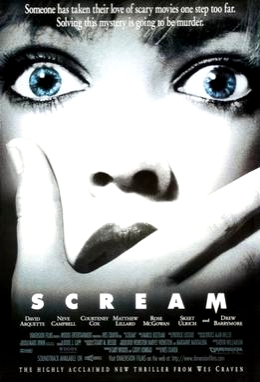
Behind the film
- Year
- 1996
- Director
- Wes Craven
- Writers
- Kevin Williamson
- Runtime
- 1h 51m
- Genres
- Horror, Slasher, Teen, Comedy
- Production
- Dimension Films
- Country
- United States
- Cast
- Neve Campbell, Skeet Ulrich, Courteney Cox, David Arquette, Matthew Lillard, Rose McGowan, Jamie Kennedy, Drew Barrymore
About the film
Contains story spoilers.
Scream starts by making a familiar domestic situation impossible to trust. Casey Becker is at home when a caller turns a conversation about films into a threat, and the distance between talking about horror and living through it disappears. Drew Barrymore’s opening role gives the attack a human centre before the story moves to Sidney Prescott and her friends. Wes Craven’s 1996 film takes a town full of people who know the conventions of slasher movies and makes that knowledge inadequate protection. A masked figure can still enter a house, a voice can still lie, and recognising a pattern does not mean recognising the person exploiting it.
Sidney’s existing grief gives the new killings another dimension. Her mother Maureen was murdered a year earlier, and the public story of that death has never remained entirely separate from Sidney’s private life. Neve Campbell plays someone trying to function among friends while carrying memories that others discuss, dispute or use to attract attention. Billy Loomis, her boyfriend, wants their relationship to move beyond the strain surrounding them, while her friend Tatum offers companionship that can be affectionate and blunt. School has its own rhythms of gossip and amusement, making the arrival of a real threat especially disturbing: the students already have language for it, but much of that language turns suffering into entertainment.
The attack on Sidney and Billy’s apparent proximity to it make trust unstable. His appearance at her window and the discovery of a phone give suspicion a concrete object, yet another call undermines the assumption that arrest has settled the question. Deputy Dewey Riley tries to protect the people around him without projecting the authority of someone who understands the whole situation. Journalist Gale Weathers is more forceful, but her interest combines professional ambition with a challenge to the accepted account of Maureen’s murder. Courteney Cox gives Gale the energy of someone prepared to ask unwelcome questions, while David Arquette makes Dewey’s uncertainty visible. Neither manner automatically identifies who is right.
The students’ talk about film rules provides both comedy and misdirection. Randy’s enthusiasm for horror gives him a set of predictions, and the others can recognise the references even when they dismiss his warnings. Kevin Williamson’s screenplay lets that familiarity become part of the characters’ social life rather than a separate commentary delivered from outside it. Watching a scary film together can be fun because the danger is contained on a screen. Once the actual killer is moving around the gathering, the distinction fails. The audience is also placed between those positions, noticing conventions while being asked to worry about particular people whose awareness cannot keep them safe.
Stu’s party concentrates the threat in a house where familiar rooms and ordinary distractions become dangerous. Tatum’s encounter in the garage shows how quickly an apparently manageable situation can change, while the gathering continues elsewhere. Billy’s arrival briefly creates the prospect of reconciliation before another apparent attack throws Sidney back into flight. The house, its doors and the people appearing outside them turn decisions about access into decisions about survival. Gale’s recording equipment adds another layer of observation, but the existence of images does not ensure that someone will read them in time. Craven keeps using the gap between what the audience can see and what the characters presently know.
The revelation that Billy and Stu are working together explains how the shifting suspicions have been arranged. Their role in Maureen’s murder also overturns the accepted earlier story, with Billy connecting his violence to the affair involving his father. That explanation belongs to the killer’s grievance; it does not make Maureen responsible for what he has chosen to do. The pair intend to blame Sidney’s father and manufacture the appearance of having survived someone else’s attack. Their control begins to break down when Sidney stops behaving as the victim they expected, and Gale’s intervention helps disrupt the staging. The ending gives survival to decisions made in the crisis rather than to a flawlessly understood list of rules.
The remaining moments refuse to treat an apparent defeat as automatically final. Randy’s awareness of the last scare becomes part of the confrontation, while Sidney acts decisively when the danger returns. Dawn brings ambulances, survivors and another report from Gale, linking the night’s private fear to the public account that will follow it. The film has changed who can tell the story and what that story means, but it does not erase the deaths along the way. Campbell’s steadiness keeps Sidney at the centre even as the villains compete to explain their cleverness. Her survival matters because she has become more than the role assigned to her within their plan.
The mask, altered voice and anonymous calls allow the threat to move between performance and physical presence. Marco Beltrami’s score supports the suspense without removing the comedy of friends who cannot stop arguing about movies. Craven and Williamson make genre knowledge a source of pleasure, vulnerability and manipulation at once. The town’s recognisable homes and school routines keep the violence close to everyday life, while the mystery rewards attention to relationships as much as to clues. This first film’s story is complete on its own: Sidney confronts the people responsible for the immediate attacks and learns that the account of her earlier loss was wrong, leaving familiarity with horror useful but far short of certainty.