
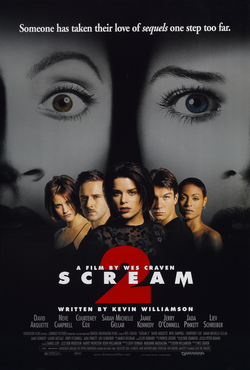
Behind the film
- Year
- 1997
- Director
- Wes Craven
- Writers
- Kevin Williamson
- Runtime
- 2h 0m
- Genres
- Slasher, Mystery, Horror
- Production
- Craven-Maddalena Films
- Country
- United States
- Cast
- Neve Campbell, David Arquette, Courteney Cox, Jamie Kennedy, Timothy Olyphant, Laurie Metcalf, Liev Schreiber, Jerry O'Connell
About the film
Contains story spoilers.
Scream 2 makes surviving a horror story an uneasy qualification for appearing in the next one. Sidney Prescott has moved into a new phase of her life, but the experience she wants to leave behind has become something other people can watch, discuss and profit from. That separation between a survivor's needs and an audience's appetite gives the sequel a reason to exist within its own story. It does not simply repeat the first film's events in another town. It imagines what repetition means when a terrible private experience has acquired a public version, complete with expectations about how another instalment ought to work.
A screening of Stab, the movie about Woodsboro, becomes the scene of two murders. At college, Sidney faces renewed attacks; Randy and her friend Hallie die, while Dewey and Gale investigate. The killers are student Mickey and Billy Loomis's mother, posing as reporter Debbie Salt. Mickey wants a celebrated trial blaming films; his partner wants revenge and intends to betray him. Derek, Sidney's boyfriend, is killed. Cotton Weary helps Sidney against Mrs. Loomis, and Sidney and Gale finish the confrontation. Dewey survives, and Sidney directs the arriving press towards Cotton. She has escaped another attempt to control her fate, but escape does not make the earlier story disappear.
The opening cinema offers a particularly disturbing version of audience participation. A crowd has come to enjoy a representation of killings, creating a setting in which real danger can be mistaken for part of the entertainment. The problem is not simply that the spectators are noisy or inattentive. Their expectations supply an explanation that delays recognition. Something dreadful can be happening directly in front of people who have already decided what kind of experience they are having. The film uses that confusion to bring the viewer's own position into the horror. Looking at a screen does not necessarily mean recognising the person who is suffering within the spectacle.
College gives Sidney a possible new community, yet a new setting cannot guarantee that the past will stop defining how others approach her. Friendship and romance require trust, while the danger encourages her to interpret familiarity as a possible disguise. Neve Campbell's role has to occupy both conditions. Sidney needs people, and she has good reasons to fear the consequences of choosing the wrong person. The sequel's mystery therefore damages something beyond physical safety. It makes ordinary closeness harder to practise. A suspicious glance can be useful to a survivor while also narrowing the life she is trying to recover outside survival.
Mickey and Mrs. Loomis offer incompatible explanations for the same campaign of violence. One imagines a future made possible by notoriety; the other tries to settle a family grievance by imposing further suffering. Their partnership shows how different motives can cooperate without becoming a coherent moral position. Neither explanation makes the victims responsible for what is done to them. Mickey's argument about films attempts to move agency away from the person making the choice, while revenge attempts to make a chosen killing look like an obligation. The film exposes both as stories the perpetrators want to tell about themselves, rather than accepting them as the truth of the event.
Gale and Cotton make the competition over a public account less simple than a division between decent survivors and malicious spectators. Recognition can matter for several reasons: professional ambition, money, restored reputation or the wish to be heard after being misrepresented. Those interests need not fit neatly with Sidney's desire for privacy. Courteney Cox and Liev Schreiber give the story people whose relationship to publicity differs from her own. The same attention can be unwanted by one person and valuable to another. That makes the final handling of the press a consequential choice about who receives the story, instead of an automatic closing image of grateful survivors surrounded by cameras.
Wes Craven and screenwriter Kevin Williamson continue the series' habit of letting characters reason through horror conventions while remaining vulnerable to horror. Knowledge can establish a pattern, but it cannot make every person fit the pattern correctly. The sequel gives discussion a practical function without granting it magical authority. Recognising how a movie might behave is different from knowing who is acting behind a mask. That distinction keeps the self-aware comedy connected to suspense. A clever remark can reveal an expectation and still leave the speaker exposed to an event that arrives by another route. The rules become part of the uncertainty rather than a reliable escape from it.
The ending restores Sidney's immediate freedom while leaving the question of narrative ownership alive. She can decide where to direct attention, but she cannot erase the fact that other people have made her experience into entertainment and opportunity. The sequel's underlying tension is consequently larger than whether a returning heroine survives. It concerns how a person can keep a life of her own when that life has become public material. Scream 2 combines its masked-killer mystery with that pressure, making each repeated threat an attempt to force Sidney back into a role. Her resistance consists partly in surviving, and partly in refusing to let survival be the only story she is allowed to have.