
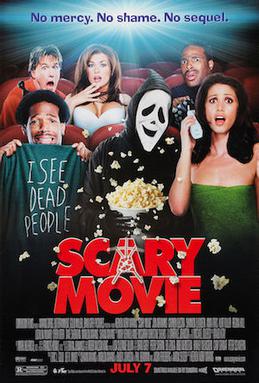
Behind the film
- Year
- 2000
- Director
- Keenen Ivory Wayans
- Writers
- Shawn Wayans, Marlon Wayans, Phil Beauman, Buddy Johnson, Jason Friedberg, Aaron Seltzer
- Genres
- Teen, Comedy horror, Horror, Slasher
- Production
- Gold/Miller Productions, Wayans Bros. Entertainment, Brad Grey Pictures
- Country
- United States
- Cast
- Anna Faris, Regina Hall, Shawn Wayans, Marlon Wayans, Jon Abrahams, Dave Sheridan, Shannon Elizabeth, Lochlyn Munro
About the film
Contains story spoilers.
Keenen Ivory Wayans’s Scary Movie follows Cindy Campbell and her friends after a masked killer murders Drew. They have concealed a fatal hit-and-run, and ominous messages seem to link the new attacks with their secret. Cindy’s boyfriend Bobby becomes a suspect, while reporter Gail and officer Doofy complicate the investigation. At a house party, Bobby and Ray announce a copycat plan, only for the actual killer to intervene. Cindy survives the confrontation, but the police later discover that Doofy was the murderer, performing a false disability to escape suspicion. He leaves with Gail. Cindy finds the discarded costume in the street and is hit by a car, turning the apparent resolution into one last gag. The story repeatedly borrows a recognizable horror setup, then changes its emotional or physical rules before the scene can settle.
Parody here works by borrowing the machinery of a recognizable slasher film and then pushing one element past its intended tone. A phone call, a masked figure and a group of teenagers establish a familiar suspense pattern; the film then undercuts the audience’s expectation with an absurd physical reaction, an overconfident character or a sudden shift into an unrelated pop-culture reference. The joke is not only that horror can be scary. It is that genre conventions are so legible that a small change in timing can make them ridiculous. The comic timing depends on preserving enough of the suspense setup for a viewer to anticipate what should happen next. A pause, a reaction or a conspicuously misplaced gesture then interrupts that expectation. The film does not abandon horror grammar; it needs the audience to recognize it before the distortion can register.
Cindy’s role gives the film a consistent center while the other characters become variations on familiar teen-horror types. She is caught between a secret she shares with friends and a present threat she wants taken seriously. The group’s attempts to protect itself are undermined by suspicion, pressure and self-interest. Anna Faris plays Cindy with an earnestness that helps the jokes land: she can react as if the mystery matters, even when the world around her refuses to hold a straight face. That contrast lets the film sustain a loose detective thread beneath the sketches.
The movie also sends up the media machinery that forms around a sensational crime. Gail Hailstorm is less interested in careful reporting than in getting close to the killer and turning danger into a broadcast spectacle. Her camera crew’s presence makes the search for a story another source of risk. This strand widens the satire beyond horror movies themselves: the film treats the public desire to watch violence as a comic impulse, while showing reporters and audiences trying to convert a murder investigation into entertainment.
Many of the jokes depend on recognition of genre grammar: the secluded victim, ominous call, suspect list, false accusation and last-minute reveal. The movie’s parody of Scream and I Know What You Did Last Summer changes the audience’s relation to one of those expected beats. A character may treat a crisis with the wrong emotional register, or a familiar suspense setup may turn into an embarrassing social encounter instead of a clean scare. The film moves quickly among these ideas, so the story feels intentionally less like a puzzle with fair clues than a vehicle for repeatedly derailing the puzzle.
The film’s bodies obey the requirements of individual jokes more than a consistent account of injury. An attack can become a piece of grotesque exaggeration, a victim can keep reacting after the point at which a suspense film would cut away, and a crowd can take over the killer’s function. That instability matters because the audience cannot use physical consequence as a reliable guide to the plot. Brenda’s cinema sequence pushes the distinction particularly far: spectators irritated by her conduct become participants in violence rather than observers of it. The scene folds moviegoing back into the parody, making the audience inside the film an exaggerated counterpart to the audience expecting another familiar kill.
The ensemble helps give the parody different rhythms. Regina Hall’s Brenda has an abrasive, self-possessed presence; Jon Abrahams plays Bobby with a more conventional boyfriend image that makes the later turn feel designed to disrupt expectations; Dave Sheridan’s Doofy is positioned in the police story as a figure others underestimate. These performances help the film shift between school comedy, media satire and slasher suspense. The fast changes in tone are part of its style, but they also keep viewers from settling into one stable emotional response.
The final explanation plays another game with the audience’s confidence in recognizing a type. Doofy has occupied the investigation as someone the other characters assume they already understand, allowing that assumption to do the work of a disguise. Gail’s departure with him makes the reporter’s search for a sensational story inseparable from the person responsible for it. The reveal rearranges earlier scenes without restoring the reassuring order of a solved mystery. Cindy’s last encounter with a car brings the film back to the arbitrary physical violence that launched its secret. Closure is therefore another convention available for interruption, and the last laugh can arrive after the story seems to have finished explaining itself.